By Ayswarya Ashok, Founder and CEO of Halleyx
For years, the narrative surrounding the United Kingdom’s telecommunications sector has been defined by a single, singular metric: reach. The "fibre story" has been told through the prism of premises passed, a relentless race to bring high-speed, gigabit-capable infrastructure to every corner of the nation. By all accounts, the industry has succeeded. Today, full fibre reaches 24.9 million premises, accounting for approximately 82% of UK homes. With 47% of those homes now actively utilizing a full-fibre service, the industry is transitioning from a "land grab" phase to a period of consolidation and optimization. Ofcom anticipates that by 2028, 73% of UK homes will have access to at least two competing gigabit-capable networks.
However, as the dust settles on the physical build-out, a new, more complex challenge has emerged. For years, the industry has focused on the question: "Can we connect the home?" But in the context of Multi-Dwelling Units (MDUs)—the apartment blocks and high-density residential towers that define modern urban living—that question is merely the starting line.
While an apartment building may appear as a single point on a coverage map, it represents hundreds of distinct commercial realities. The shift from "passing a premise" to "managing a unit" is not just a semantic distinction; it is the next frontier of operational efficiency and revenue growth for UK fibre operators.
A Building is Not a Customer: The Multi-Dimensional MDU Challenge
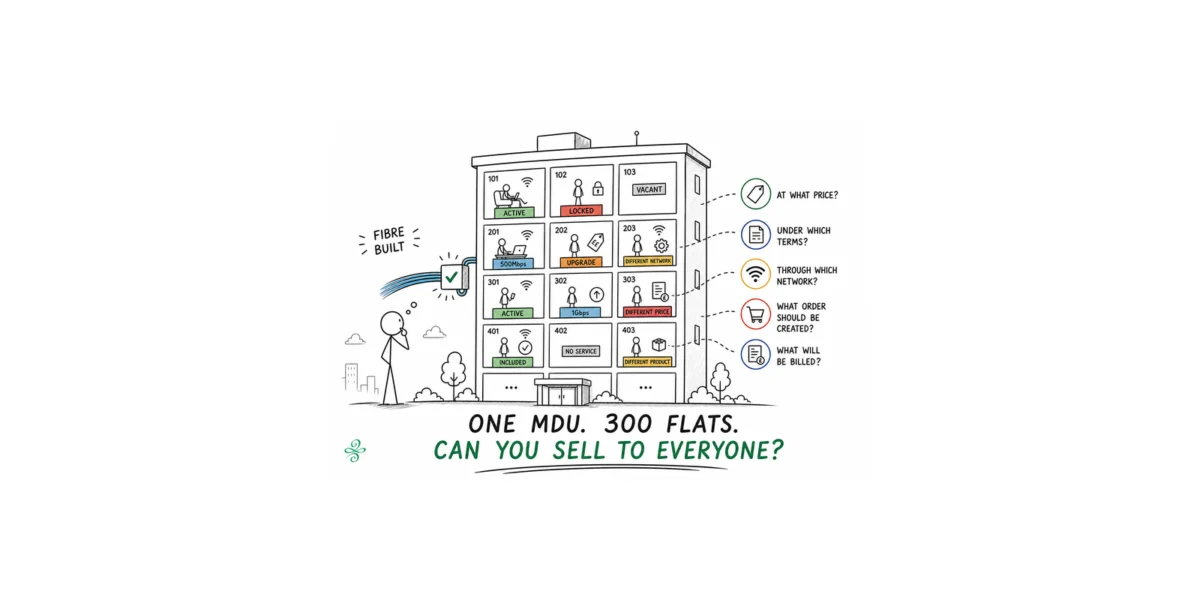
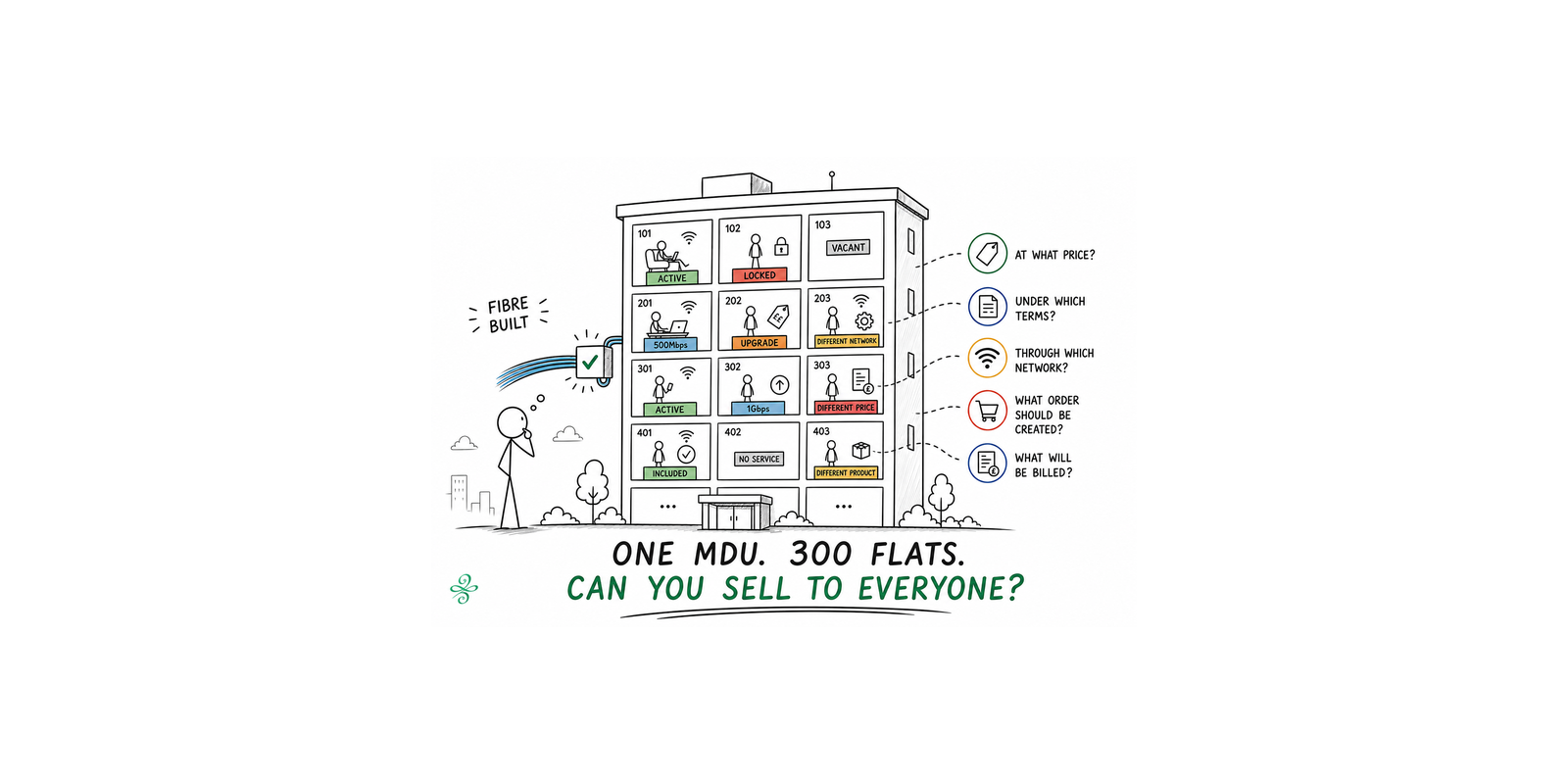
To understand the complexity of the MDU market, one must look past the infrastructure and into the living room of a single apartment. Consider a 300-unit residential building. On a standard coverage heat map, it is one dot—one location. But inside those walls, there are 300 unique stories.
In one unit, a high-spending professional requires a premium 1Gbps service. The unit next door may be currently vacant, awaiting a new tenant. A third unit might be bound by a specific bulk building agreement, while a fourth might be serviced by an entirely different network provider due to legacy infrastructure. When one customer moves out and another moves in, the physical network remains unchanged, but the commercial context is rewritten entirely.
The industry’s current BSS (Business Support Systems) models are often ill-equipped to handle this granularity. Traditional telecom journeys follow a linear path: Customer → Product → Order → Service → Bill. This model assumes a static relationship between the user and the service. MDUs, however, introduce a layer of complexity that disrupts this simplicity: Building → Unit → Customer.
In this environment, the customer is transient, but the unit is persistent. When a resident moves out of Flat 217, they should not leave behind a "blank slate." Instead, the system should retain the unit’s network availability, the specific building-level commercial agreements, the eligible product propositions, and the billing rules. Currently, the industry fails to carry this "unit-level context" through the lifecycle of the service, leading to fragmented operations and, ultimately, lost revenue.
Chronology of the MDU Data Gap
The evolution of the UK fibre market has historically been front-loaded with civil engineering and physical deployment.
- 2018–2021 (The Build Era): The focus was on penetration. The primary goal was to get fibre into the ground and up the walls of MDUs. If the cable was in the building, the premise was considered "served."
- 2022–2024 (The Adoption Era): As competition intensified, operators focused on marketing and consumer take-up. The challenge shifted to convincing residents to switch from legacy copper/coax to full fibre.
- 2025–Present (The Efficiency Era): The current market reality. With multiple networks vying for the same buildings, the differentiator is no longer "do you have fibre?" but "how effectively can you manage the service?"
The failure to bridge the data gap between the "building" and the "unit" has become the primary bottleneck in this new era. When a customer in Flat 217 attempts to upgrade their service, the process often triggers a manual investigation. Does the building agreement allow for a 1Gbps upgrade? Is it a standard price, or is it governed by a bulk contract? Which network provider is responsible for the last-meter delivery?
Without a system that carries the context of the unit from the moment of qualification to the final bill, operators are forced to rely on human intervention. Every time a human has to step in to manually reconcile an order, the cost of acquisition rises, and the customer experience drops.
Supporting Data: The Hidden Cost of Manual Intervention
The financial implications of ignoring the "unit context" are profound. In a competitive market, where the margin on fibre services is often squeezed by high capital expenditure (CAPEX) for the initial build, operational expenditure (OPEX) becomes the primary lever for profitability.
Industry data suggests that "MDU readiness" is currently being measured by availability alone, rather than the velocity of the transaction. Operators should start measuring the following KPIs to gauge their efficiency:
- Manual Intervention Rate: How many orders require a customer service representative to manually verify building agreements or network eligibility?
- Order Correction Frequency: What percentage of orders are rejected or require modification after initial submission due to incorrect eligibility data?
- Qualification-to-Activation Latency: How long does it take for a customer to move from an eligibility check to an active, billed service?
- Billing Discrepancy Rate: How many billing issues can be traced back to a mismatch between the unit’s service profile and the underlying commercial agreement?
If an operator cannot answer these questions without manual reconciliation, they are leaking value. Every "stuck" order is a potential customer lost to a competitor who offers a more seamless, digital-first experience.
The "MDU Ready" Paradigm Shift
For the fibre industry to mature, the definition of "MDU Ready" must evolve. It should no longer be a synonym for "serviceable." True MDU readiness means that an operator can take a specific unit and, without human intervention, determine:
- Product Eligibility: Can this specific unit support the requested speed?
- Commercial Terms: Does the building’s bulk agreement override the standard price?
- Network Routing: Which underlying network infrastructure is responsible for fulfilling this order?
- Billing Logic: What is the precise billing structure, including any building-specific discounts or subsidies?
This context must remain consistent across the entire transaction chain: Qualification → Proposition → Order → Activation → Billing.
When the building establishes the context and the unit carries that context into every transaction, the operator achieves a significant competitive advantage. This is not just about convenience; it is about scaling. As the UK moves toward a landscape where most buildings have access to two or more gigabit networks, the operator that can process orders faster, more accurately, and with less overhead will win the customer.
Implications for the UK Digital Economy
The implications of this shift are twofold. First, for the operators, it is a matter of survival. As the initial "build phase" ends, the industry will see a transition from capital-intensive competition to service-intensive competition. Those who fail to optimize their BSS to handle the complexities of MDUs will find their profit margins eroded by the cost of servicing these high-density environments.
Second, for the UK’s broader digital economy, the maturity of these systems is vital. The government’s ambition to build a world-class digital infrastructure depends on a thriving, profitable private sector. If operators are bogged down by inefficient systems that struggle to manage the realities of urban apartment living, the end-user experience will suffer.
The industry must stop viewing the MDU as a homogeneous block of premises. It is, in reality, a mosaic of individual units, each with its own commercial life cycle. The technology required to run the business behind the network—the BSS—is just as important as the fibre-optic cable itself.
As we look toward events like Connected Britain 2026, the conversation must pivot. We have proven we can connect the building. Now, the industry’s focus must be on making every unit count. By replacing manual, siloed processes with intelligent, unit-centric data models, UK fibre operators can unlock the true value of their infrastructure investments and set a new standard for operational excellence in the global telecommunications market.
The fibre is in the ground. The networks are lit. The next battle is not about building the network—it is about managing it. The operators that master the complexity of the unit will be the ones that define the next chapter of the UK’s digital success story.