San Francisco, CA – September 27, 2026 – North America is firmly establishing itself as the powerhouse of the global broadband equipment market in 2026, driven by a significant surge in investment from major telecommunications and cable operators. AT&T, Verizon, Comcast, and Charter are leading this charge, aggressively deploying fiber optic networks, embracing the advanced DOCSIS 4.0 standard, rolling out multi-gigabit broadband services, and equipping homes with the latest Wi-Fi 7 technology. This strategic pivot is not only reshaping the competitive landscape but also redefining the future of high-speed internet access for millions of consumers.
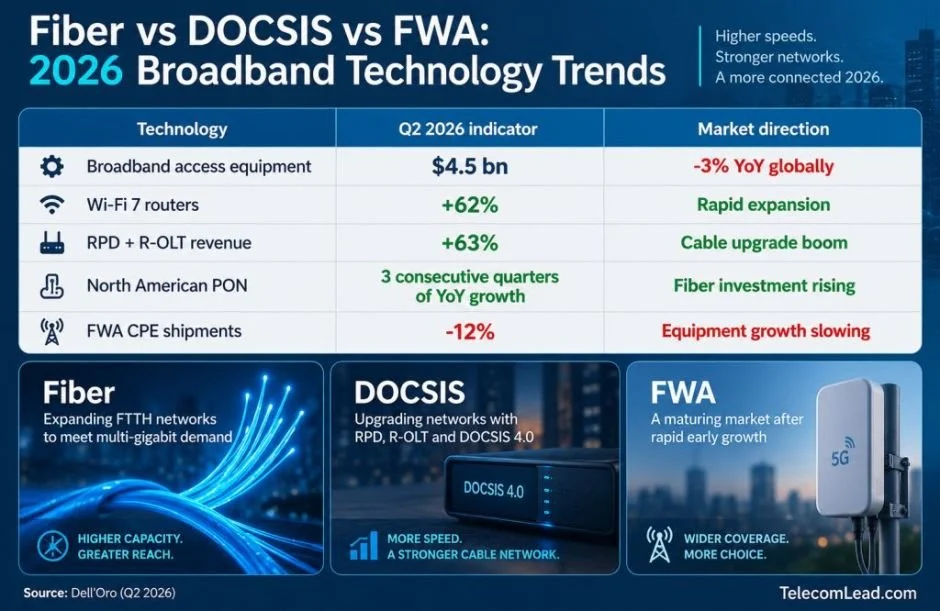
While the global broadband access equipment market experienced a modest 3 percent year-over-year decline in revenue to $4.5 billion in the second quarter of 2026, according to Dell’Oro Group, the North American segment is charting a decidedly different, upward trajectory. Telecom and cable giants across the continent are significantly increasing their procurement of Passive Optical Network (PON) equipment, Remote PHY Devices (RPDs), Remote Optical Line Terminal (R-OLT) platforms, and next-generation home networking hardware. This robust investment cycle is creating a discernible technological divergence, with residential Wi-Fi 7 router shipments skyrocketing by 62 percent year-over-year, and combined revenue for RPD and R-OLT platforms surging by an impressive 63 percent. In stark contrast, Fixed Wireless Access (FWA) Customer Premises Equipment (CPE) shipments have seen a 12 percent decrease, signaling a strategic shift in operator priorities.
The data clearly indicates that the next wave of broadband investment in the United States is increasingly concentrated on the synergistic deployment of fiber, DOCSIS 4.0, and Wi-Fi 7. While Fixed Wireless Access continues to play a vital role in subscriber growth for operators like Verizon and T-Mobile, the focus for core network infrastructure and in-home connectivity is unmistakably shifting towards these three key technologies.
H2: The Fiber Frontline: North American Spending Recovers Momentum
Fiber optics are proving to be one of the most significant catalysts for the current broadband equipment upswing. Dell’Oro Group’s analysis reveals that North American operators have now recorded their third consecutive quarter of growth in PON equipment spending, bringing investment momentum back to levels not witnessed since the broadband expansion era of 2022.
H3: Navigating Supply Chains and Price Pressures
A critical factor influencing this accelerated purchasing behavior is the prevailing equipment pricing environment. Operators are proactively increasing their orders for Optical Line Terminals (OLTs) and Optical Network Terminals (ONTs) as persistent shortages of memory and other essential components exert upward pressure on equipment costs. Jeff Heynen, Vice President at Dell’Oro, observes that operators are strategically “pulling purchases forward” to preemptively mitigate the impact of rising average selling prices for OLTs and ONTs. This proactive approach suggests that the current expansion is far more than a simple capacity upgrade; it is a multifaceted strategy to simultaneously broaden fiber coverage, prepare networks for multi-gigabit service delivery, and proactively manage supply chain risks and equipment price escalations.
H2: Titans of the Network: Key Operator Strategies
The robust North American market is being shaped by the strategic decisions of its largest players. Each is employing distinct, yet interconnected, approaches to enhance their broadband offerings and maintain a competitive edge.
H3: AT&T’s Ambitious Fiber Footprint Expansion
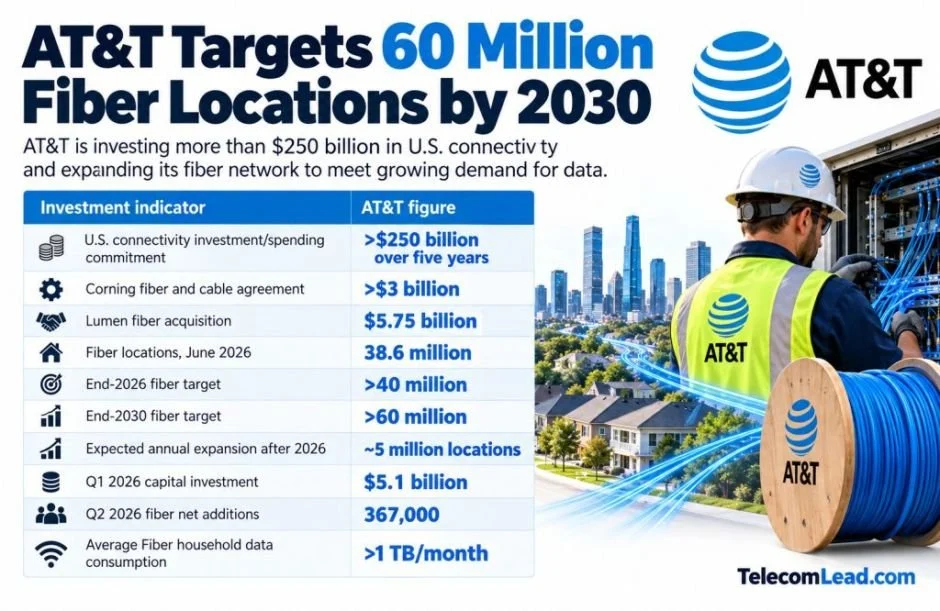
AT&T continues to be a dominant force in the US fiber equipment market. The company’s expansive fiber network now reaches over 36 million locations, with a clear objective to extend this reach to approximately 40 million locations by the close of 2026. Looking further ahead, AT&T has set its sights on an even more ambitious target, aiming for a total of around 60 million fiber locations by the end of 2030, a goal to be achieved through a combination of organic fiber construction and strategic acquisitions.
A significant catalyst for this long-term vision was AT&T’s recent acquisition of substantially all of Lumen’s Mass Markets fiber business for $5.75 billion. This strategic move has provided AT&T with access to millions of additional fiber-ready locations, further solidifying its position. AT&T’s fiber expansion strategy and its 2030 network targets underscore a fundamental repositioning of its fixed-network business, prioritizing fiber over its legacy copper infrastructure.
Furthermore, AT&T is increasingly integrating its fiber access capabilities with the customer’s in-home network. Its forward-looking Wi-Fi strategy incorporates Wi-Fi 7 gateways, designed to more effectively extend multi-gigabit fiber speeds to compatible devices throughout the home. For equipment suppliers, AT&T’s aggressive expansion translates into substantial demand across a wide spectrum of product categories, including fiber optic cable, OLTs, ONTs, optical components, access electronics, and Wi-Fi gateways.
H3: Verizon’s Dual-Pronged Approach: Fiber and FWA Synergy
Verizon is pursuing a diversified broadband strategy that effectively combines its growing fiber optic network with the strategic deployment of 5G Fixed Wireless Access (FWA). In the second quarter of 2026, the operator reported impressive subscriber growth, adding 155,000 fiber broadband customers and 193,000 fixed wireless access customers, resulting in total broadband net additions of 348,000. By the end of the quarter, Verizon had amassed approximately 17.1 million total broadband connections across both fiber and FWA services.
Verizon’s Q2 2026 operating results offer a crucial perspective on the FWA market. While Dell’Oro recorded a 12 percent year-over-year decline in FWA CPE unit shipments, primarily attributed to softer new-unit sales in North America, Verizon’s continued customer acquisition in the FWA segment, adding nearly 200,000 customers during the quarter, highlights a maturing market. This trend suggests that after several years of rapid customer acquisition and initial CPE deployment, equipment shipment growth may slow even as the installed subscriber base continues to expand. Verizon’s fiber expansion is also becoming increasingly strategic, bolstering its overall broadband footprint and offering a robust alternative for high-demand areas.
H3: Comcast and Charter: The DOCSIS 4.0 Powerhouse
In response to the intensifying competition from fiber providers, cable operators like Comcast are strategically upgrading their existing Hybrid Fiber-Coax (HFC) networks rather than undertaking the costly and disruptive process of a complete fiber replacement. Dell’Oro Group’s report on a 63 percent year-over-year increase in combined revenue from Remote PHY Devices and Remote OLT equipment directly reflects this industry trend.
Comcast is a key architect of the industry’s transition towards DOCSIS 4.0. This advanced standard allows cable operators to significantly enhance both downstream and upstream capacity while leveraging substantial portions of their existing network infrastructure. This capability is particularly vital as fiber operators increasingly promote symmetrical and multi-gigabit services. Comcast has been actively deploying its next-generation network architecture to boost broadband speeds and improve upstream performance.
The technological evolution is already extending beyond the initial iterations of DOCSIS 4.0. Comcast, in collaboration with Charter and Broadcom, is actively working on a unified DOCSIS chipset architecture designed to support speeds of up to a remarkable 25 Gbps. This collaborative initiative underscores the cable industry’s commitment to extending the competitive lifespan of HFC networks while simultaneously increasing their capacity. For Comcast, the strategic objective is clear: to narrow the performance gap with fiber without incurring the substantial costs and operational disruptions associated with an immediate network-wide replacement.
Charter Communications, another significant player in the cable network equipment market, has further solidified its position following the completion of its transaction with Cox Communications in August 2026. This merger has created a substantially larger US broadband and connectivity platform, enabling Charter to deploy network upgrades, customer-premises equipment, and Wi-Fi technology at a greater scale. The acquisition is also anticipated to enhance Charter’s purchasing power with broadband equipment suppliers as the combined entity modernizes its infrastructure. Charter has been diligently pursuing distributed access architecture and network upgrades aimed at increasing broadband capacity and supporting higher upstream speeds. The 63 percent surge in RPD and R-OLT revenue, as reported by Dell’Oro, serves as a crucial indicator of Charter’s, Comcast’s, and their technology suppliers’ ongoing investments in these advanced architectures.
H2: The In-Home Revolution: Wi-Fi 7 Takes Center Stage
The broadband upgrade narrative is increasingly extending beyond the external network and into the customer’s home. Residential Wi-Fi 7 router shipments experienced a remarkable 62 percent year-over-year increase in Q2 2026, positioning home networking as one of the most dynamic segments within the broadband equipment market.
H3: Driving Factors Behind Wi-Fi 7 Adoption
Dell’Oro attributes this surge to two primary drivers. Firstly, the rapid proliferation of more affordable dual-band Wi-Fi 7 products in markets like China and Southeast Asia is expanding the reach of this advanced technology. Secondly, and critically for the North American market, US broadband operators are proactively accelerating purchases of Wi-Fi 7 equipment to facilitate the delivery of multi-gigabit internet services.
This development is paramount because the benefits of fiber and DOCSIS network upgrades can be significantly diminished if the home gateway, router, or client devices rely on older Wi-Fi technology. Wi-Fi 7 directly addresses this bottleneck by offering increased capacity, wider channels, and more efficient spectrum utilization. Operator-led deployments can accelerate adoption far more rapidly than individual retail router replacements, as internet service providers can introduce new technology across millions of customer gateways simultaneously.
H3: The Symbiotic Relationship Between Fiber and Wi-Fi 7
The concurrent surge in PON and Wi-Fi 7 spending is far from coincidental. Fiber operators, including AT&T, increasingly require gateways capable of delivering a more substantial proportion of advertised multi-gigabit speeds over wireless connections. The same imperative applies to cable operators deploying DOCSIS 4.0. This dynamic is fostering a broader equipment ecosystem that encompasses PON and DOCSIS technologies, gateways, Wi-Fi chipsets, mesh systems, and optical components.
This evolution is fundamentally altering the nature of broadband competition. Consumers are increasingly evaluating broadband performance based on the actual speed experienced on their smartphones, PCs, and televisions via Wi-Fi, rather than solely on the theoretical capacity delivered to an ONT or cable modem.
H2: DOCSIS 4.0: A Resilient Investment in Cable Infrastructure
The significant 63 percent increase in combined RPD and R-OLT revenue is particularly noteworthy, as it clearly demonstrates the continued willingness of cable operators to make substantial investments in their access networks, even in the face of aggressive fiber expansion by competitors. Remote PHY technology moves physical-layer functionality closer to subscribers, enhancing network efficiency, while Remote OLT technology empowers operators to integrate fiber services within distributed access architectures. Both of these technological advancements provide cable companies with enhanced flexibility in determining whether to maintain or transition specific neighborhoods to fiber infrastructure. This enables a hybrid network model where DOCSIS 4.0 and fiber can coexist, offering operators a pragmatic approach that avoids the necessity of a uniform technology choice across their entire operational footprint.
H2: Fixed Wireless Access: Maturing Market, Shifting Dynamics
Fixed wireless access represented a notable exception to the prevailing broadband equipment growth trends. Global FWA CPE unit shipments saw a 12 percent year-over-year decline in Q2 2026, largely attributable to a slowdown in new-unit sales within North America. This decline stands in sharp contrast to the robust growth observed in Wi-Fi 7 routers (62 percent increase) and RPD/R-OLT revenue (63 percent increase).
However, this trend does not necessarily indicate a diminishing relevance for 5G home broadband. Verizon’s continued addition of 193,000 FWA subscribers in Q2 demonstrates that operators can still expand their customer base while equipment shipment growth moderates. The FWA market may instead be transitioning from an initial phase of rapid CPE deployment to a more mature stage characterized by ongoing subscriber additions and equipment replacement cycles.
H2: The Evolving Investment Landscape and Vendor Opportunities
The current investment cycle presents significant opportunities across the entire broadband supply chain. Companies like Nokia and Adtran are well-positioned to benefit from the increased demand for fiber access and PON equipment. Calix offers a comprehensive suite of solutions, integrating broadband access technology with subscriber and managed Wi-Fi platforms.
The surge in cable network spending creates opportunities for suppliers involved in DOCSIS, distributed access architectures, and Remote PHY, including companies such as CommScope, Harmonic, and Vecima. Semiconductor suppliers like Broadcom are crucial enablers of both cable and Wi-Fi technology development. The widespread adoption of Wi-Fi 7 further expands the market for gateway manufacturers and chipset companies as broadband operators refresh customer-premises equipment.
A key consideration for vendors will be the sustainability of this accelerated purchasing trend, particularly given Dell’Oro’s assessment that operators are strategically bringing forward some orders to mitigate anticipated future equipment price increases.
H2: North America’s Broadband Renaissance: A New Era of Competition
The 3 percent decline in the global broadband access equipment market belies a significantly more robust investment environment within North America. AT&T’s aggressive expansion towards 40 million fiber locations by 2026 and its ambitious 60 million target by 2030 are providing substantial impetus to the PON equipment cycle. Verizon continues to fortify its broadband presence by integrating fiber expansion with its substantial base of approximately 17.1 million fiber and FWA connections.
Comcast and Charter are strategically responding by advancing their DOCSIS and distributed access architectures, directly contributing to the impressive 63 percent surge in RPD and R-OLT revenue. Concurrently, the 62 percent growth in Wi-Fi 7 router shipments signifies a crucial shift in the investment battleground, moving from the external network infrastructure to the customer’s in-home connectivity experience.
The cumulative effect is a broadband market increasingly defined by four interconnected investment themes: relentless fiber expansion, comprehensive DOCSIS 4.0 modernization, widespread Wi-Fi 7 adoption, and a maturing yet still vital Fixed Wireless Access market. For industry leaders like AT&T, Verizon, Comcast, and Charter, the paramount competitive question in 2026 and beyond is no longer solely about advertising the highest theoretical broadband speeds. It is about effectively and economically delivering multi-gigabit capacity across the access network and consistently ensuring superior performance through advanced Wi-Fi technology within millions of American homes.
By Baburajan Kizhakedath