This week, Apple did more than merely influence the form factor of foldable devices; it effectively redrew the map of mobile computing architecture. With the introduction of the A20 Pro chip, embedded in the newly launched iPhone 18 Pro and Pro Max, Apple has solidified its position as the undisputed leader in silicon performance. By ushering in the era of 2nm mass-market processors and fundamentally rethinking thermal management, the company has created a widening gulf between its proprietary hardware and the rest of the mobile industry.
Main Facts: The Power of 2nm
At the heart of the iPhone 18 Pro series lies the A20 Pro, a technological marvel that serves as the first 2nm chip to enter the smartphone market. This manufacturing milestone allows for a density of transistors that was, until very recently, considered the domain of theoretical computing.
The A20 Pro is configured with a six-core CPU and a seven-core GPU, supported by a revamped Dual 16-core Neural Engine. While the core count remains familiar to observers of the A19 Pro, the architectural gains are significant. The shift to a 2nm process node enables higher clock speeds—approaching the 5 GHz threshold—while simultaneously lowering power consumption. This provides a "responsiveness ceiling" that is currently unmatched in the industry.
For the end-user, this translates into immediate, tangible benefits. Computational photography, which has become the cornerstone of the iPhone experience, sees a massive leap forward. High-resolution image processing, instant shutter response, and real-time editing of complex, AI-enhanced video become seamless operations rather than taxing workloads.
A Chronology of Apple Silicon Evolution
To understand the significance of the A20 Pro, one must look at the trajectory of Apple’s silicon strategy over the last decade.
- 2020: The M-Series Transition: Apple disrupted the desktop market by moving from Intel to its own M-series silicon, proving that ARM-based architecture could outpace x86 counterparts in power efficiency and performance.
- 2023–2025: The Refinement Years: With the A17 and A19 chips, Apple focused on refining the 3nm process, integrating hardware-accelerated ray tracing and increasing the capability of the Neural Engine to handle on-device AI.
- 2026: The 2nm Breakthrough: The launch of the A20 Pro marks the culmination of years of investment in fabrication technology. By moving to a 2nm node, Apple has successfully moved the "on-device AI" needle, enabling complex Large Language Models (LLMs) to run locally without relying on cloud latency or privacy-compromising data transfers.
Supporting Data: Thermal Engineering and Packaging
Perhaps the most understated yet critical innovation in the A20 Pro is not the chip itself, but how Apple manages the environment surrounding it. Historically, mobile processors used InFO POP (Package-on-Package) design, where the DRAM memory was stacked directly on top of the processor. While space-efficient, this design created a "thermal sandwich," where the heat from the CPU would bleed into the memory, and vice-versa, leading to inevitable thermal throttling during intensive tasks.
The WMCM Approach
Apple has moved to a Wafer-level Multi-Chip Module (WMCM) approach, inspired by the thermal architecture of the M-series Mac chips. By placing the memory and processor side-by-side rather than stacked, Apple has physically separated the components. This design choice reduces the thermal interference between the two, allowing each to maintain higher performance states for longer durations.
Furthermore, this configuration allows the processor to make direct contact with a redesigned vapor chamber cooling system. The new vapor chamber, constructed from advanced materials, boasts three times the surface area of the previous generation. This ensures that the heat generated by the 2nm architecture is wicked away from the core components with unprecedented efficiency.
Implications for the Industry
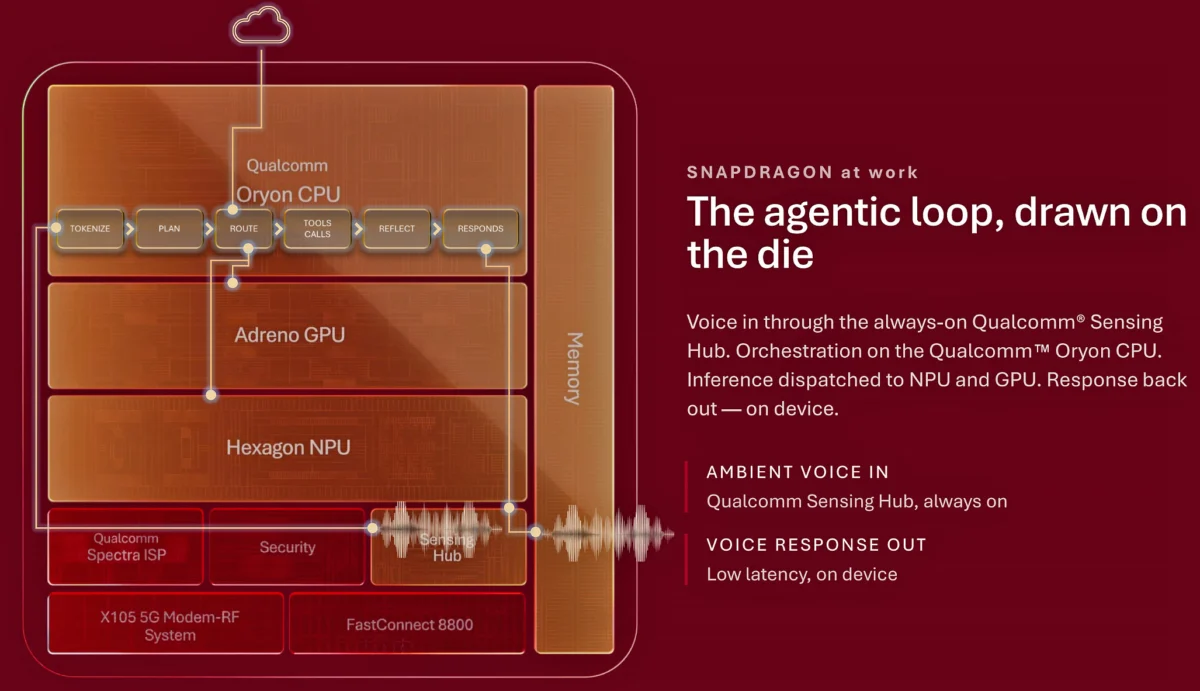
The arrival of the A20 Pro has sent shockwaves through the semiconductor industry. Major competitors, most notably Qualcomm and MediaTek, are already scrambling to pivot their roadmaps. Reports from supply chain analysts at Digitimes suggest that these vendors are now working at an accelerated pace to mimic Apple’s 2nm adoption and its side-by-side packaging philosophy.
The "On-Device AI" Imperative
The industry is currently locked in a race to dominate the "on-device AI" sector. As privacy concerns regarding cloud-based AI processing grow, the ability to run sophisticated, generative models locally has become the primary battleground for smartphone manufacturers.
Apple’s ecosystem, which includes Macs, iPads, and iPhones, has been designed from the ground up for this transition. By integrating the Neural Engine deep into the chip architecture, Apple ensures that AI tasks—such as live translation, predictive text, and advanced computational video—are handled by dedicated hardware rather than the general-purpose CPU. This preserves battery life and ensures that user data never needs to leave the device.
Official Perspectives and Market Sentiment
While Apple maintains its characteristic silence regarding specific competitor benchmarks, the performance data leaking from Geekbench and other stress-testing platforms paints a clear picture. The A20 Pro’s single-core performance lead over the current generation of Qualcomm Snapdragon and MediaTek Dimensity chips is substantial.
Industry analysts have noted that the competitive gap is not just closing—it is, in some regards, widening. "The move to 2nm, paired with the sophisticated WMCM packaging, puts Apple in a position where they are competing not just with other phones, but with the efficiency standards of modern laptops," says one industry analyst.
Future Outlook: The "Apple-First" Strategy
The history of Apple’s hardware strategy is often defined by a pattern: Apple enters a space, sets a high bar, and forces the rest of the industry to spend the next two to three years catching up. Critics who have repeatedly bet against Apple’s silicon prowess have consistently been proven wrong.
The A20 Pro is a clear signal that Apple intends to keep the "PC-level performance in a pocket" narrative alive for at least the next half-decade. By controlling the entire stack—from the architecture of the chip to the thermal management of the chassis and the software that leverages the Neural Engine—Apple has built an ecosystem that is increasingly difficult for traditional manufacturers to replicate.
As we look toward the next cycle, the focus will likely shift from raw power to "intelligence per watt." With the A20 Pro, Apple has demonstrated that it is no longer enough to just have a fast processor. In the age of AI, the winner is the company that can pack the most computational power into the smallest thermal envelope. For now, that company remains Apple.
The message to the industry is clear: the bar has been raised, the cooling systems have been improved, and the race to 2nm has officially begun. Whether or not competitors can replicate this feat without compromising the aesthetic and form-factor constraints of their own devices remains the most compelling question in the mobile hardware landscape for the coming year.