
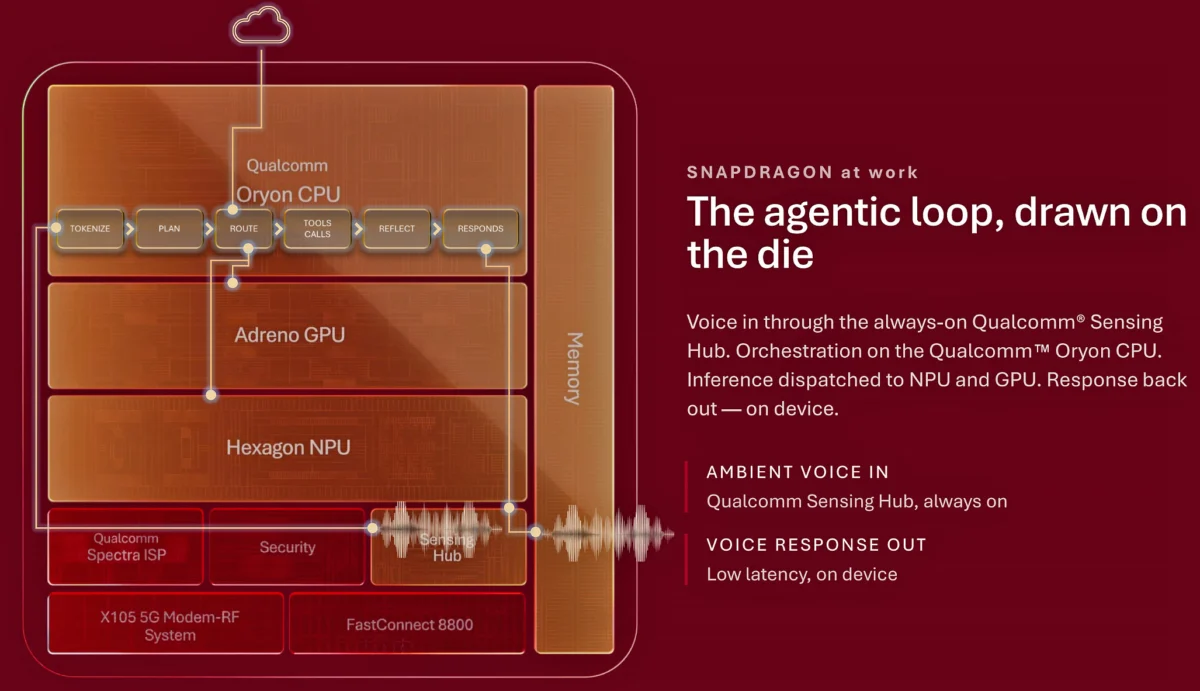
In a departure from its traditional "big reveal" strategy, Qualcomm is fundamentally altering how it introduces its next-generation premium mobile platform. Rather than holding the curtain back at its annual Snapdragon Summit in Maui—a venue typically reserved for the unveiling of its flagship silicon—the company has opted for a methodical, multi-week disclosure campaign. By peeling back the layers of its upcoming architecture piece by piece, Qualcomm is signaling that the era of the "all-in-one" SoC (System-on-Chip) is evolving into something more specialized, agentic, and deeply integrated.
At the heart of this strategy is a singular, driving philosophy: the future of AI is not in the cloud, but in the palm of your hand. Qualcomm is betting that by keeping compute, memory, and AI acceleration physically closer together on the silicon, it can solve the latency and power bottlenecks that currently hinder truly autonomous, agentic AI on mobile devices.
A Chronology of Disclosures: Building the Architecture
The company’s strategy for this year’s platform launch has been one of calculated anticipation. By focusing on the foundational elements of its architecture before the official product naming, Qualcomm is inviting the industry to look at the "how" rather than just the "what."
- The Foundation (Oryon CPU): In August, Qualcomm confirmed that its next-generation Oryon CPU would reach a staggering 5GHz, a milestone for mobile processors. This move showcased the company’s transition to its fully custom, in-house Arm-based architecture, granting it granular control over everything from branch prediction to cache hierarchy.
- The Graphics Overhaul (Adreno GPU): Following the CPU reveal, Qualcomm detailed its updated Adreno GPU, which integrates dedicated AI processing engines directly into the graphics pipeline.
- The Brain (Hexagon NPU): Most recently, the company unveiled the new Hexagon NPU, optimized for the high-bandwidth, low-latency requirements of modern Transformer models and "agentic" loops—AI that performs multi-step tasks on behalf of the user.
Taken together, these disclosures paint a picture of a company shifting its focus from raw clock speeds to the efficiency of data movement.
Supporting Data: The Architecture of Efficiency
While the 5GHz clock speed on the Oryon CPU is the "headline-grabber," the real innovation lies in the company’s memory-centric design philosophy.
FlexCache and the End of Memory Bottlenecks
The new FlexCache architecture is perhaps the most significant performance driver in the upcoming platform. By allowing the Prime and Performance cores to dynamically share a pool of cache, Qualcomm is effectively eliminating the "starvation" of high-demand processes. In traditional designs, cores are often limited by fixed slices of cache, forcing them to perform "expensive" trips to system memory—an operation that costs both time and battery life. By keeping working data sets closer to the compute, Qualcomm is creating a more fluid, responsive system capable of handling complex, multi-stage AI tasks.
Adreno Neural Fusion
On the graphics front, the introduction of Adreno Matrix Cores and 18MB of High-Performance Memory (HPM) marks a turning point. Qualcomm’s Neural Fusion technology is designed to combine super-resolution, neural processing, and frame generation within a unified pipeline. The results are significant: internal tests on the "Dragon Alley" demo showed a 40% reduction in power consumption compared to the previous generation. This is a critical development for mobile gaming and AR applications, where power envelopes are notoriously tight.
The Hexagon NPU’s New "Element Accelerator"
The Hexagon NPU has been completely overhauled to support the next generation of AI. The inclusion of a dedicated "Element Accelerator" specifically for Transformer workloads allows the chip to handle key-value (KV) cache acceleration and context lengths of up to 32K. With 50% more shared memory, the NPU can now keep more of an AI model’s "state" on the chip, reducing the need for constant, energy-draining data swaps.

The Shift to Agentic AI: A New Paradigm
For years, "on-device AI" was synonymous with simple tasks: image enhancement, basic voice-to-text, or computational photography. Qualcomm’s latest disclosures suggest a move toward "agentic" AI—systems that act as persistent agents capable of navigating apps, reasoning through complex workflows, and maintaining long-term context.
By supporting Mixture-of-Experts (MoE) models up to 30 billion parameters, Qualcomm is changing the game. By activating only the "experts" (or parameters) required for a specific task, the silicon can run sophisticated models without the thermal or power profile of a massive, monolithic model. This allows for features like real-time, multi-modal reasoning—where a phone might "see" a user’s environment, "hear" their intent, and "reason" through an action—all without a persistent cloud connection.
Implications for the Industry and Business
The implications of this architectural shift extend far beyond the consumer smartphone market.
Competitive Dynamics: Qualcomm vs. Apple
Apple has long held the advantage of vertical integration—controlling the OS, the hardware, and the application layer. By creating a unified, highly optimized platform for Android OEMs like Samsung, Xiaomi, and Honor, Qualcomm is effectively leveling the playing field. It provides these manufacturers with a powerful, AI-ready foundation that they could not feasibly engineer on their own.
The Enterprise Impact
For business users, this architecture offers a compelling value proposition: privacy and security. By processing agentic AI tasks locally, companies can minimize the amount of sensitive corporate data sent to the cloud. This aligns with the broader push in IT toward "Edge AI," where consistent compute foundations across Windows PCs (via the Snapdragon X series) and Android handsets create a unified, secure, and responsive computing ecosystem.
Developer Adoption: The Final Hurdle
While the hardware is undeniably impressive, its success will hinge on developer adoption. Qualcomm’s early integration of Neural Fusion into Unity and Unreal Engine is a strategic move to ensure that games and applications are built to exploit this hardware from day one. If these features remain "spec sheet" items, they will fail; if they become the standard for how mobile applications are built, Qualcomm will have successfully defended its premium position against both Apple and the increasing pressure from MediaTek.
Conclusion: Looking Ahead to Maui
As we look toward the upcoming Snapdragon Summit, the focus remains on whether these architectural promises can survive the transition from a laboratory environment to the real-world usage of a flagship handset. We have yet to see the final power consumption metrics under sustained load, or the specific "killer apps" that will utilize the 32K context window and MoE model acceleration.
However, the trajectory is clear: Qualcomm is no longer just a chipmaker; it is an AI systems company. By prioritizing memory locality and specialized AI acceleration over mere frequency increases, the company is positioning itself to lead the shift toward a world where the smartphone is not just a portal to the cloud, but a capable, autonomous, and private AI agent. The true test will be in the benchmarks and, more importantly, the hands-on experiences of users when these devices hit the market in the coming months. For now, the "Snapdragon" brand is clearly signaling that the future of compute is, and will remain, local.