Introduction: A Converging Crisis
The United Kingdom is facing a "perfect storm" of infrastructure decay and environmental volatility. With an aging water network losing approximately 2.6 billion litres of treated water to leaks every single day, the nation’s utility providers are under unprecedented pressure. This challenge is further compounded by record-breaking temperatures, water-stressed regions, and the recent, controversial delay of critical reservoir projects.
However, a technological breakthrough is emerging from an unlikely source: the telecommunications industry. Southern Water, one of the UK’s primary providers, has officially announced a strategic partnership with Lightsonic, an innovator in acoustic sensing technology. By repurposing the existing, sprawling Openreach fibre-optic network, this partnership promises to transform how the UK identifies, locates, and repairs its leaking subterranean water infrastructure.
The Scale of the Problem: Why 2.6 Billion Litres?
To understand the significance of the Lightsonic deployment, one must first grasp the sheer scale of the UK’s water wastage. The country’s pipe network is a patchwork of Victorian-era engineering and mid-20th-century expansion. As these assets reach the end of their design life, they are increasingly prone to fractures and pinhole leaks that go undetected for months—or even years—due to the logistical nightmare of excavating buried pipes.
The environmental and economic costs are staggering. Treating water to drinking standards is energy-intensive and carbon-heavy; when that water leaks into the ground, the energy used for purification and pumping is effectively wasted. With the UK experiencing its hottest summers on record and the subsequent implementation of mandatory hosepipe bans, the social contract between water companies and their customers is strained. The public, facing severe restrictions, is demanding more accountability and faster action to plug the leaks.
Chronology: From Pilot to Partnership
The path to this partnership has been a deliberate, data-driven journey of innovation.
- March 2024: Openreach and Lightsonic, in collaboration with Affinity Water, initiated a series of proof-of-concept trials. These pilots were designed to test whether acoustic vibrations—the subtle "hum" of a water leak—could be captured by fibre-optic cables running in parallel to water mains.
- Mid-2024: The results of these trials provided empirical evidence that the fibre network could indeed act as a massive, distributed sensor array. The technology successfully identified leaks with pinpoint accuracy, proving that the infrastructure could deliver value far beyond mere broadband connectivity.
- September 2026: Following the success of the trials, Southern Water formalized the partnership with Lightsonic. This transition from a pilot program to an operational deployment marks a significant milestone in the digital transformation of utility management.
To date, this sensing technology has already helped save more than 4 million litres of water per day across 650km of the UK’s water network, proving its immediate viability.
The Science: How Fibre Becomes a Sensor
The core of the Lightsonic solution lies in the intersection of physics and telecommunications. Fibre-optic cables, which consist of hair-thin strands of glass, are incredibly sensitive to their environment.
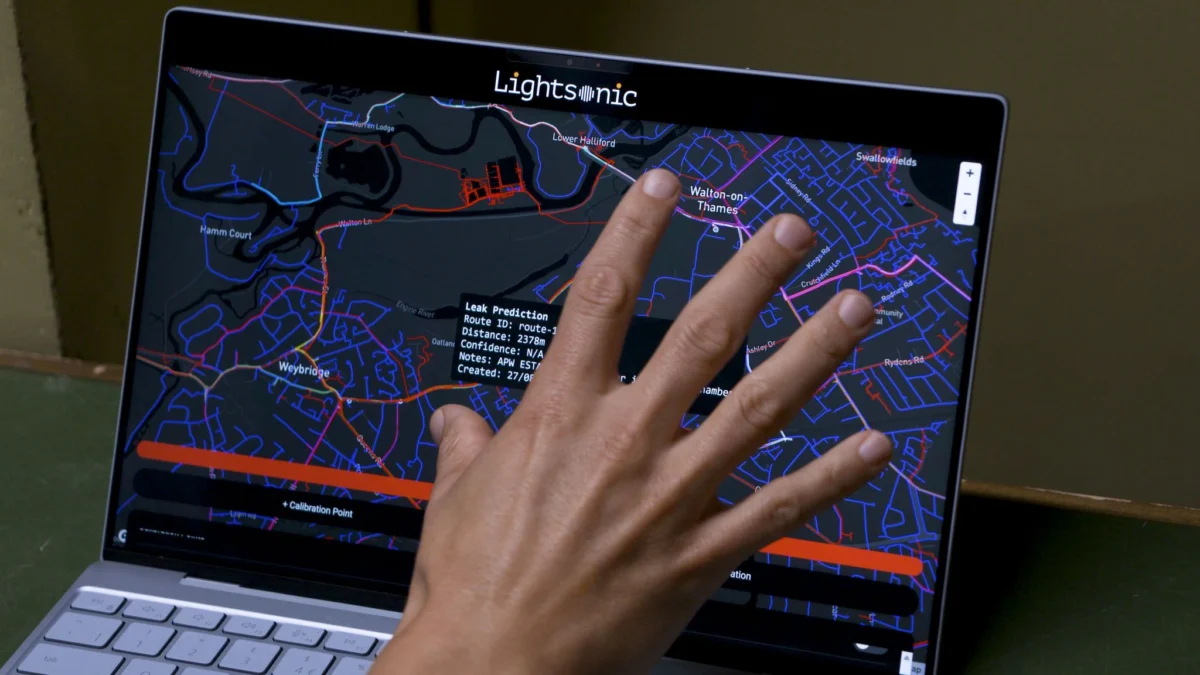
In this application, acoustic sensing units are attached to the fibre network. Because Openreach’s cables often share utility trenches or run parallel to water pipelines, they are perfectly positioned to act as a "listening device." When a pipe leaks, it creates specific high-frequency vibrations. These vibrations propagate through the soil and subtly shake the fibre-optic cable.
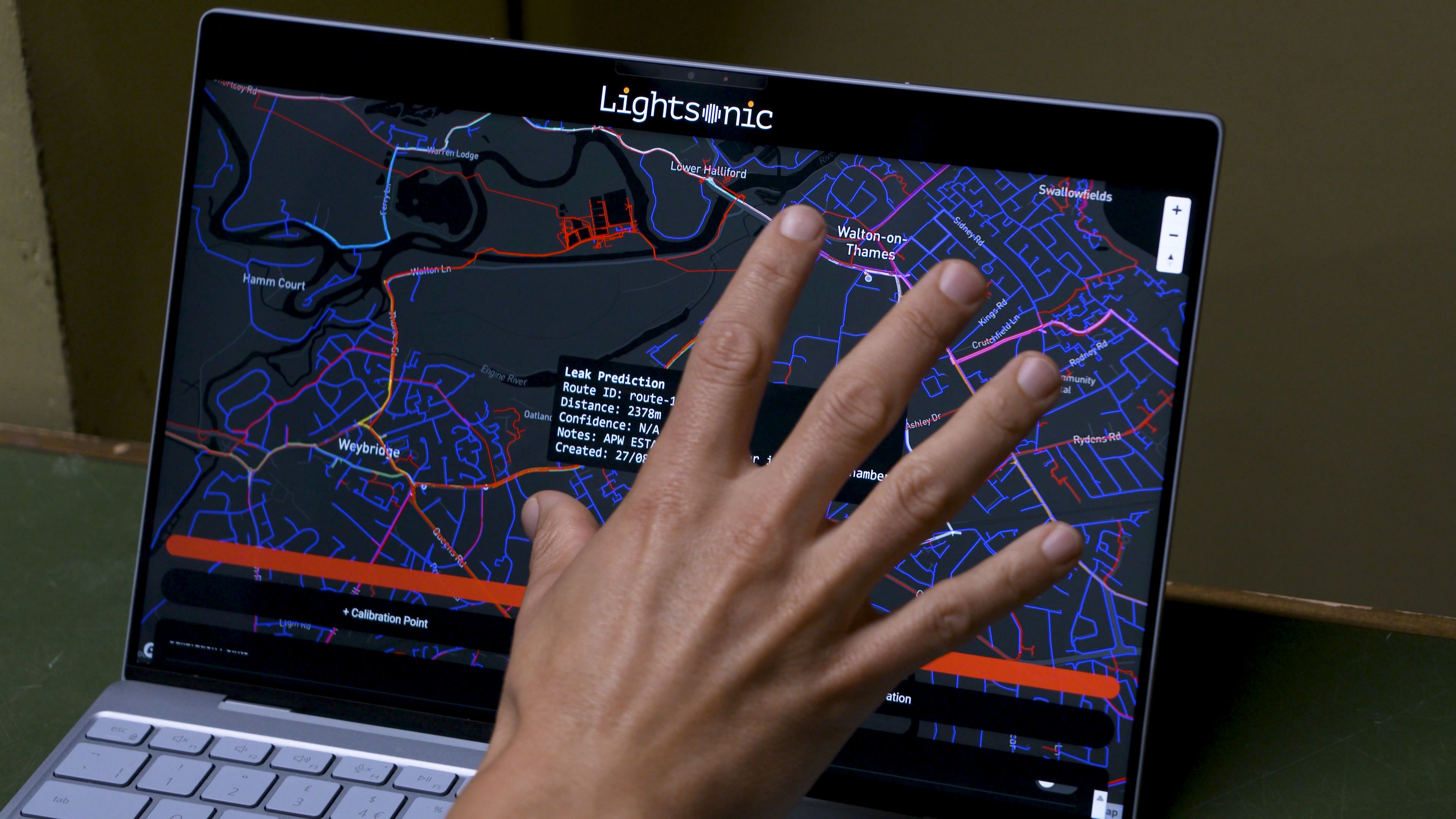
This movement creates a measurable impact on the optical signal passing through the glass strands. Lightsonic’s proprietary software processes these micro-disturbances, effectively filtering out "noise" (like traffic or construction) to isolate the distinct acoustic signature of a water leak. By triangulating these signals, the company can provide water companies with a precise location, allowing engineers to dispatch repair teams to a specific spot rather than conducting costly, exploratory street excavations.
Supporting Data and Efficiency
According to performance metrics shared by Lightsonic, the solution is remarkably efficient. The technology typically detects 1.2 million litres of water leaks per day for every 100km of the network covered annually.
The economic argument is equally compelling. Building a dedicated sensor network for water infrastructure would involve billions of pounds in capital expenditure, years of planning, and significant disruption to urban environments. By contrast, leveraging the existing Openreach "Full Fibre" footprint allows for rapid, scalable deployment. The capital expenditure required is significantly lower because the "backbone" of the sensor network—the fibre—is already in the ground.
Official Perspectives: The Synergy of Two Industries
The View from Lightsonic
Tommy Langnes, CEO of Lightsonic, views the partnership as a necessary evolution in the face of a changing climate. "Ageing infrastructure, leaking networks, and mounting climate pressure are converging, causing major water stress," Langnes stated. "By utilising existing fibre optic infrastructure, we have a solution that can be quickly and effectively scaled across the UK to help utility companies get a handle on leaks, secure supply, and generate savings that can be reinvested to upgrade our aging network."
Langnes emphasizes that the industry can no longer rely on manual, reactive maintenance. "The industry needs a quick and comprehensive response, and that is what we offer," he added.
The View from Openreach
For Openreach, this project demonstrates that telecommunications infrastructure is becoming a foundational element of the "Smart City" and "Smart Utility" ecosystem. Trevor Linney, Director of Network Technology at Openreach, believes this is a game-changer for the country.
"The results of our existing pilots show that our new full fibre infrastructure can deliver value far beyond broadband," Linney noted. "Combining Lightsonic’s technology with the reach of Openreach’s Full Fibre network makes continuous utility monitoring genuinely scalable, without the cost and disruption of building a separate sensor network."
Implications: A New Era for UK Water Security
The implications of this partnership extend far beyond the immediate reduction of water loss.
1. Climate Resilience
With global temperature records being broken with alarming frequency, the UK’s water security is increasingly precarious. The recent decision to delay the construction of new reservoirs by five years has left the country with little room for error. Technologies that maximize the efficiency of existing supplies are now the primary line of defense against future drought conditions.
2. Economic Reinvestment
Every litre of water saved is a reduction in operational costs. For water companies, these savings represent capital that can be directly reinvested into long-term infrastructure upgrades—replacing lead pipes, installing modern smart meters, and upgrading pumping stations.
3. Digital-Physical Convergence
This partnership serves as a blueprint for the future of utility management. By integrating telecom assets with civil engineering needs, the UK is demonstrating how cross-industry collaboration can solve complex, systemic problems. It raises the possibility of further "dual-use" scenarios, where fibre networks could potentially monitor ground stability, detect gas leaks, or map seismic activity.
Conclusion: The Path Forward
The collaboration between Southern Water, Lightsonic, and Openreach is a testament to the power of lateral thinking. By looking at the problem of water loss not through the lens of traditional plumbing, but through the lens of digital connectivity, these organizations have unlocked a solution that is both environmentally essential and economically sound.
As the UK moves into a future defined by climate uncertainty, the ability to "listen" to our infrastructure will become as important as the physical pipes themselves. This project is not just about stopping leaks; it is about building a more resilient, responsive, and intelligent nation. For a country facing the heat of a changing climate, the hum of data moving through fibre-optic cables might just be the sound of a more secure future.
As this technology scales, the hope is that the 2.6 billion litres lost daily will become a relic of the past, replaced by a precision-managed, digitally-monitored network that guarantees water security for generations to come.