In the rapidly evolving landscape of artificial intelligence, the ability to integrate Large Language Models (LLMs) into custom software is no longer a luxury—it is a baseline requirement for modern developers. Among the leading providers, Anthropic’s Claude series has emerged as a preferred choice for its sophisticated reasoning, nuanced writing, and commitment to safe, constitutional AI.
Integrating Claude into a Python-based application is a seamless process, but moving from a "Hello World" API call to a production-ready system requires a deep understanding of the SDK’s mechanics. This guide provides a deep dive into the Claude ecosystem, offering a professional roadmap for developers looking to harness the power of Claude within their Python workflows.
1. Main Facts: The Foundation of Claude Integration
At its core, the Claude API is designed around the Messages API, a robust interface that allows developers to send prompts and receive intelligent, context-aware responses. The official Claude Python SDK abstracts away the complexities of HTTP request handling, retry logic, and JSON parsing, allowing developers to focus on application logic rather than low-level network communication.
Key Components of the Ecosystem
- The SDK: A typed Python library that ensures data integrity and simplifies interactions.
- The Messages API: The primary endpoint for all text-based interactions.
- The Model ID: A versioned identifier (e.g.,
claude-sonnet-5) that dictates the reasoning capabilities and performance characteristics of the model. - The Context Window: The operational "memory" of the model, encompassing both your input prompts and the model’s generated output.
Understanding these components is the first step toward building applications that are not only functional but also scalable and cost-efficient.
2. Chronology: From Setup to Production
The journey of integrating Claude follows a logical progression, moving from environmental configuration to advanced streaming capabilities.
Phase I: Environment Preparation
Before writing a single line of code, developers must establish a secure development environment.
- Account Provisioning: Developers must obtain an API key via the Claude Console.
- Credential Security: The golden rule of API management is never to hardcode secrets. By utilizing environment variables—specifically
ANTHROPIC_API_KEY—or utilizing tools likepython-dotenv, developers ensure that their keys remain isolated from version control systems like GitHub. - Installation: The SDK is installed via
pip install anthropic.
Phase II: The Initial Request
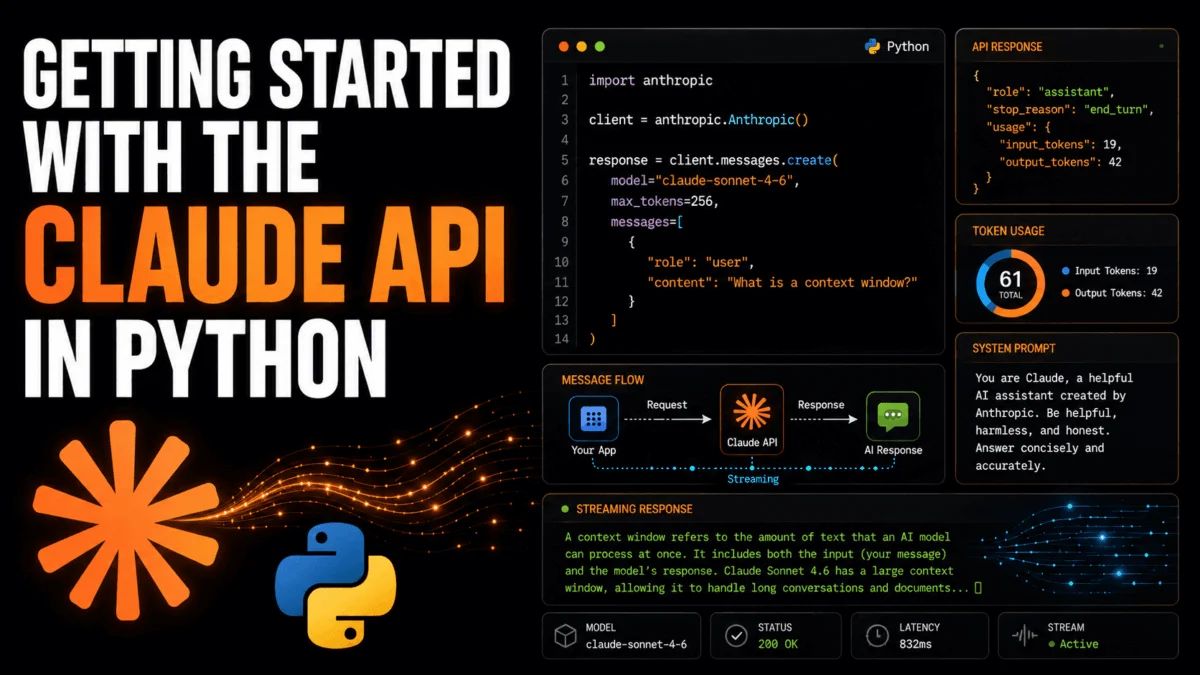
The client.messages.create() function is the engine of the SDK. By passing the model, max_tokens, and the messages array, developers initiate a conversation. The messages array is structured as a list of dictionaries, alternating between user and assistant roles, which allows the model to maintain a stateful history of the conversation.
Phase III: Response Handling
Unlike basic API wrappers, the Claude SDK returns a Message object. This object is a goldmine of metadata, containing:
stop_reason: Explains why the model finished (e.g.,end_turnfor completion ormax_tokensfor truncation).usage: A critical field for financial monitoring, detailing the exact count of input and output tokens consumed.
3. Supporting Data: Technical Nuances and Best Practices
To build enterprise-grade applications, developers must move beyond basic queries. This requires a deeper understanding of how the model processes information.
The Power of System Prompts
System prompts are arguably the most effective tool for "steering" the behavior of an LLM. Unlike standard user input, system prompts define the persona, constraints, and operational boundaries of the AI. By placing instructions in the system parameter, you ensure that the model adheres to specific formatting (such as returning only JSON or specific code structures) without needing to repeat those instructions in every user turn.
The Mathematics of Context
One of the most common pitfalls for new developers is underestimating the "Context Window." Every character sent to the model—and every character returned—consumes tokens. As the conversation length increases, so does the cost and the latency.
- Amortized Costs: Understanding that models like Claude process information in chunks helps in optimizing for long-running sessions.
- Streaming: For real-time applications, waiting for the full response to load can degrade user experience. Utilizing
client.messages.stream()allows the developer to display tokens as they are generated, effectively masking latency and providing a more interactive feel.
4. Official Perspectives and Implementation Strategies
Anthropic emphasizes that developers should treat API interactions as stateless. Because the API does not "remember" previous conversations automatically, the developer must manage the conversation history.
Managing State
When building a chatbot, the developer must maintain a list of messages. Each time a user adds a new prompt, the full list—including the model’s previous responses—must be sent back to the API. This is why the usage metadata provided by the SDK is so vital; it allows developers to implement "context truncation" logic, where older messages are pruned or summarized when the context window approaches its limit.
Error Handling and Resilience
Professional applications require robust error handling. The SDK is designed to be resilient, but developers should implement retries for transient network errors and handle specific exceptions related to rate limits or invalid requests. Monitoring the stop_reason is particularly crucial: if the stop_reason is max_tokens, the application should ideally notify the user or automatically extend the max_tokens parameter for the next turn.
5. Implications: The Future of AI-Driven Software
The shift toward API-first LLM integration has significant implications for the software development industry.
From Monolithic to Modular AI
By decoupling the "brain" of the application (Claude) from the interface (your Python app), developers can swap models, update system prompts, and refine logic without needing to rebuild the underlying architecture. This modularity is a core tenet of modern MLOps.
The Rise of Agentic Workflows
The next horizon for Claude API users is "Tool Use" (or function calling). This capability allows the model to interact with external databases, APIs, or calculators to solve complex problems. By enabling Claude to execute code or query data, developers move beyond simple chatbots and into the realm of autonomous agents capable of performing multi-step tasks.
Ethical and Responsible Development
Anthropic’s "Constitutional AI" approach means that Claude is pre-aligned with safety guidelines. However, the responsibility for how this tool is used rests with the developer. Implementing robust input sanitization and output validation is a professional obligation. Developers should treat the AI as a powerful but fallible component, ensuring that human oversight remains central to high-stakes applications.
Conclusion: Starting Your Journey
The transition from a learner to an expert in the Claude API is defined by your ability to manage state, optimize for token efficiency, and design thoughtful system prompts. Whether you are building a simple script to summarize documents or a complex agentic system that interacts with internal enterprise databases, the Claude SDK provides the reliability and performance required for professional-grade software.
As you move forward, prioritize exploring structured outputs and tool use. These advanced features will unlock the full potential of the model, transforming your Python application from a passive interface into an active, intelligent collaborator. With the foundational knowledge covered here, you are well-equipped to contribute to the next generation of AI-enhanced software.
Happy coding, and may your tokens always be used efficiently.