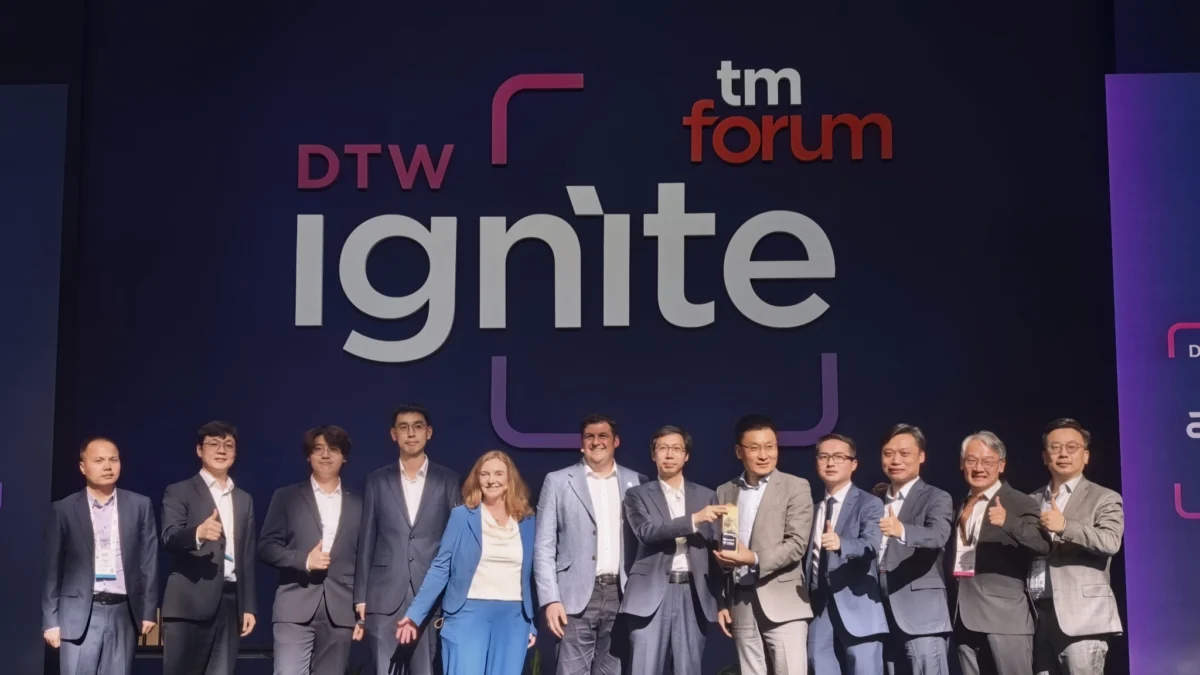
Copenhagen, Denmark – The global telecommunications landscape reached a significant inflection point this week at Digital Transformation World (DTW 2026), hosted by the TM Forum. Amidst a backdrop of rapid technological shifts and increasing consumer demands, China Telecom and Huawei were jointly honored with the prestigious 2026 Excellence in Autonomous Networks Award.
The recognition, centered on their pioneering project, "To AN Level 4 and Beyond – How 900+ AI Agents Have Transformed China Telecom’s Operations," serves as a testament to the industry’s shift from traditional, human-centric network management to self-healing, intelligent infrastructure. This victory marks a historic milestone: the second consecutive year the duo has secured a top-tier TM Forum Excellence Award, cementing their status as the vanguards of the global autonomous network movement.
The Core Achievement: Scaling AI for Network Excellence
At the heart of this award-winning initiative lies a radical shift in operational architecture. The transition to Autonomous Network (AN) Level 4—where the network functions with high levels of self-governance and predictive maintenance—has long been the "North Star" for global carriers. China Telecom, in collaboration with Huawei, has moved beyond theoretical frameworks, deploying over 900 specialized AI agents across its operations to manage the complexities of modern network environments.
The Problem: A Demand for Unprecedented Performance
The modern mobile landscape is no longer just about basic connectivity. The explosion of high-bandwidth, latency-sensitive services—specifically mobile AI, high-definition live streaming, and competitive mobile gaming—has pushed consumer expectations for network quality to an all-time high.
Legacy optimization methods, which relied heavily on manual data analysis and reactive troubleshooting, are no longer sufficient to maintain the seamless experience users demand. When thousands of network parameters shift in real-time, human intervention is simply too slow.
The Solution: The Network Experience Improvement Large Model
To address this, China Telecom and Huawei co-developed a domain-specific large language model (LLM) designed exclusively for radio network experience improvement. This model is not a general-purpose AI; it is a highly specialized engine built on China Telecom’s proprietary network large model foundation.
At its core, the system utilizes SRCON 2.0 (Simulated Reality of Communication Networks 2.0). This engine allows the AI to create a "digital twin" of the network environment, running simulations to identify poor Quality of Experience (QoE) events before they impact the end user. By translating complex, multi-dimensional user experience anomalies into precise, actionable optimization commands, the system bridges the gap between massive data streams and actual network performance.
Chronology: A Trajectory of Innovation
The road to this 2026 accolade has been marked by a rigorous, multi-year evolution of technological integration and strategic alignment.
- 2024: The Foundations of Intelligence. China Telecom and Huawei initiate a pilot program focused on integrating AI into core operational layers, shifting away from standard automation toward "Autonomous Network" concepts.
- 2025: The Breakthrough. The partners achieve a major industry milestone, winning a TM Forum Excellence Award for their early efforts in network automation. This success validates the efficacy of their research-driven approach and sets the stage for the massive scale-up of AI agents.
- 2026 (Early Q1): Deployment at Scale. Following the successful validation of the Network Experience Improvement Large Model, the solution is rolled out across 21 major cities in China, covering vast urban and suburban populations.
- 2026 (June): Global Recognition. At DTW 2026 in Copenhagen, the project is officially crowned with the 2026 Excellence in Autonomous Networks Award, confirming its status as the global gold standard for AN Level 4 implementation.
Supporting Data: Quantifying the Impact
The success of this initiative is not merely anecdotal; it is defined by clear, measurable performance metrics that highlight the transition from AI potential to operational reality.
| Metric | Result |
|---|---|
| City Deployment Coverage | 21 Cities |
| Reduction in Poor-QoE Grids | 20% |
| Decrease in Network Complaints | 10% |
| AI Agent Count | 900+ deployed |
By identifying and rectifying poor-QoE events at the grid level before they escalate into widespread outages or service degradation, the AI agents have directly contributed to a 10% drop in network-related customer complaints. This reduction is significant in an industry where customer retention is increasingly tied to the reliability of high-speed data experiences.
Official Responses and Strategic Implications
The industry response to the award has been one of validation for the "new quality productive forces" movement.
The Vision for "AI-Native" Networks
"Our partnership with Huawei is built on the shared belief that AI must be deeply embedded into the DNA of the network," stated a senior spokesperson from China Telecom. "We are not just automating tasks; we are building systems that ‘understand’ both the network infrastructure and the human experience it supports. This is the essence of autonomous networks."
Huawei representatives echoed this sentiment, highlighting that the deployment of 900+ agents represents a transition toward a truly "AI-Native" telecom architecture. By leveraging SRCON 2.0, the partners have essentially democratized high-level network optimization, ensuring that the benefits of massive AI computing power are translated into tangible, high-quality experiences for the average end user.
A Blueprint for the Global Industry
The implications for the broader telecommunications industry are profound. As global operators struggle with the rising cost of network maintenance and the increasing complexity of 5G and 6G preparation, the China Telecom-Huawei model offers a scalable blueprint.
- Standardization: The project highlights the necessity of common standards for AI agents in networks, a focus area for future TM Forum collaboration.
- Efficiency: The model demonstrates that large-scale AI deployment can reduce operational overhead while simultaneously increasing customer satisfaction—a "win-win" that has historically been difficult to achieve in network engineering.
- Future-Proofing: By committing to "new quality productive forces," the partners are positioning themselves to handle the demands of future technologies, including mass-market augmented reality (AR) and industrial IoT, which will require even higher levels of network responsiveness.
The Path Forward: Toward Intelligent Autonomy
As DTW 2026 concludes, the dialogue in the industry has shifted from if networks will become autonomous to how quickly they can reach full autonomy.
China Telecom and Huawei have signaled that their work is far from finished. The next phase of their strategic partnership involves a deeper focus on standardizing the interactions between diverse AI agents. If 900 agents have successfully transformed current operations, the next frontier is a unified, cross-domain ecosystem where these agents communicate seamlessly to manage the entire lifecycle of a network—from planning and construction to maintenance and optimization.
Commitment to "New Quality Productive Forces"
The term "new quality productive forces" frequently appeared throughout the conference, referring to the shift toward technology-led growth that relies on innovation rather than traditional labor-intensive models. China Telecom and Huawei’s joint project is perhaps the most concrete manifestation of this concept currently in existence within the global telecommunications sector.
By continuing to refine their AI-driven models, the partners aim to create a network that is not only "smart" but also predictive, ethical, and highly efficient. As they continue to bridge the gap between complex engineering and human-centric service, the industry will undoubtedly look to their ongoing collaboration as the primary indicator of what is possible in the age of autonomous connectivity.
In summary, the 2026 Excellence in Autonomous Networks Award is more than just a trophy. It is a reflection of a fundamental shift in the telecommunications paradigm—a future where networks are no longer just passive pipes for data, but active, intelligent participants in the digital economy. Through their commitment to innovation, China Telecom and Huawei have effectively signaled to the world that the era of Level 4 autonomous networks has officially arrived.