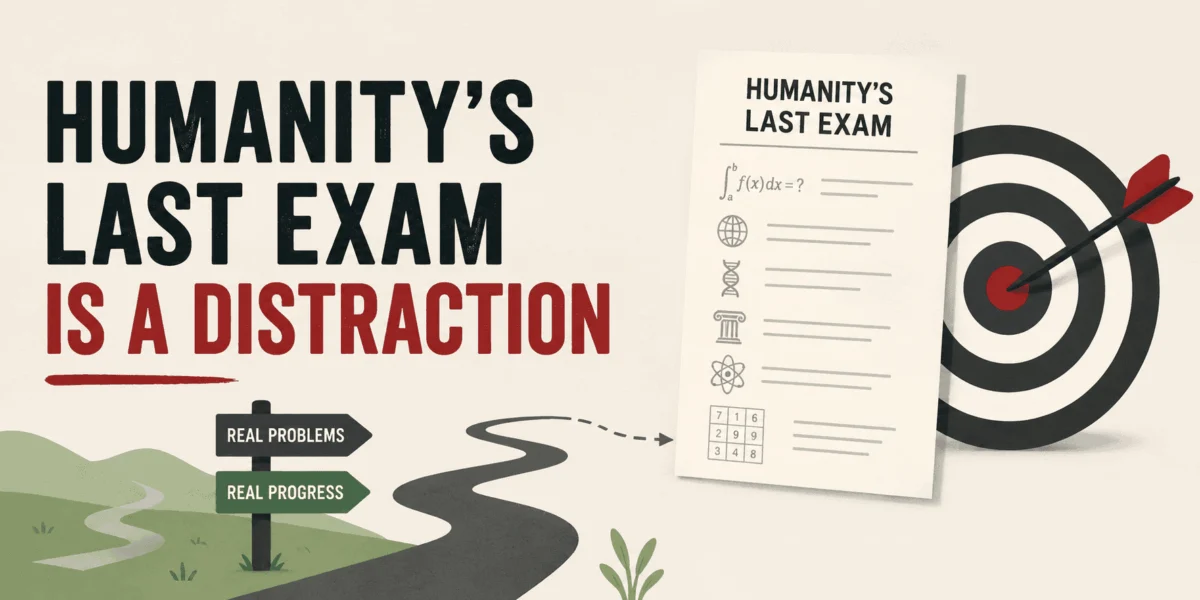
In the rapidly accelerating landscape of artificial intelligence, the metrics we use to define "intelligence" have become as volatile as the models themselves. As large language models (LLMs) continue to shatter records on legacy benchmarks, the research community has faced a crisis of measurement. Enter Humanity’s Last Exam (HLE)—a rigorous, high-stakes evaluation framework designed to push AI to its absolute limits. Published in Nature in January 2026, the HLE represents a pivotal shift from simple knowledge retrieval to the testing of deep, deductive reasoning. But is it the gold standard for Artificial General Intelligence (AGI), or merely a sophisticated marketing distraction?
The Chronology of Obsolescence: From Turing to HLE
The history of AI evaluation is a history of rapid saturation. For decades, the Turing Test served as the philosophical North Star for machine intelligence. However, as AI systems evolved, the focus shifted toward quantitative benchmarks.
- The Era of MMLU: For several years, the Massive Multitask Language Understanding (MMLU) dataset was the industry standard. It tested models across various academic subjects using multiple-choice questions.
- The Saturation Point: By 2024, frontier models like GPT-4 and Claude 3 were routinely scoring above 90% on MMLU. When a model achieves near-human parity on a benchmark, the benchmark ceases to be a tool for differentiation and becomes a ceiling that obscures further progress.
- The Birth of HLE: Recognizing that traditional tests were becoming "solved," the Center for AI Safety, in collaboration with Scale AI, began developing a more robust alternative.
- January 2026: The HLE was formally unveiled in Nature. It was not designed to be passed; it was designed to be failed, serving as a "stress test" for the next generation of neural architectures.
Anatomy of the Exam: Why HLE Defies Simple Memorization
Humanity’s Last Exam distinguishes itself through its architectural complexity. It consists of over 2,500 questions curated by world-leading experts across more than 100 distinct academic disciplines. Unlike previous iterations of testing, HLE mandates:
- Reasoning over Retrieval: The questions are specifically engineered to bypass the "memory trap." AI models cannot rely on training data regurgitation; they must synthesize disparate concepts to formulate a coherent, logical response.
- Multidisciplinary Depth: From quantum physics to advanced humanities, the exam forces models to pivot between logical structures, testing their versatility.
- The "I Don’t Know" Threshold: A crucial component of the HLE is its ability to measure epistemic humility. The test penalizes "hallucinations"—a common pitfall where AI models speak with high confidence about incorrect information. The HLE rewards models that can identify the limits of their own knowledge.
The results have been sobering. Even the most powerful models, including the latest iterations from OpenAI, Google, and Anthropic, have struggled to exceed a 45–50% accuracy rate. These figures provide a stark reality check, suggesting that while modern AI is proficient at data synthesis, it remains far from the "deep reasoning" required for true expertise.
Expert Perspectives: A Divided Community
The introduction of HLE has sparked a polarized debate within the scientific and engineering communities. The discourse can be categorized into three distinct schools of thought.
The Proponents: The Case for Necessary Rigor
Roughly 60% of the field views the HLE as a vital evolution. Proponents argue that without a "hard" benchmark, the industry is blind. If every model scores 95% on a test, developers have no way to measure incremental improvements in reasoning architecture. Furthermore, the HLE’s emphasis on honesty—penalizing overconfident errors—is seen as a critical safety feature. If an AI cannot admit when it lacks information, it cannot be safely deployed in high-stakes environments like medicine or law.
The Skeptics: The "Marketing Hamster Wheel"
About 30% of critics view the HLE as a distraction. Their argument is rooted in the "real-world applicability" gap. They contend that by focusing on obscure, highly academic questions, the HLE moves further away from the practical, agentic tasks that AI performs in the real world. Critics argue that corporations are caught in a "marketing hamster wheel," where each release of an HLE-adjacent benchmark is used to drum up headlines about "AGI progress" rather than genuine utility.
The Critics: The "Flawed Framework" Contingent
A smaller but vocal minority points to technical flaws. In peer-to-peer data science forums, researchers have identified instances where the HLE’s own answer keys were incorrect, particularly in specialized fields like organic chemistry and non-linear mathematics. In a poetic twist, it was the AI models themselves that first flagged these inconsistencies, raising questions about whether we should be testing the AI against the benchmark, or the benchmark against the AI.
Supporting Data and Technical Implications
The implications of the HLE extend beyond mere rankings. For researchers, the HLE provides a "heatmap" of current AI deficiencies. Data suggests that while models have achieved near-perfect fluency, their deductive chains frequently break down when faced with multi-step problems that require internal consistency.
The performance gap between 50% (the current HLE threshold) and 100% represents the "Reasoning Frontier." Achieving higher scores on this exam likely requires a fundamental shift in architecture—perhaps moving away from purely probabilistic token prediction toward systems that utilize formal verification or symbolic reasoning engines.
Official Responses and The Path Toward AGI
The Center for AI Safety has been clear in its messaging: HLE is not meant to be a final destination, but a mirror reflecting the current limitations of synthetic intelligence.
"The goal is not to pass the test," noted a lead researcher involved in the project. "The goal is to understand why our systems fail when the complexity increases."
The official stance from major AI labs has been largely supportive, with many companies integrating HLE-style questions into their internal "Red Teaming" processes. However, the industry remains cautious about using the HLE as the sole metric for AGI. The consensus among top scientists is that AGI is not a test score; it is a manifestation of agency, adaptability, and intent—none of which can be fully captured by a static exam, no matter how difficult.
Conclusion: The Horizon of Intelligence
Humanity’s Last Exam is a brilliant, albeit imperfect, addition to the AI toolkit. It serves as a necessary reality check in an industry prone to the hype of "exponential growth."
While the benchmark is unlikely to define the exact moment of AGI’s arrival, it succeeds in providing a high-pressure environment where the limits of current machine intelligence are laid bare. As we move forward, the HLE will likely evolve—becoming less of a static document and more of a dynamic, interactive system that grows alongside the intelligence it measures.
Ultimately, the HLE reminds us that intelligence is not just about knowing facts—it is about the ability to reason through the unknown. Whether this exam helps us reach the summit of human-level AI or simply proves how far we still have to climb, one thing is certain: the era of easy benchmarks is over. We have entered an era where we must test the limits of our machines with the same rigor we apply to our most profound scientific inquiries.
Iván Palomares Carrascosa is a leader, writer, speaker, and adviser in AI, machine learning, deep learning, and LLMs. He specializes in guiding organizations through the complex transition toward AI-integrated operations.