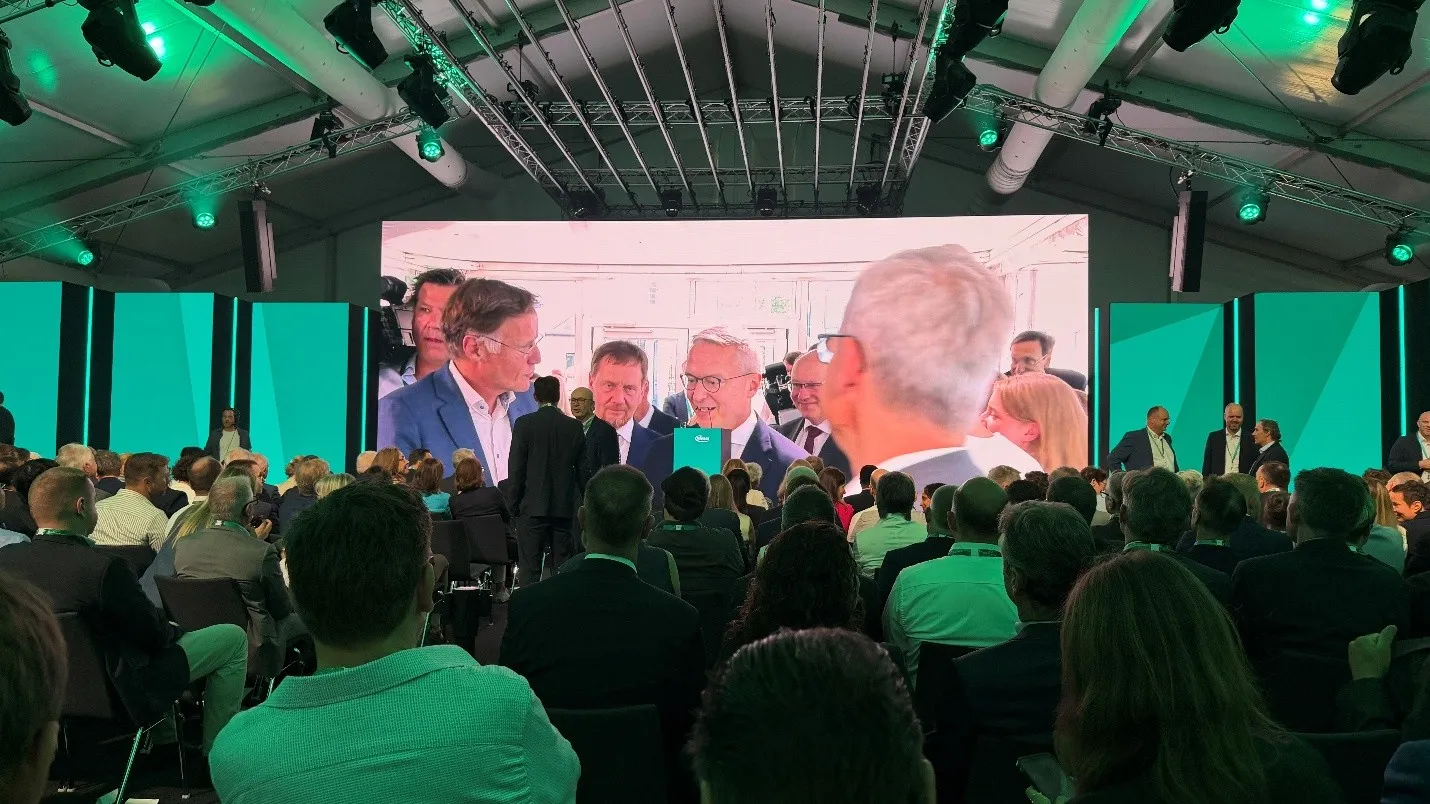
In a milestone event that signals a significant shift in European industrial capability, Infineon Technologies officially inaugurated its new “Module 4” smart power fab in Dresden, Germany, on Thursday, July 2, 2026. The facility, representing a colossal €5 billion (~$5.7 billion) investment, was completed three months ahead of its original schedule.
While the headline-grabbing price tag highlights the scale of the commitment, industry observers suggest the more profound achievement lies in the execution speed. From the initial groundbreaking in May 2023 to the ribbon-cutting ceremony just over three years later, Infineon has demonstrated that even the most complex semiconductor manufacturing projects can be accelerated through aggressive digital transformation and standardized global operational models.
A Chronology of Rapid Execution
The trajectory of the Dresden Module 4 project serves as a masterclass in modern industrial management. When construction began in May 2023, the global semiconductor landscape was characterized by supply chain volatility and an urgent need for regional capacity.
- May 2023: Groundbreaking ceremony in Dresden, setting the stage for what would become Infineon’s largest facility for intelligent power semiconductor systems.
- 2023–2025: A period of rapid construction and infrastructure integration, supported by the deployment of advanced digital twins.
- July 2026: Official opening of the fab, marking the completion of a multi-year effort that finished three months ahead of schedule.
The speed of this delivery was not accidental. According to Alexander Gorski, Chief Operations Officer at Infineon Technologies, the project benefited from the "one virtual fab" strategy, which allowed the company to synchronize its manufacturing expertise across its major global hubs in Villach (Austria), Kulim (Malaysia), and Dresden. By treating these geographically dispersed sites as a single, unified entity, Infineon was able to streamline equipment qualification and process optimization.

The “One Virtual Fab” Strategy: Leveraging AI and Digital Twins
During an exclusive interview with EE Times at the opening ceremony, Alexander Gorski provided deep insight into the internal mechanics of the project’s success. The cornerstone of this strategy is the "one virtual fab" concept, an operational philosophy that relies heavily on standardization.
Infineon has spent the last several years aligning its global manufacturing hubs to run on identical tools, software architectures, and processes. This harmonization is critical. When a process is optimized or a tool is qualified at one site, the “digital twin” of that system allows the engineering teams at other sites to implement the same configuration with near-instantaneous efficiency.
“We aren’t just building a factory; we are building a global, synchronized machine,” Gorski explained. By utilizing real-time digital twins, the company effectively eliminated the traditional learning curve associated with launching a new facility. Instead of starting from scratch, the Dresden team leveraged the operational data and "lessons learned" from the Villach and Kulim sites, allowing them to ramp up capacity twice as fast as historical industry standards.
Supporting Data: Impact and Revenue Potential
The financial and operational implications of Module 4 are significant. When fully loaded and operational at peak capacity, Infineon expects the fab to generate approximately €5 billion in additional annual revenue. This revenue will be driven by the production of critical components that are currently in high demand globally.

The facility is designed to scale beyond any of the company’s existing sites in Asia or the U.S., positioning Dresden as the primary nexus for Infineon’s power semiconductor output. The product portfolio will be expansive, covering:
- Standard Power Switches: Including high-efficiency MOSFETs that form the backbone of energy distribution systems.
- Analog/Mixed-Signal ICs: Complex power management integrated circuits that are essential for modern electronics.
- Advanced SoCs: Highly intricate Systems-on-Chip designed specifically for the next generation of humanoid robotics and autonomous systems.
This diversity ensures that the fab is not dependent on a single market segment, but rather acts as a hedge against volatility in the broader technology sector.
Official Responses and Political Significance
The opening of the fab was attended by a host of dignitaries, underscoring the strategic importance of the site to both the German economy and the broader European semiconductor initiative.
In his keynote address, Infineon CEO Jochen Hanebeck emphasized the timing of the investment. “We’re opening our new plant at just the right time,” Hanebeck stated. “Our smart power fab is creating urgently needed capacities for the key technologies of the future, for everything from energy supply for AI data centers to software-defined vehicles and renewable energies. Infineon is thus giving an important impulse in making the global AI revolution possible and securing supply chains in critical industries.”

The political sentiment was equally optimistic. While German Federal Chancellor Friedrich Merz addressed the 400 attendees via video, praising the investment as a triumph for "Silicon Saxony," the onsite presence of Federal Minister for Digital Transformation Karsten Wildberger and Saxony’s Minister-President Michael Kretschmer underscored the government’s commitment to the project.
Kretschmer noted that the success of the fab sends a "strong signal" about the viability of microelectronics in Europe. He argued that the project proves that major industrial undertakings can be implemented securely and swiftly when the state and private sector align on the necessary prerequisites.
Implications for the Global Supply Chain
A recurring theme in recent policy discourse has been the effort to “bring the supply chain home.” However, Gorski cautioned that a simplistic view of reshoring is insufficient. He advocated for a “hybrid manufacturing strategy” that acknowledges the reality of global interdependence.
Infineon’s approach recognizes that no single country or company can manage every aspect of the semiconductor value chain—from initial process development to final packaging. Consequently, the company employs a balanced model:

- Strategic Outsourcing: A higher proportion of control and connectivity products are outsourced to specialized partners.
- Internal Control: High-value power and sensing devices, which require proprietary, cutting-edge manufacturing processes, are kept within the internal “virtual fab” network.
This hybrid model provides Infineon with the agility to respond to market shifts without the burden of owning every piece of the manufacturing puzzle. It is a pragmatic strategy that allows the company to remain competitive in the face of rising costs and geopolitical pressures.
The Road Ahead: AI and Future-Proofing
The emergence of AI data centers has created an unprecedented demand for power management and analog devices. As these centers scale, they require increasingly sophisticated power semiconductors that can handle higher loads with greater efficiency. Module 4 is explicitly configured to address this market, with its capacity specifically tailored to meet the needs of the energy-hungry AI infrastructure of tomorrow.
By integrating AI-driven monitoring and process control into the heart of the Dresden fab, Infineon has ensured that the facility is not merely a static building, but a dynamic, self-optimizing environment. As the industry moves toward 2030, the ability to adapt to new node requirements and process shifts—facilitated by the virtual fab model—will likely be the defining factor that separates market leaders from laggards.
In conclusion, the inauguration of the Dresden Module 4 fab is more than a successful construction project; it is a proof-of-concept for a new way of manufacturing. By blending heavy capital investment with a sophisticated, data-driven operational strategy, Infineon has solidified its position at the vanguard of the global power semiconductor market. The facility serves as a beacon for European industry, proving that with the right technology and strategic foresight, it is possible to maintain a competitive edge in the most demanding high-tech sectors on the planet.