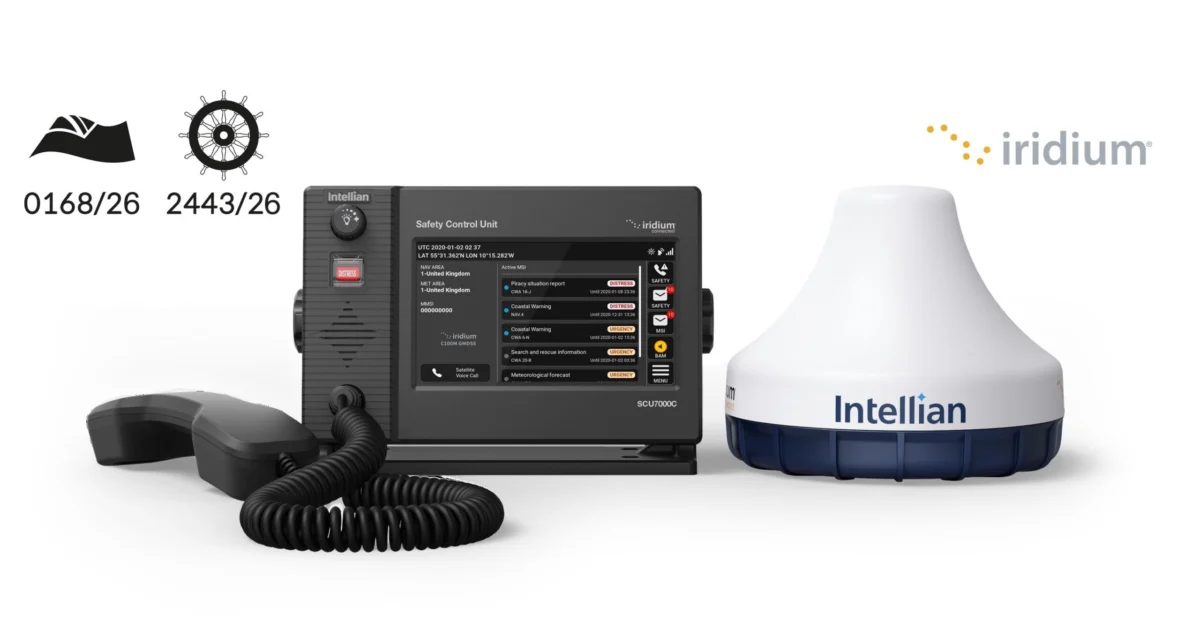
In a significant move for maritime safety and satellite communications, Intellian Technologies has officially unveiled its latest terminal designed specifically for Iridium’s Global Maritime Distress and Safety System (GMDSS). The new C100M terminal, which leverages the robust Iridium Certus 100 service, represents a strategic enhancement to the company’s portfolio, positioning Intellian as the only manufacturer to provide a dedicated terminal for every service tier within the Iridium Certus ecosystem.
This development arrives at a critical juncture for the maritime industry, as vessel operators increasingly prioritize reliable, global, and seamless safety connectivity in an era of heightened maritime activity and stricter regulatory requirements.
Main Facts: The C100M GMDSS Solution
The Intellian C100M GMDSS is an advanced, all-in-one terminal engineered to provide comprehensive safety coverage for mariners operating anywhere on the globe, including the historically difficult-to-reach polar regions.
Core Capabilities
The system is built to serve as a mission-critical lifeline for vessels. Its primary functionalities include:
- Full Distress Alerting: A dedicated, one-touch system to trigger distress signals to Rescue Coordination Centers (RCCs).
- Safety Voice: High-quality voice communication for emergency coordination.
- Maritime Safety Information (MSI): Real-time reception of navigational warnings, weather alerts, and other critical data.
- Ship Security Alert System (SSAS): Ensuring the security of the vessel and crew against threats.
- Long-Range Identification and Tracking (LRIT): Automated tracking capabilities for regulatory compliance.
Engineering Innovation
What sets the C100M apart is its emphasis on efficiency and ease of integration. By consolidating the below-deck unit and the user interface into a single, integrated "Safety Control Unit," Intellian has significantly reduced the physical footprint of the equipment. Furthermore, the company has engineered the system to be compatible with existing legacy GMDSS antenna cabling, provided the infrastructure remains in good condition. This "plug-and-play" compatibility drastically lowers the barrier for shipowners looking to upgrade from aging, disparate safety systems to a modern, unified network.
Chronology: The Evolution of Iridium GMDSS
To understand the significance of the C100M launch, one must look back at the historical trajectory of Iridium’s role in maritime safety.
2020: The Historic Authorization
For decades, the maritime safety landscape was dominated by a single legacy provider. That changed in January 2020, when Iridium Communications officially received authorization from the International Maritime Organization (IMO) to provide GMDSS services. This marked the first time a satellite operator had broken the monopoly on GMDSS, bringing the benefits of Iridium’s L-band, pole-to-pole satellite constellation to the global maritime community.
2020–2025: The Expansion Phase
Following the 2020 authorization, the industry saw a gradual transition. Vessel owners began exploring Iridium’s services for their superior coverage, particularly for ships traversing high-latitude routes where traditional geostationary satellites often suffer from signal degradation. During this period, Intellian worked closely with Iridium to develop hardware that could translate this robust satellite capacity into user-friendly maritime interfaces.
2026: The Completion of the Portfolio
The July 2026 launch of the C100M GMDSS terminal completes a multi-year roadmap for Intellian. By covering the entire spectrum of Iridium Certus tiers—from the high-throughput Certus 700 to the specialized, compact Certus 100—Intellian has established itself as a primary hardware partner for the Iridium maritime safety ecosystem.
Supporting Data: Why Certus 100 Matters
The reliance on the Iridium Certus 100 service is not accidental. The Certus 100 tier is specifically optimized for small-to-mid-sized vessels, leisure crafts, and as a redundant safety system for larger commercial vessels.
The L-Band Advantage
Unlike Ku-band or Ka-band services, which are susceptible to "rain fade" and atmospheric interference, Iridium’s L-band service is exceptionally resilient. It is essentially weather-proof, ensuring that during a storm—the very time a GMDSS system is most needed—the signal remains clear.
Regulatory Compliance and Reliability
Under the Safety of Life at Sea (SOLAS) convention, vessels are required to maintain strict communication standards. The C100M meets these international standards, offering a modern alternative to the aging Inmarsat-C systems that have served the industry for years. Data latency on the Certus 100 network is minimal, and the global nature of Iridium’s Low Earth Orbit (LEO) constellation ensures that there are no "blind spots" in the ocean, even in the Arctic and Antarctic.
Official Responses and Strategic Vision
The launch has been met with enthusiasm from industry stakeholders, who see the terminal as a bridge between the analog past and the digital future of maritime safety.
Eric Sung, CEO of Intellian Technologies
During the unveiling, Eric Sung, CEO of Intellian, highlighted the strategic importance of this release:
"With the launch of the C100M GMDSS System, we now offer the industry’s most extensive portfolio of Iridium GMDSS Systems, with a tailored solution for every vessel size and requirement. This compact, all-in-one terminal offers mariners a seamless, modern upgrade path from legacy safety networks, ensuring vital, global connectivity when it matters most."
Industry analysts note that Sung’s emphasis on the "upgrade path" is key. For many shipping companies, the cost of retrofitting a vessel is a significant deterrent to technological adoption. By allowing the reuse of existing cabling and reducing the hardware footprint, Intellian is directly addressing the "cost-of-compliance" concern that keeps many vessels locked into obsolete safety technology.
Implications for the Maritime Industry
The introduction of the C100M GMDSS has several far-reaching implications for global shipping, maritime security, and safety standards.
1. The Death of the "Blind Spot"
With more vessels adopting Iridium-based GMDSS systems, the era of the maritime blind spot is coming to an end. As commercial shipping routes expand into the Northern Sea Route and other high-latitude areas, the reliability of the C100M becomes a vital component of safe navigation.
2. Streamlining Fleet Management
For fleet managers, the ability to standardize hardware across different vessel classes is a major operational benefit. If a fleet operator can deploy a common architecture (Intellian/Iridium) across their entire fleet, it simplifies crew training, reduces spare part inventory, and streamlines maintenance protocols.
3. Increased Competitiveness in Maritime Tech
The success of the Iridium GMDSS service, supported by hardware manufacturers like Intellian, has sparked a healthy, competitive environment. As other satellite providers look to modernize their own safety offerings, the end-user—the mariner—benefits from faster, more reliable, and more affordable communication options.
4. A Boost for Maritime Sustainability
While GMDSS is fundamentally about safety, the underlying Certus 100 connectivity also supports basic IoT data transmission. By having a modern, always-on terminal, shipowners can gain better visibility into engine health and fuel consumption, indirectly contributing to the industry’s broader goals of maritime decarbonization and efficiency.
Conclusion: A New Standard for Life at Sea
The Intellian C100M GMDSS system is more than just a piece of hardware; it is a manifestation of the evolution of maritime safety. By combining the unique advantages of Iridium’s L-band satellite network with a refined, installer-friendly, and cost-effective terminal design, Intellian has set a new benchmark for the industry.
As vessels continue to navigate an increasingly complex and demanding global environment, the importance of reliable, always-on communication cannot be overstated. With the C100M, Intellian has ensured that regardless of a vessel’s size or its route, the safety of the crew remains protected by the most advanced technology currently available. As the maritime sector continues its digital transformation, the C100M stands as a testament to the fact that when it comes to the safety of life at sea, innovation and accessibility are not just desirable—they are essential.