On October 25, 1671, the landscape of planetary astronomy shifted irrevocably. Gazing through his telescope at the golden, ringed majesty of Saturn, the Italian-French astronomer Giovanni Domenico Cassini identified a faint, flickering speck of light that had eluded humanity since the dawn of time. This was Iapetus, the second moon ever discovered orbiting Saturn. Little did Cassini know that his observation would spark a centuries-long scientific mystery, leading to one of the most striking visual anomalies in our solar system.
The Dawn of Saturnian Exploration
To understand the magnitude of Cassini’s discovery, one must look at the state of 17th-century science. Before 1671, the Saturnian system was largely a mystery. Only six years earlier, in 1655, the Dutch polymath Christiaan Huygens had identified Titan, the largest and most prominent of Saturn’s moons. For half a decade, Titan stood alone as the sole satellite known to orbit the ringed planet.
Cassini, working from the Paris Observatory, was an indefatigable observer. Following his identification of Iapetus, his success rate in the Saturnian system soared. He would eventually go on to discover three more moons—Rhea, Tethys, and Dione—cementing his legacy as the preeminent mapper of the outer solar system. However, Iapetus remained the most peculiar of his findings.
The Case of the Vanishing Moon
The initial study of Iapetus presented a baffling problem that challenged the physics of the era. Upon first spotting the moon on the western side of Saturn, Cassini carefully calculated its orbital trajectory. Based on his projections, he expected to observe the moon on the eastern side of the planet exactly 39 days later. When the date arrived, however, Cassini was met with silence from the heavens; the moon had vanished.
As the weeks passed, Cassini continued his vigil. When the moon finally reappeared on the western side again, the astronomer realized he was witnessing a celestial optical illusion. Iapetus, he concluded, possessed a surface with starkly different light-reflecting properties—one hemisphere was significantly darker than the other. When the dark face turned toward Earth, the moon became effectively invisible to the telescopes of the 17th century. This realization marked one of the first times an astronomer inferred the physical surface characteristics of a distant, unresolved moon based solely on its orbital behavior.
Supporting Data: A Closer Look at the Yin-Yang World
It would take over 300 years to confirm Cassini’s theory. In the early 21st century, NASA’s Cassini spacecraft—named in honor of the astronomer—conducted a series of close-range flybys of the moon. The images transmitted back to Earth were nothing short of breathtaking.
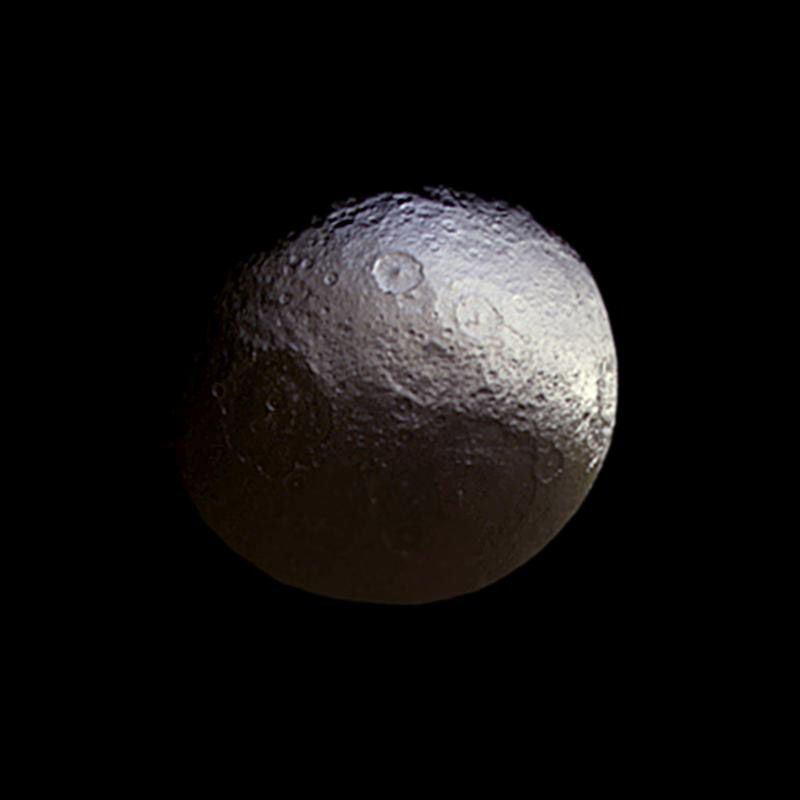
The moon, which spans approximately 900 miles (1,470 kilometers) in diameter, appeared as a literal "yin-yang" world. One hemisphere is coated in a dark, reddish-brown material, while the other is as bright as fresh snow. This extreme albedo contrast is unique among the major moons of the solar system.
Scientific analysis suggests that the dark material is likely composed of organic compounds, possibly deposited by the moon’s unique orbital path. As Iapetus travels through the Saturnian system, it acts like a cosmic snowplow, sweeping up dark, dusty debris shed by the distant, outer moon Phoebe. This debris migrates inward and coats the leading face of Iapetus, causing it to warm up, sublimate its surface ice, and trap even more dark material in a runaway process of thermal feedback.
Implications for Solar System Formation
The study of Iapetus has provided far more than just a beautiful photograph; it has forced a fundamental rethink of the history of the Saturnian system. For years, scientists assumed that the major moons of Saturn were ancient, primordial structures formed alongside the planet billions of years ago. However, modern computer simulations have challenged this timeline.
Researchers have found that the inner moons of Saturn and its iconic, complex ring system may be significantly younger than previously thought—perhaps even younger than the extinction of the dinosaurs. This conclusion stems from complex orbital resonance models. If the moons and rings were truly ancient, their orbits would have likely been disrupted by the gravitational influence of the sun.
"Our best guess is that Saturn had a similar collection of moons before, but their orbits were disturbed by a special kind of orbital resonance involving Saturn’s motion around the sun," researchers noted in recent studies regarding the Saturnian system. "Eventually, the orbits of neighboring moons crossed, and these objects collided. From this rubble, the present set of moons and rings formed."
While Titan and Iapetus, being further out, were not necessarily formed in the same violent epoch as the inner rings, their positions and characteristics serve as crucial data points in reconstructing this chaotic history. By analyzing the "rubble" of the inner system versus the more stable, ancient nature of the outer moons, planetary scientists are gaining a clearer picture of how gas giants curate their own miniature solar systems.

Official Responses and Modern Perspectives
The legacy of Giovanni Cassini is maintained today by organizations like NASA and the European Space Agency (ESA). When the Cassini-Huygens mission concluded in 2017 with a final plunge into Saturn’s atmosphere, the data it left behind ensured that Iapetus would be studied for generations.
Dr. Linda Spilker, a planetary scientist who served as the project scientist for the Cassini mission, has often highlighted how the moon’s "yin-yang" appearance serves as a pedagogical tool. "Iapetus reminds us that nature is rarely uniform," she once noted. "When we look at these distant, frozen worlds, we are looking at the evidence of billions of years of solar system evolution. Every crater, every color variation, and every orbital quirk tells a story of collision, deposition, and gravity."
Conclusion: A Legacy Carved in Light and Shadow
The discovery of Iapetus on October 25, 1671, was a triumph of human observation. Giovanni Cassini possessed the patience to wait for a moon that refused to be seen, and the intellect to understand why. In the centuries since, our tools have improved from simple glass lenses to sophisticated interplanetary probes, yet the mystery of Iapetus remains as compelling as ever.
As we continue to look toward the outer planets, the lessons learned from this two-toned moon remain vital. They remind us that the solar system is a dynamic, changing place, defined by the interplay of light, shadow, and orbital mechanics. Whether it is the strange, dark coating of Iapetus or the complex, icy dance of the rings, the Saturnian system continues to offer profound insights into our own origins.
For those interested in the ongoing history of space exploration, the archives of discovery—from Cassini’s 17th-century sketches to the high-definition telemetry of modern rovers—remain open. Each day brings a new "On This Day" moment in the annals of space science, proving that while our methods of observation have evolved, our fundamental drive to understand the cosmos remains as fervent as it was when Cassini first aimed his telescope at the night sky.