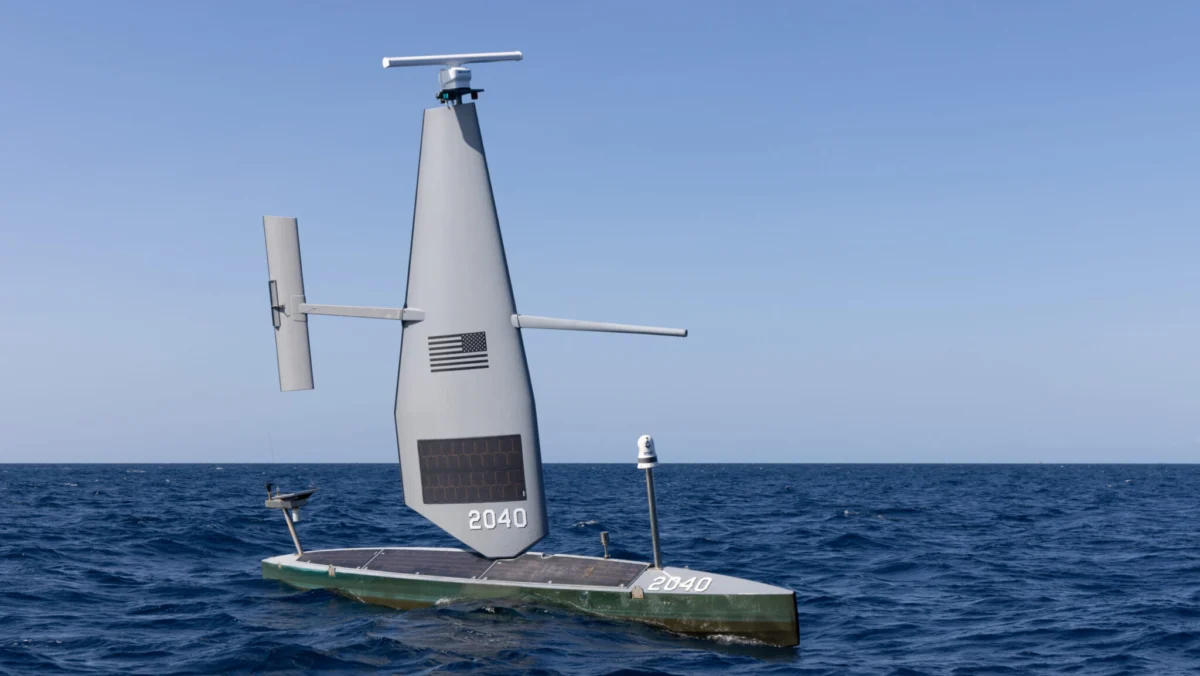
WASHINGTON — In a move underscoring the U.S. Navy’s accelerating transition toward a distributed, autonomous maritime force, Saildrone has been awarded a new $16.3 million task order to continue its operations within the U.S. Southern Command (SOUTHCOM) area of responsibility. The contract ensures that the company’s Voyager unmanned surface vessels (USVs) will maintain their persistent presence in the Caribbean and the Eastern Pacific through 2027.
This latest investment cements the Voyager platform as a cornerstone of the Navy’s “hedge strategy,” a multi-year effort to integrate low-cost, high-endurance autonomous systems into traditional maritime operations to counter dynamic, decentralized threats.
The Core Mandate: Persistent Presence and Counter-Narcotics
The task order represents an extension of a successful deployment that began in 2023. At the heart of this mission is the support provided to the Joint Interagency Task Force South (JIATF South), a multi-national organization tasked with detecting, monitoring, and interdicting the illicit flow of narcotics into the United States.
Saildrone’s Voyagers have become a force multiplier for the U.S. 4th Fleet. By providing an “unblinking eye” over vast stretches of the Caribbean, these vessels allow human-crewed ships to focus on higher-complexity tasks while the autonomous drones maintain constant surveillance of suspicious transit corridors.
The effectiveness of this partnership was validated in October 2025, when a Voyager USV proved instrumental in a high-profile drug interdiction. According to U.S. Navy records, the autonomous craft successfully tracked and identified a suspicious vessel, providing the actionable intelligence necessary for U.S. forces to intercept the ship. The subsequent raid resulted in the seizure of approximately $81 million worth of cocaine, a testament to the tactical utility of unmanned assets in counter-trafficking operations.
Chronology: From Experimental Deployment to Strategic Asset
The integration of Saildrone technology into naval operations did not happen overnight. The firm’s relationship with the Department of Defense has evolved through several distinct phases:
- Early 2023: Initial operational testing begins in the SOUTHCOM area of responsibility, focusing on intelligence, surveillance, and reconnaissance (ISR) capabilities.
- February 2025: Saildrone announces a milestone deployment, with 20 Voyager USVs actively operating in the region to support 4th Fleet’s Operation Southern Spear.
- October 2025: A Voyager USV contributes to a major $81 million narcotics seizure in the Caribbean, marking a high-water mark for USV operational success.
- May 2026: The program expands in scope as the U.S. Coast Guard partners with Saildrone to deploy 16 Voyagers to the Great Lakes for border security and the North Atlantic for illegal, unreported, and unregulated (IUU) fishing enforcement.
- Early 2027 and Beyond: With the new $16.3 million task order, the Voyager fleet is contracted to maintain its operational cadence, with expectations that the platform will serve as the baseline for future autonomous integration in the Eastern Pacific.
Technical Capabilities: The "Voyager" Advantage
The Voyager USV is engineered for endurance, capable of remaining at sea for up to 100 days without requiring fuel or maintenance. This capability is central to the Navy’s desire for “long-dwell” platforms that can endure harsh maritime environments without the logistical tether of a mothership.
Beyond its primary role in ISR, the Voyager platform is highly modular. It is equipped with advanced sensor suites that allow for:
- Near-shore Mapping: Providing high-fidelity bathymetric data that is crucial for littoral navigation.
- Seabed Surveys: Assessing the physical environment of the seafloor, which is increasingly important for the protection of underwater infrastructure.
- Anti-Submarine Warfare (ASW) ISR: As noted in recent industry disclosures, Saildrone has been refining the Voyager’s capacity to support sub-surface tracking, providing a low-signature way to monitor acoustic signatures in contested waters.
Official Perspectives and Strategic Implications
John Mustin, president of Saildrone and a retired Vice Admiral who formerly served as the Chief of the Navy Reserve, framed the extension as a validation of the company’s long-term strategy.

"The continuity of Saildrone’s presence along the southern border for nearly three years demonstrates the strategic value we bring as the world’s most experienced operators of unmanned surface vehicles," Mustin said in a statement. "Our unmatched ability to remain on station and on mission in critical regions for months at a time is why our fleet serves as a powerful deterrent to bad actors."
The "Hedge Strategy"
The task order is a direct manifestation of the Navy’s "hedge strategy," a concept that has gained significant traction under current naval leadership. In an era where building large, crewed combatants is expensive and time-consuming, the Navy is pivoting toward a hybrid fleet.
The hedge strategy seeks to introduce tailored force packages that deviate from the traditional Carrier Strike Group (CSG) model. By incorporating autonomous assets like the Voyager, the Navy can achieve “sea denial and global seabed control” at a fraction of the cost. Chief of Naval Operations Adm. Daryl Caudle has been vocal about the role of the 4th Fleet as a testing ground for this transformation, describing the region as a "test bed" for new operational doctrines.
Expanding the Footprint: Beyond the Caribbean
The success in the SOUTHCOM theater has had a ripple effect, drawing interest from other maritime services. The Coast Guard’s decision in May 2026 to utilize Saildrone for northern border security and North Atlantic fisheries enforcement highlights the dual-use nature of these platforms.
In the Great Lakes, the Voyagers provide persistent surveillance against illicit border crossings, a task that traditionally requires significant manpower and aerial assets. In the North Atlantic, the focus shifts to illegal fishing—a global security issue that drains economic resources and disrupts maritime stability. By using autonomous vessels to monitor these vast, cold-water environments, the Coast Guard can effectively enforce maritime law without exposing personnel to the risks associated with long-range, small-boat patrols.
Future Outlook: Challenges and Opportunities
While the $16.3 million contract is a significant win for Saildrone, it also signals a shift in how the Navy evaluates success. The focus is no longer just on technical performance—whether the drone works—but on operational impact.
Moving forward, the Navy is expected to address several challenges:
- Command and Control (C2): As the number of USVs in the water increases, the challenge of integrating their data into the broader Common Operational Picture (COP) becomes more acute.
- Scalability: While 20 vessels have provided a "proof of concept," scaling this to hundreds of units will require breakthroughs in automated data processing and AI-driven mission planning.
- Resilience: As these systems become more critical to the Navy’s ISR mission, they will inevitably become targets for electronic warfare. Developing "hardened" autonomous systems that can operate in a GPS-denied or high-interference environment will be the next major hurdle for contractors like Saildrone.
As the Navy moves further into 2027, the role of the Voyager USV will likely serve as the litmus test for the service’s broader transition to a hybrid fleet. If the current trajectory continues, the success of these unmanned systems in the Caribbean may well become the blueprint for how the United States manages maritime security in the Indo-Pacific and beyond. For now, the mission remains clear: keep the drones at sea, keep the data flowing, and keep the "bad actors" at bay.