
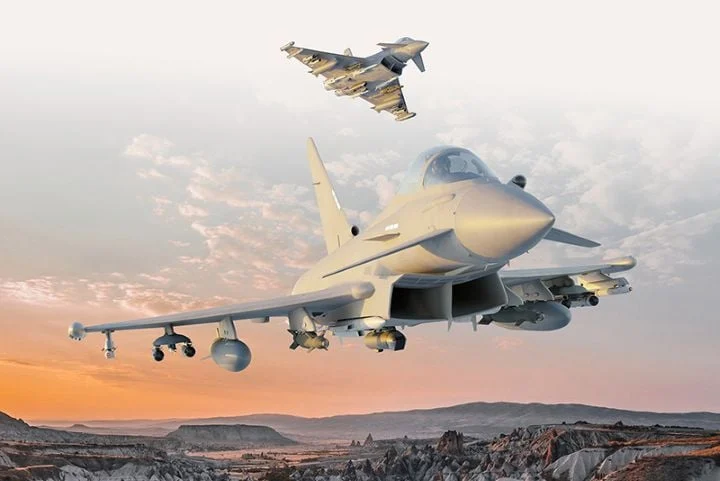
ANKARA — In a move that fundamentally reshapes the geopolitical landscape of the Eastern Mediterranean and signals a tectonic shift in Turkish procurement strategy, the Republic of Turkey has officially signed a £8 billion ($11 billion) contract for the acquisition of 20 Eurofighter Typhoon multirole combat aircraft.
The agreement, finalized on October 27, 2025, represents the first major export success for the four-nation Eurofighter consortium since the 2017 Qatar deal. It also marks a historic departure for the Turkish Air Force (TuAF), which has traditionally relied almost exclusively on American-made platforms for its frontline fighter capabilities. This acquisition is seen as a critical "bridge" strategy as Turkey continues the development of its indigenous fifth-generation fighter, the KAAN, while navigating the complexities of its post-F-35 defense posture.
Main Facts: A New Era for the Turkish Air Force
The $11 billion package is comprehensive, covering not only the initial 20 airframes but also a massive logistics tail, integrated weapons systems, and a multi-year training program for Turkish pilots and ground crews. The aircraft will be built to the latest production standard—likely Tranche 4 or the emerging Tranche 5 configuration—featuring the E-Scan (Active Electronically Scanned Array) radar and an advanced electronic warfare suite.
Key highlights of the deal include:
- Quantity: 20 new-built Eurofighter Typhoons.
- Total Value: Approximately £8 billion ($11 billion USD).
- Configuration: Advanced AESA radar (CAPTOR-E) and integration of both European and indigenous Turkish munitions.
- Strategic Context: This is Turkey’s first acquisition of a European-designed frontline combat aircraft, diversifying a fleet that has been dominated by the Lockheed Martin F-16 for decades.
The deal arrives at a pivotal moment for the Eurofighter consortium—comprising the UK, Germany, Italy, and Spain. For the production lines at BAE Systems in the UK, Leonardo in Italy, and Airbus in Germany and Spain, the Turkish order provides a significant industrial buffer, ensuring the longevity of the assembly lines into the late 2020s.
Chronology: From F-35 Expulsion to European Integration
The road to the Eurofighter deal was paved by nearly a decade of defense procurement friction between Turkey and its NATO allies.
The S-400 Crisis and F-35 Exit (2019–2021)
The genesis of this deal can be traced back to 2019, when Turkey was formally removed from the F-35 Lightning II program following its purchase of the Russian S-400 missile defense system. The expulsion left a "capability gap" in the Turkish Air Force’s long-term planning. While Turkey initially sought to modernize its F-16 fleet, the realization grew that a twin-engine, high-altitude interceptor was needed to maintain parity in the Aegean and Mediterranean theaters.
The Pivot to Eurofighter (2022–2024)
By late 2022, Turkish Defense Minister Yaşar Güler began publicly expressing interest in the Eurofighter Typhoon. However, the path was blocked by diplomatic hurdles, most notably from Germany. Under the consortium’s rules, any export requires the unanimous consent of all four partner nations. Berlin had long expressed reservations regarding Turkey’s military operations in Northern Syria and domestic human rights concerns.
Throughout 2023 and 2024, intensive diplomatic maneuvering led by the United Kingdom’s Ministry of Defence sought to soften Berlin’s stance. The UK argued that Turkey’s role as a NATO bulwark on the southern flank necessitated a modernized air force, especially in light of the shifting security dynamics following the invasion of Ukraine.
The Breakthrough (Early 2025)
The diplomatic deadlock broke in early 2025, following a series of high-level summits in Berlin and London. Germany’s shift in policy was reportedly influenced by Turkey’s support for NATO expansion and a commitment to maritime stability in the Eastern Mediterranean. By mid-2025, the "green light" was given, leading to the rapid finalization of technical specifications and the formal signing on October 27.
Supporting Data: Technical and Financial Breakdown
The $11 billion price tag reflects the "total package" nature of modern defense contracts. When broken down, the cost per flight hour and the life-cycle support indicate a deep integration between the Turkish Air Force and the Eurofighter consortium.
Technical Specifications of the Turkish Typhoon
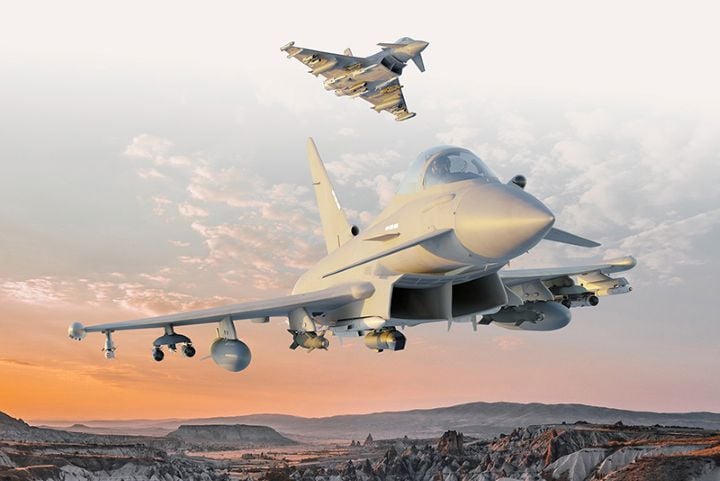
The 20 aircraft destined for Ankara are expected to be among the most advanced Typhoons ever produced. They will feature:
- CAPTOR-E Radar (Mk1/Mk2): Providing superior multi-target tracking and electronic attack capabilities.
- Human-Machine Interface (HMI): A large-area display cockpit, similar to those being integrated for the German Quadriga and Spanish Halcon programs.
- Weaponry Integration: Crucially, the deal includes the integration of Turkish-made stand-off missiles (SOM), the Bozdoğan and Gökdoğan air-to-air missiles, and the Çakır cruise missile. This allows Turkey to maintain its "defense sovereignty" while using a European platform.
Industrial Impact
For the Eurofighter partners, the deal is an economic windfall:
- BAE Systems (UK): As the lead negotiator for the Turkish deal, BAE Systems will see a significant increase in its workload at the Warton and Samlesbury sites.
- Leonardo (Italy): Will benefit from the production of sensors and electronic warfare components.
- Airbus (Germany/Spain): Will provide major aerostructures and engine components through the Eurojet consortium.
The $11 billion investment also includes the construction of a dedicated maintenance, repair, and overhaul (MRO) facility in Turkey, allowing the TuAF to perform deep-level maintenance domestically.
Official Responses: Strategic Alignment
The signing ceremony in Ankara was attended by high-ranking officials from all four consortium nations, signaling a unified front.
Yaşar Güler, Turkish Minister of National Defense:
"Today marks a new chapter in Turkey’s defense history. The Eurofighter Typhoon is a world-class platform that will enhance our operational readiness and provide our pilots with the cutting-edge technology they deserve. This deal is not just about aircraft; it is about a long-term strategic partnership with our European allies."

John Healey, UK Secretary of State for Defence (Representative):
"The UK has always viewed Turkey as an indispensable NATO ally. Bringing the Typhoon to the Turkish Air Force strengthens the interoperability of our forces and ensures that the Eurofighter remains the backbone of European and NATO air defense for decades to come."
Eurofighter Jagdflugzeug GmbH Statement:
"We are honored to welcome Turkey into the Eurofighter family. This contract is a testament to the aircraft’s enduring relevance and its ability to adapt to the most demanding combat environments. We look forward to a long and successful partnership with the Turkish industry."
Implications: Geopolitics and the Future of the Skies
The acquisition of the Eurofighter by Turkey has ripple effects that extend far beyond a simple commercial transaction.
1. The Aegean Balance of Power
For years, the air superiority balance between Turkey and Greece has been a focal point of regional tension. With Greece recently acquiring the French-made Rafale and upgrading its F-16s to the "Viper" standard, Turkey was at risk of losing its qualitative edge. The introduction of the Typhoon—particularly with its superior high-altitude performance and Meteor long-range missiles—effectively resets that balance.
2. NATO Interoperability and Independence
By choosing the Eurofighter, Turkey avoids total reliance on the United States. While the U.S. recently approved a major F-16 modernization package for Turkey, the Eurofighter provides a "Plan B" that is less susceptible to the whims of the U.S. Congress. Simultaneously, since the Typhoon is a NATO-standard aircraft, it ensures that Turkey remains fully integrated into the alliance’s command and control structures.
3. A Bridge to the KAAN
The Turkish aerospace industry is currently pouring billions into the TAI KAAN, its indigenous stealth fighter. However, the KAAN is not expected to reach full operational capability until the early 2030s. The 20 Eurofighters provide a high-end capability that can fill the gap left by the aging F-4E Phantom IIs and older F-16 blocks, ensuring that the Turkish Air Force does not suffer a capability "trough" during the transition to fifth-generation technology.
4. European Defense Consolidation
The deal is a significant win for "Strategic Autonomy" proponents in Europe. It demonstrates that European defense giants can compete with American counterparts (like Boeing’s F-15EX or Lockheed’s F-16) in high-stakes markets. It also suggests a warming of relations between Turkey and the European Union’s major powers, which could lead to further cooperation in areas like naval technology and missile defense.
Conclusion
The $11 billion Eurofighter deal is more than a procurement program; it is a statement of intent. For Turkey, it is an assertion of its role as a regional power capable of diversifying its alliances. For the Eurofighter consortium, it is a validation of a 30-year-old program that continues to evolve. As the first of these 20 aircraft begin to roll off the assembly lines, the skies over the Eastern Mediterranean are set to become the playground of one of the world’s most sophisticated multirole fighters, marking a definitive end to Turkey’s period of "procurement isolation."
