While the broader mandates of the European Union’s Cyber Resilience Act (CRA) are frequently framed as a comprehensive compliance milestone for December 2027, a critical, high-stakes deadline looms much sooner. On September 11, 2026, the regulatory landscape for manufacturers operating within the European market will fundamentally shift. From this date, the CRA’s mandatory reporting obligations go into effect, requiring companies to disclose actively exploited vulnerabilities and severe security incidents through the European Union Agency for Cybersecurity (ENISA) Single Reporting Platform (SRP).
For manufacturers of hardware and software with digital elements—ranging from consumer IoT devices and industrial controllers to semiconductors and mobile applications—this is not merely a bureaucratic hurdle. It is an operational imperative that requires immediate institutional preparation. The 24-hour "early warning" window mandated by the EU leaves zero room for the slow, multi-layered approval processes that characterize many modern corporate structures.
The Scope: Who Must Comply?
The CRA’s reach is broad, designed to cover any product with a network or data connection that is sold within the EU. Importantly, this includes both new products and "legacy" devices already on the market prior to the December 2027 full-application date. If a product is sold in the EU and possesses digital elements, it is subject to the reporting requirements. This encompasses:
- Consumer Products: Smart home devices, wearables, and connected appliances.
- Industrial and Networking Devices: Operational technology (OT), routers, gateways, and industrial IoT.
- Software: Desktop applications, mobile apps, and embedded firmware.
- Semiconductors: Integrated circuits that power these connected systems.
For organizations still questioning whether their product portfolio falls under this umbrella, the primary test is simple: Does the product connect to a network or exchange data? If the answer is yes, the organization must be prepared to interface with the SRP by September 2026.
Chronology of Obligation: The Reporting Timeline
The CRA imposes a rigorous, tiered reporting structure. When an actively exploited vulnerability or a severe incident is identified, the manufacturer must adhere to a strict countdown. The clock begins ticking the moment the manufacturer becomes "aware" of the issue, regardless of whether a full root-cause analysis has been performed.

Actively Exploited Vulnerabilities
- Early Warning (24 Hours): A preliminary alert must be filed via the SRP, detailing the nature of the exploited vulnerability and listing all EU member states where the affected product is available.
- Notification (72 Hours): A more detailed report is required, including the affected product versions, the nature of the exploit, initial mitigating actions, and instructions for users to protect their systems.
- Final Report (14 Days after remediation): A comprehensive account detailing the vulnerability, the severity of the impact, information regarding the malicious actors involved, and the final corrective measures implemented.
Severe Incidents
- Early Warning (24 Hours): Similar to the vulnerability report, this is a high-level alert notifying authorities of the incident’s occurrence and geographical scope.
- Notification (72 Hours): This submission must include an initial assessment of the incident, the corrective measures taken thus far, and specific guidance for end-users.
- Final Report (One Month after notification): A deep-dive analysis covering the root cause, a full impact assessment, and a detailed description of all mitigation strategies deployed to resolve the situation.
Supporting Data and Operational Reality
The primary challenge for most manufacturers is not the act of reporting, but the internal speed required to gather the necessary data. Most corporations are accustomed to lengthy security review boards and legal consultations. However, the 24-hour window for an "Early Warning" makes such a workflow impossible.
To meet these requirements, companies must transition from a reactive posture to a "readiness-first" model. This involves identifying in-scope products, designating authorized personnel who can trigger a report without waiting for executive sign-off, and creating pre-approved templates that ensure consistency and accuracy under pressure.
Seven Steps to Achieving Compliance Readiness
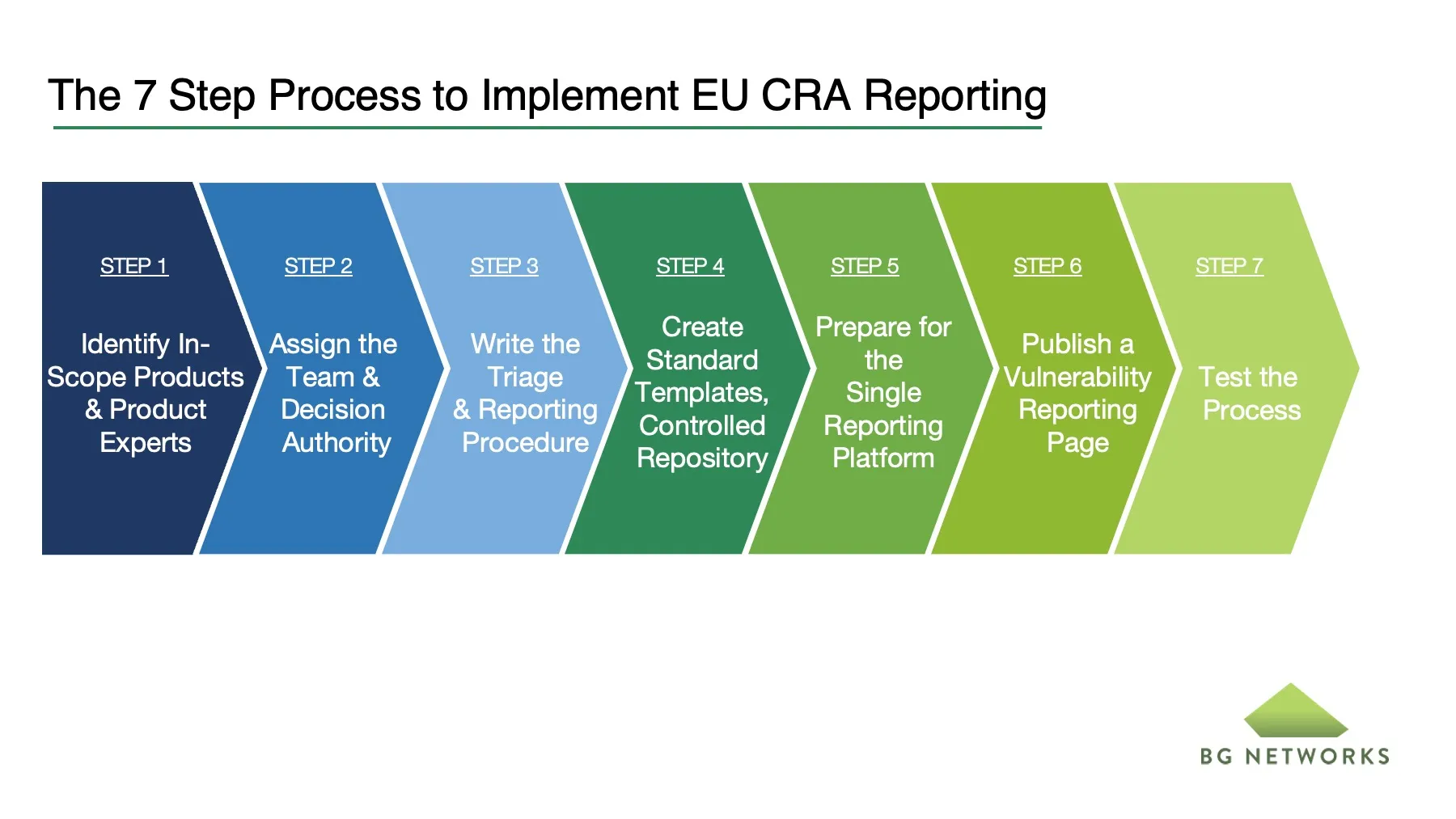
To ensure the organization is prepared by September 11, 2026, manufacturers should follow this seven-step roadmap:
1. Catalog In-Scope Products and Expertise
Compliance begins with an exhaustive inventory. You cannot report what you haven’t mapped. For every product, maintain an up-to-date registry of internal experts who understand the product’s architecture and can perform a rapid security assessment.
2. Assign Decision Authority
Do not let the "statutory clock" outrun your bureaucracy. Appoint a dedicated cross-functional team, including security engineers, product managers, and legal counsel. Grant this team the pre-authorized power to submit reports to the SRP without waiting for a lengthy chain of executive approvals.

3. Formalize Triage Procedures
Create a clear, documented process for how intelligence—from internal security testing or external reports—is triaged. This procedure must identify the specific Computer Security Incident Response Team (CSIRT) in the relevant member state, as this is where the primary coordination will occur.
4. Develop Standard Templates
Do not waste precious hours drafting reports from scratch. Create standardized templates that map directly to the fields required by the ENISA SRP. This ensures that the information provided is consistent, complete, and compliant with EU expectations.
5. Master the Single Reporting Platform (SRP)
The SRP is the official gateway for all submissions. Manufacturers must ensure their designated representatives have active "EU Login" credentials and have thoroughly rehearsed the submission process. Familiarity with the interface is vital to avoiding last-minute technical errors during an actual crisis.
6. Implement a Vulnerability Disclosure Policy
Establish a clear, public-facing channel for security researchers and customers to report vulnerabilities. While the full requirement for a Coordinated Vulnerability Disclosure (CVD) policy is a 2027 mandate, implementing it now serves as a "fail-safe" mechanism to ensure that security intelligence reaches your team before it reaches the public.
7. Conduct Tabletop Exercises
Theory is no substitute for practice. Conduct a mock incident exercise—a "tabletop drill"—to simulate an active exploitation event. This will reveal gaps in your communication channels, identify bottlenecks in your decision-making, and ensure your team is mentally and operationally prepared for the pressure of the 24-hour deadline.

The Implications for Global Manufacturers
The implementation of the EU CRA signals a global shift in product security accountability. Manufacturers can no longer treat cybersecurity as a "set-and-forget" feature. By mandating transparency and speed, the EU is forcing the industry to treat digital product security with the same rigor as physical safety.
Failure to comply with these reporting requirements carries significant risks. Beyond the potential for regulatory fines and sanctions, a failure to report accurately and on time can result in reputational damage and the loss of the "CE" mark, effectively barring the product from the European market.
Conclusion: Preparation is the Only Strategy
The September 11, 2026, deadline is a watershed moment for the tech and manufacturing sectors. It demands a shift in culture, process, and technology. Organizations that treat this as a "registration" task—simply opening an account on an EU portal—will find themselves woefully underprepared when a real-world incident occurs.
True readiness requires the development of a robust, repeatable, and cross-functional incident response machine. By identifying in-scope products now, formalizing triage workflows, and training the team through simulation, manufacturers can turn a complex regulatory burden into a competitive advantage. In the evolving digital economy, those who can demonstrate transparency, speed, and integrity in the face of security threats will be the ones that earn the lasting trust of their customers and the regulatory authorities alike.