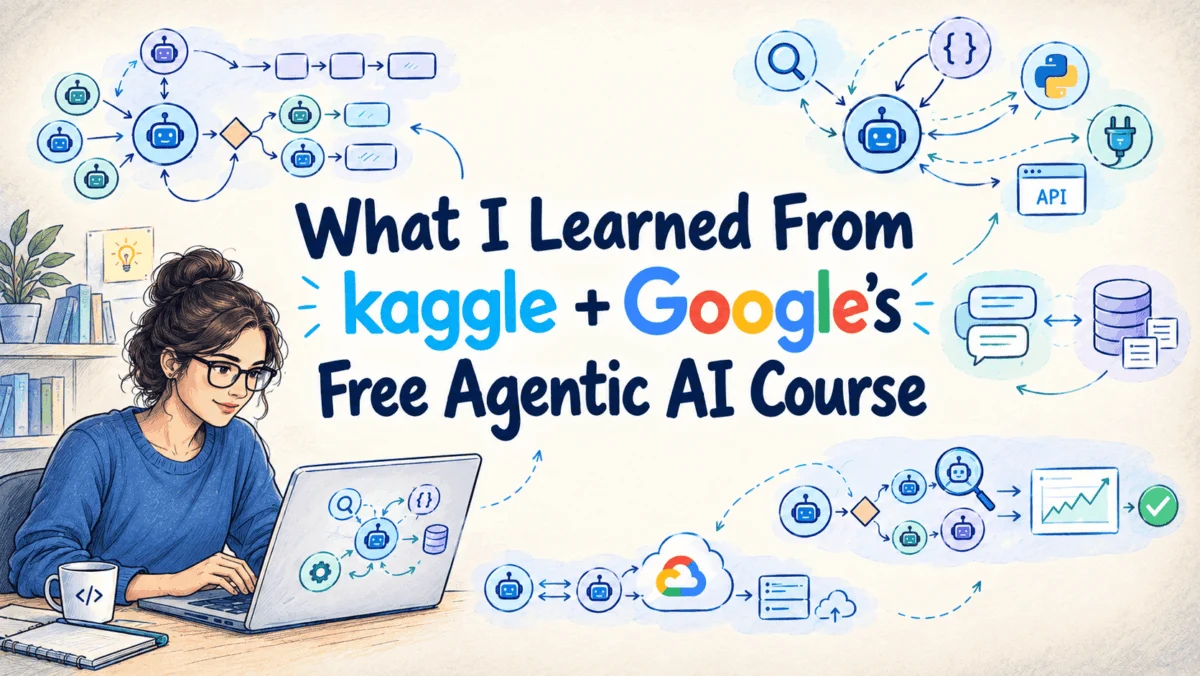
In the rapidly shifting landscape of artificial intelligence, the industry is moving beyond the simple "chat-and-respond" paradigm toward a more sophisticated frontier: Agentic AI. Unlike standard Large Language Models (LLMs) that provide static answers to single prompts, AI agents function as dynamic operators. They reason through problems, execute multi-step workflows, utilize external tools, and iterate based on the feedback they receive from their environment.
To bridge the gap between theoretical potential and practical implementation, Google and Kaggle recently collaborated to launch the 5-Day AI Agents Intensive Course. Originally debuted as a live series, this comprehensive curriculum is now available as a free, self-paced resource, offering developers a roadmap to building robust, agentic systems using Google’s Agent Development Kit (ADK).
The Paradigm Shift: From Chatbots to Agents
For many developers, the journey into AI begins with a standard API call: Input prompt, receive completion. However, building an agent introduces a critical "loop" architecture. In this loop, a model does not just output text; it performs a deliberate cycle: it identifies an action, triggers a tool, interprets the tool’s output, and determines the subsequent step.
This architecture introduces fundamental engineering challenges: How does the agent maintain state across turns? How can we ensure the agent selects the correct tool from a vast library? And crucially, how do we transition these systems from a local Jupyter notebook to a production-grade, persistent environment? The Kaggle-Google course systematically addresses these questions through a blend of whitepapers, hands-on codelabs, and architectural theory.
Chronology: A Five-Day Deep Dive into Agentic Workflows
The course is structured to guide learners from basic concepts to full-scale deployment, mirroring the actual lifecycle of an enterprise AI project.
Day 1: Foundations and Architectural Design
The curriculum begins by defining an agent as a modular bundle consisting of a name, a model, specific behavioral instructions, and a suite of tools. The initial sessions explore how to move from a single prompt to a functional "runner."
As complexity grows, developers are taught to move away from monolithic agents toward decentralized systems. The course introduces various design patterns:
- Sequential Pipelines: Agents pass outputs linearly, ideal for tasks requiring a fixed, predictable order.
- Parent-Sub-Agent Systems: A "manager" agent delegates specific sub-tasks to specialized agents.
- Parallel Branching: Systems that execute multiple processes simultaneously to increase efficiency.
Day 2: Tooling and Execution Best Practices
An agent’s utility is defined by its ability to interact with the world. The course covers four primary categories of tools:
- Built-in Tools: Pre-configured capabilities like Google Search.
- Function Tools: Custom Python functions wrapped to extend the agent’s reach.
- Agent Tools: Allowing one agent to invoke another, enabling hierarchical delegation.
- MCP (Model Context Protocol) Tools: Standardized connectors that allow agents to interface with external services without needing bespoke client code.
A critical takeaway here is the "Description-First" approach. Because models rely on docstrings and type hints to determine when to call a function, the quality of the tool’s metadata is the single biggest factor in reducing execution errors.
Day 3: The Architecture of Memory
LLMs are stateless by design; they possess no "long-term" memory of their own. The course introduces a two-tier memory architecture managed by the ADK:
- Short-Term Memory (Session): Manages the immediate conversation history, essential for maintaining context in a single interaction.
- Long-Term Memory (Persistent): Uses memory services to retrieve facts across different sessions.
The course distinguishes between Reactive Retrieval (where the agent searches when it deems necessary) and Proactive Retrieval (where the system fetches relevant data before the model even receives the prompt). Choosing between these modes is a balancing act between token costs and the depth of context required.
Day 4: Observability and the Quality Loop
Because agents are non-deterministic, they can deviate from expected paths. The course argues that quality must be an intrinsic design feature rather than an afterthought. Using logs, traces, and metrics, developers can visualize the "path" an agent takes. Evaluation isn’t just about the final answer; it is about the process. An agent that succeeds but consumes excessive tokens or calls unnecessary tools is technically a failure in a production environment.
Day 5: Scaling and Deployment
The final stage of the curriculum focuses on moving beyond the local notebook. It introduces the Agent2Agent (A2A) protocol, which allows disparate agents—regardless of the language they were built in (Python, Go, or Java)—to communicate and exchange data. The course concludes with deployment strategies on Vertex AI, emphasizing CI/CD pipelines to ensure that agents remain reliable and scalable after they go live.
Supporting Data and Technical Implications
The shift toward Agentic AI has significant implications for how organizations allocate technical resources. According to the insights shared in the course, the transition requires a change in how we measure "model success."
| Metric | Traditional LLM Focus | Agentic AI Focus |
|---|---|---|
| Success Criteria | Accuracy of text completion | Accuracy of process/path execution |
| Context | Single-turn token window | Multi-turn session + long-term memory |
| Tooling | Minimal/None | Extensive (API integrations, MCP) |
| Debugging | Prompt tuning | Tracing, observability, and state-checks |
The implication for developers is clear: technical expertise in Python is no longer enough. Proficiency in structured data, API management, and distributed systems is becoming the new baseline for building functional AI agents.
Official Perspectives: The Role of the ADK
Google’s decision to open-source the Agent Development Kit (ADK) is a strategic move to standardize the "agentic" developer experience. By providing a framework that handles the heavy lifting of state management, memory, and tool invocation, Google allows developers to focus on higher-level logic rather than the underlying plumbing of LLM interactions.
The inclusion of the Model Context Protocol (MCP) within the course is particularly noteworthy. By supporting an industry-wide standard for how AI models connect to data sources, Google is signaling that the future of agentic AI is interoperable. Organizations that adopt these standards now will likely find it easier to integrate future, more capable models without having to rewrite their core agent infrastructure.
Future Outlook: The Road Ahead
The 5-Day AI Agents Intensive serves as more than just a tutorial; it acts as a foundational document for the next era of software development. As agents become more prevalent, the "Human-in-the-loop" concept will evolve. The course emphasizes that for long-running or high-stakes tasks, human approval mechanisms are not just recommended—they are a mandatory safety feature.
For those looking to transition from basic prompt engineering to building complex systems, this course provides the perfect entry point. It demystifies the buzzwords and replaces them with a concrete, code-heavy methodology. Whether you are an experienced machine learning engineer or a developer looking to integrate AI into existing products, the tools and frameworks provided in this curriculum represent the current state-of-the-art in agentic design.
Further Learning Resources
For developers ready to take the next step, the following resources are recommended:
- Agent2Agent Protocol Documentation: Understanding the communication standards for future AI ecosystems.
- Model Context Protocol (MCP): Essential for connecting agents to live data and enterprise tools.
- Google Cloud Vertex AI Documentation: Deep dives into deploying agentic systems at scale.
The age of the static chatbot is ending. The era of the agentic workflow has begun. By mastering these foundational concepts today, developers can ensure they remain at the forefront of this technological transformation.