The landscape of Artificial Intelligence has undergone a seismic shift. Eighteen months ago, the debate between open-source and proprietary Large Language Models (LLMs) was largely theoretical, often defined by a stark trade-off: choose the sheer, unrivaled intelligence of proprietary frontier models or accept the "good enough" performance of open-weight alternatives in exchange for control.
In 2026, that binary choice has dissolved. As the capability gap between open-weight powerhouses and proprietary APIs continues to narrow, the decision-making process for data scientists and MLOps engineers has transitioned from a philosophical preference to a rigorous, multi-variable engineering challenge.
The Current State of the LLM Landscape
To navigate this terrain, one must first distinguish between the two primary delivery models. "Open-weight" models—such as Meta’s Llama 4, DeepSeek V3/R1, and Alibaba’s Qwen 3.5—provide the model weights publicly, allowing for local hosting, fine-tuning, and granular control. Conversely, proprietary models like OpenAI’s GPT-5, Anthropic’s Claude, and Google’s Gemini exist behind managed APIs, where the provider assumes the burden of infrastructure, scaling, and continuous updates.
A Chronology of Convergence
- Early 2023: Proprietary APIs dominate; open-source models are primarily experimental and restricted to hobbyists or niche R&D.
- Late 2024: The "Mixture of Experts" (MoE) architecture revolutionizes efficiency. Open-weight models achieve near-parity on standard benchmarks for coding and summarization.
- Mid 2025: Hosted inference providers (e.g., Together AI, Groq) emerge as a "middle-ground" infrastructure layer, lowering the barrier to entry for self-hosting.
- 2026: The era of "fit-for-purpose." Open-weight models are now production-grade for 80% of enterprise use cases, while proprietary models continue to hold the high ground in ultra-complex, multi-step agentic reasoning.
The Four-Pillar Decision Framework
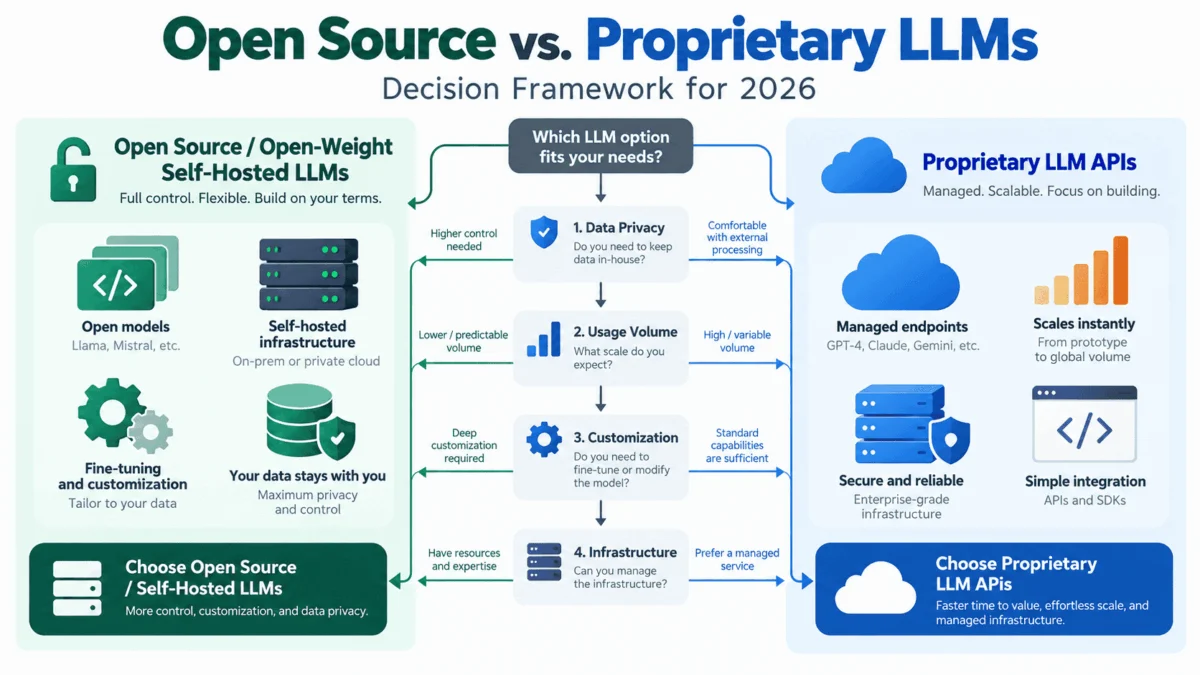
For technical leaders, the path forward is illuminated by four critical questions. These factors should dictate your architecture, rather than the latest social media benchmarks.
1. Data Sovereignty and Compliance
The most common bottleneck is not compute—it is legal. If your organization handles sensitive data—specifically clinical records (HIPAA), financial transaction histories, or classified government information—sending data to a third-party API is often a non-starter.
In these instances, the decision is binary. You must utilize open-weight models within a private cloud or on-premise infrastructure. This ensures that the data never leaves your secure perimeter. For these organizations, self-hosting is not a preference; it is a regulatory mandate.
2. The Economics of Scale: Usage Volume
The financial modeling for LLMs in 2026 has shifted dramatically. With API costs dropping roughly 80% since early 2023, the threshold for self-hosting has risen.
- Low Volume (<1M tokens/month): Proprietary APIs are the gold standard. The cost of maintaining a GPU cluster, hiring MLOps talent, and managing security patches outweighs the marginal savings of hosting your own model.
- Medium Volume (1M–10M tokens/month): This is the sweet spot for hosted open-model APIs. By leveraging platforms like Groq or Replicate, you gain the benefits of open-weight models—lower inference costs and architectural flexibility—without the overhead of managing hardware.
- High Volume (>10M tokens/month): Self-hosting becomes the clear economic winner. At this scale, the massive reduction in per-token costs justifies the capital expenditure of dedicated GPU infrastructure.
3. The Customization Imperative
Proprietary models offer "fine-tuning," but they maintain ownership of the resulting model weights. For companies needing to integrate proprietary, domain-specific terminology—such as legal jargon, specialized engineering schematics, or niche financial taxonomy—open-weight models are superior.
Owning the weights allows for deep, iterative fine-tuning that is not beholden to the constraints of an API provider’s terms of service. If your competitive advantage lies in your data, you should be training on your own infrastructure.
4. Operational Capacity and MLOps Maturity
Infrastructure capacity is the "hidden" cost of the open-weight movement. Running a production-grade LLM requires a robust serving stack—vLLM, Ollama, and specialized monitoring tools. If your team lacks the expertise to manage GPU provisioning, auto-scaling, and model drift, self-hosting will become a source of technical debt. If you lack the infrastructure, utilize the hosted middle-path.
Analyzing the Market Players
The Open-Weight Titans
- Llama 4 (Meta): Continues to set the industry standard. The introduction of a 10-million-token context window makes it a powerhouse for long-form document analysis.
- DeepSeek V3/R1: The benchmark for mathematical and logical reasoning. Its MIT licensing makes it arguably the most accessible choice for high-end reasoning tasks.
- Qwen 3.5 (Alibaba): Currently leading in multilingual performance and general-purpose reasoning. Its Apache 2.0 license ensures a smooth path for commercial integration.
- Mistral: Optimized for efficiency. Its smaller models (Mistral Small) are highly effective for GDPR-compliant EU deployments.
The Proprietary Giants
- GPT-5 (OpenAI): The undisputed king of ecosystem integration. If your stack is built on OpenAI’s SDKs, the friction of switching is high, but the convenience is unmatched.
- Claude (Anthropic): Renowned for its 200K context window and superior performance in nuances of tone and safety-critical tasks.
- Gemini (Google): The primary choice for organizations heavily invested in the Google Cloud/Vertex AI ecosystem, offering seamless integration with existing data pipelines.
Implications for Strategy
The Risk of Vendor Lock-in
Many organizations fall into the trap of "API-native" development, building their entire application layer around the specific quirks and memory structures of one provider. This is a strategic error. To mitigate risk, treat the LLM as a pluggable component. Keep your prompt templates model-agnostic and ensure your data pipelines can pivot between APIs and local models with minimal refactoring.
The Myth of "Free" Open Source
It is essential to clarify that "open-weight" is not synonymous with "free." When you calculate the total cost of ownership (TCO), you must account for GPU compute, engineering hours for model maintenance, and the security overhead of hardening your own API endpoints. For many firms, the perceived savings of open-source are quickly eroded by the cost of maintaining the underlying infrastructure.
The Hybrid Future
The most sophisticated engineering teams are not choosing one or the other—they are adopting a hybrid strategy. This involves routing simple, high-volume tasks (such as sentiment analysis or basic summarization) to cost-effective, self-hosted open-weight models, while reserving high-latency, frontier-tier proprietary APIs for complex, agentic chains that require the highest possible reasoning capabilities.
Conclusion: Engineering for Longevity
The 2026 decision framework is clear: stop chasing the latest headline benchmark and start auditing your specific requirements. If you are in a highly regulated industry, prioritize data sovereignty through self-hosting. If you are a startup prioritizing iteration speed, lean into proprietary APIs. If you are an enterprise at scale, build a robust MLOps practice to leverage the economic advantages of the open-weight ecosystem.
As LLM pricing continues its downward trend and performance converges, the "best" model will increasingly be defined not by a leaderboard, but by how well it fits into your existing architecture, compliance protocols, and budget. The era of the "one-size-fits-all" model is over; the era of strategic, context-aware deployment has begun.
Vinod Chugani is an AI and data science educator focusing on the intersection of agentic AI and practical enterprise application. His work emphasizes building sustainable, scalable AI architectures that prioritize long-term value over short-term trends.