
For the better part of a decade, the corporate world has been swept up in a surge of environmental, social, and governance (ESG) reporting. The prevailing theory, long championed by institutional investors and civil society watchdogs, is that transparency drives accountability. If a company lays bare its carbon footprint, supply chain ethics, and labor practices in a glossy annual sustainability report, stakeholders can exert pressure, capital can be allocated more efficiently toward sustainable firms, and corporate behavior will—by necessity—evolve.
However, a groundbreaking new study from the University of Chicago Law School is challenging this core assumption. By leveraging large language models (LLMs) to analyze more than 15,000 disclosures from 2,100 large companies, researchers have uncovered a troubling trend: while the volume of sustainability reporting is skyrocketing, the actual utility of these documents may be in decline. Instead of becoming more precise and data-driven, modern ESG reports are increasingly characterized by what researchers call a "fluff ratio"—a high concentration of vague, aspirational, and ultimately meaningless corporate jargon.
The Fluff Era: A Quantitative Analysis of Corporate Vague-speak
To understand the scope of the problem, researchers led by Hajin Kim at the University of Chicago Law School developed a methodology to categorize the content of sustainability reports. They utilized an LLM to scan thousands of disclosures, tracking the adoption of established reporting frameworks—such as the Global Reporting Initiative (GRI), the Sustainability Accounting Standards Board (SASB), and CDP—and measuring the specificity of the language used.
The study’s most innovative metric is the "fluff ratio." This is calculated by taking the total number of sentences that are either vague or entirely devoid of actionable meaning—such as "Our aim is to be a leader in the industry" or "We are committed to building a sustainable future"—and dividing that by the total number of sentences in the document.
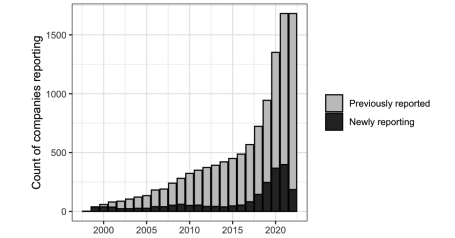
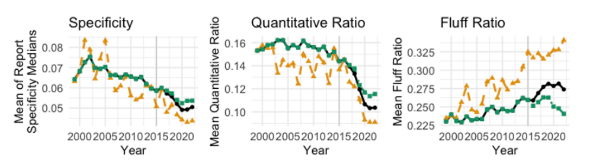
The findings suggest that the industry is experiencing a "hollow boom." Since 2015, there has been a massive surge in the number of companies publishing sustainability reports. Simultaneously, there has been a rapid adoption of standardized reporting frameworks. On the surface, this looks like a triumph for transparency. But when the researchers stripped away the branding, they found that this rush of interest brought uneven benefits. In many cases, as reports grew longer, they became less quantitative, less specific, and significantly "fluffier."

A Chronology of Disclosure: From Silence to Saturation
The trajectory of corporate disclosure over the last twenty years can be broken down into three distinct phases.
Phase 1: The Voluntary Frontier (Pre-2015)
In the early 2000s, sustainability reporting was the domain of the environmentally conscious outlier. Only a handful of companies produced reports, and those that did were often driven by genuine internal ESG initiatives or pressure from niche advocacy groups. Because these reports were not yet part of a massive, standardized industry, they were often highly specific and focused on unique operational challenges.
Phase 2: The Standardization Surge (2015–2020)
The 2015 Paris Agreement served as a catalyst for the mainstreaming of ESG. As institutional investors began to demand climate-related financial risk assessments, companies flocked to organizations like the GRI and SASB to provide a "template" for their disclosures. This period saw an exponential increase in the number of companies reporting, as businesses sought to avoid the reputational risk of being the only firm on the block without a sustainability strategy.
Phase 3: The Era of "Disclosure Inflation" (2020–Present)
The current era is defined by a mismatch between quantity and quality. The University of Chicago study reveals that while the number of reporters has plateaued at a high level, the nature of the reports has shifted. The pressure to produce a report every year has arguably led to "boilerplate" content. Companies are now churning out massive, professionally designed documents that satisfy the check-the-box requirements of reporting frameworks while avoiding the disclosure of sensitive or unfavorable data.
The Data Gap: Why More Text Doesn’t Mean More Truth
The study highlights a stagnation in report quality. While early reporters tend to produce more concrete reports than companies just entering the space, the researchers found that neither group is showing a marked improvement in the specificity of their disclosures over time.
The researchers note that "fluff shows improvement" in some veteran reporters—meaning they are getting better at avoiding the most egregious "puffery"—but this is not the same as becoming more transparent. A company might cut down on empty platitudes about "being a leader" only to replace them with dense, technocratic descriptions of their governance processes that fail to provide actual performance metrics.
For investors, this creates a "needle in a haystack" problem. The data is often buried under layers of narrative. As the study suggests, voluntary regimes that rely solely on adoption are failing to move the needle on substantive, actionable change. Without a firmer agreement on what high-quality, topic-specific disclosure looks like, the market is being flooded with "noise" that masks actual corporate performance.
The Counter-Perspective: A Defense of Narrative
Not all experts are convinced that the rise in narrative text is inherently negative. Maximilian Müller, a financial accounting expert at the University of Cologne, offers an alternative explanation for the "fluff" detected by the University of Chicago team.
Müller argues that the increase in narrative content relative to "hard numbers" is a natural byproduct of complexity. As companies are forced to disclose more information across a wider range of ESG topics—from Scope 3 emissions to biodiversity impact—the context required to interpret that data grows exponentially.
"The concern is not necessarily that hard information is disappearing," Müller notes. "Rather, the concern is that the hard information is becoming increasingly difficult to find amid a faster-growing layer of narrative."
According to Müller, the evolution of the sustainability report is akin to the evolution of the annual financial report. A modern 10-K filing is significantly longer than one from forty years ago, not because the numbers are "fluffier," but because accounting standards require more detailed explanations of methods, assumptions, and risk factors. The critical question, Müller posits, is not whether the reports are wordy, but whether the increasing volume of information is presented in a way that is clear, comparable, and useful to the end-user.
Implications for Investors and Policymakers
The University of Chicago study carries profound implications for the future of ESG regulation. If the current voluntary regime is yielding diminishing returns in terms of information quality, policymakers may be forced to shift toward mandatory, standardized disclosure requirements.
1. The Death of the "Check-the-Box" Culture
The study suggests that current frameworks are too permissive. By allowing companies to pick and choose which metrics to report, the frameworks inadvertently encourage "greenwashing" through omission. Future regulations will likely need to mandate the disclosure of specific, standardized data points—such as verified carbon intensity or specific labor metrics—to prevent companies from hiding behind long-winded, non-quantifiable narratives.
2. The Role of Technology in Auditing
As LLMs become more sophisticated, they will change the landscape of corporate accountability. Just as researchers used AI to identify "fluff," investors and regulators will soon use these tools to audit thousands of reports in real-time. Companies that continue to rely on vague, PR-driven language may find their reports flagged by automated systems, leading to a "transparency discount" on their stock price.
3. Toward a New Standard of Materiality
The debate over report quality ultimately forces a conversation about materiality. What actually matters to an investor? Is it a 100-page report filled with stock photography and mission statements, or a three-page table of hard data? The findings from the University of Chicago suggest that the market is currently experiencing a glut of the former and a scarcity of the latter.

Conclusion: A Call for Substance
The sustainability report was born of a desire for corporate transparency, but it is in danger of becoming a victim of its own success. When every company feels compelled to report on every ESG metric, the incentive to provide truly meaningful, comparative data is often outweighed by the desire to project a positive brand image.
The University of Chicago’s research serves as a wake-up call for the ESG industry. Voluntary frameworks, while essential for the initial adoption of sustainability goals, are now reaching their limit. To move from "fluff" to "substance," the industry requires a new generation of disclosure standards—ones that prioritize quantitative, audited, and comparable data over the narrative-heavy documents that currently define the status quo.
As the pressure for corporate accountability grows, the companies that will thrive are those that recognize a simple truth: in an era of information overload, clarity is the ultimate competitive advantage. Those who hide behind the fluff will eventually be exposed, not by their competitors, but by the very data they pretend to provide.