For years, the corporate world has viewed Synthesia through a singular lens: the pioneer of AI-generated video training. By allowing enterprises to replace expensive film crews and studio rentals with digital avatars that could speak any language, the British startup fundamentally disrupted the corporate educational market. However, as the initial novelty of generative AI gives way to a demand for measurable Return on Investment (ROI), Synthesia is evolving.
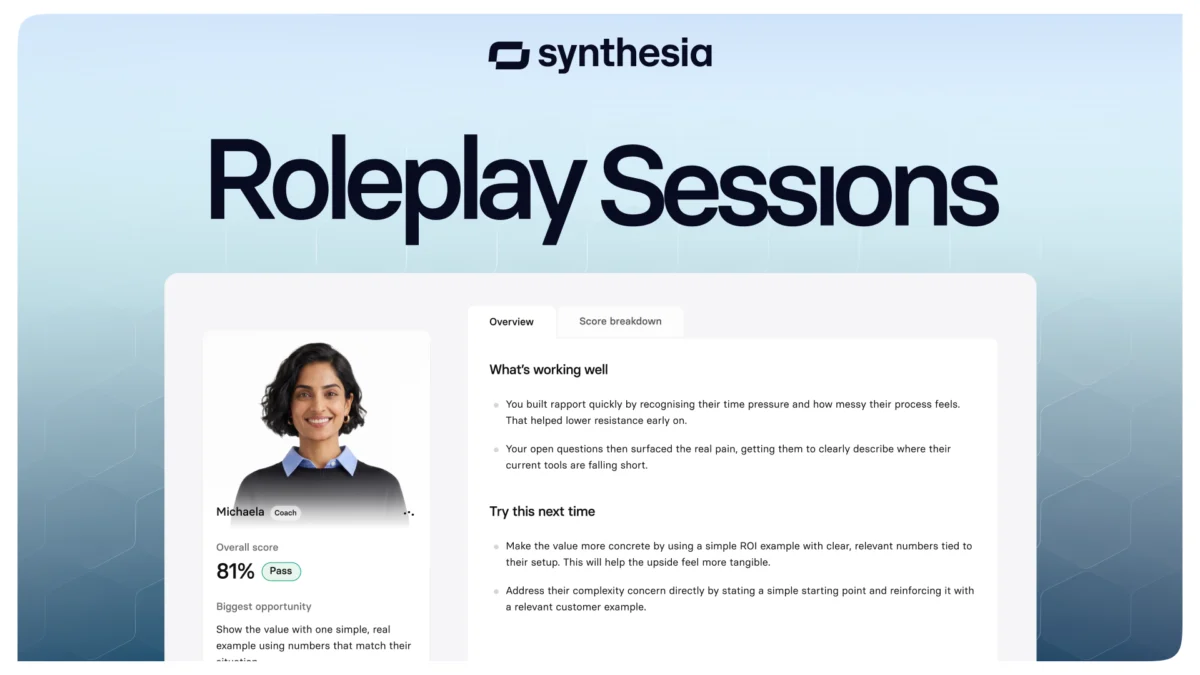
On Wednesday, the company unveiled "Roleplay Sessions," an interactive training product that marks a significant departure from passive content delivery. By facilitating high-stakes, real-time conversations between employees and AI avatars, Synthesia is signaling that the true value of enterprise AI lies not in the creation of content, but in the measurement of human performance.
The Core Offering: From Passive Learning to Active Mastery
The premise behind Roleplay Sessions is simple yet profound: employees learn better by doing than by watching. Traditionally, corporate training has relied on static videos, text-based modules, or, at best, cumbersome in-person role-playing workshops that are difficult to scale and notoriously difficult to track.
Synthesia’s new platform allows employees to engage in simulated high-stakes interactions—such as complex sales pitches, sensitive performance reviews, or de-escalating customer complaints. The AI avatar does not merely recite a script; it is programmed to push back, offer counterarguments, and react dynamically to the employee’s input.
Once the interaction concludes, the system evaluates the employee against a customized rubric, providing immediate feedback. This transition from "informational" to "experiential" learning addresses a chronic gap in professional development: the inability to bridge the chasm between understanding a concept and applying it under pressure.
Chronology: The Evolution of a Unicorn
To understand the weight of this launch, one must look at the trajectory of Synthesia’s ascent:
- The Early Years (Foundational AI): Synthesia established itself by solving a cost-efficiency problem. Enterprises needed training materials in dozens of languages; Synthesia provided the tools to generate those videos in minutes rather than weeks.
- The Scaling Phase (Valuation Surge): As the company refined its proprietary avatar and voice technology, it secured a $4 billion valuation, signaling massive market confidence in its ability to dominate the enterprise video space.
- The "Sessions" Pivot (January 2026): Synthesia began signaling a move beyond video. The company envisioned a broader "Sessions" platform that would not just provide video content, but serve as a comprehensive interface for human-AI interaction.
- The Launch of Roleplay (Current Day): With the introduction of Roleplay Sessions, the company officially enters the performance-management sector. Future roadmap items—exclusively reported by TechCrunch—include expanding this technology into high-volume sectors like candidate screening and automated job interviews.
Supporting Data: Why Enterprises Are Demanding More
The launch of Roleplay arrives at a critical juncture for the AI industry. CFOs and IT directors are no longer blindly funding "AI initiatives." There is a growing, industry-wide skepticism regarding whether the current wave of AI spending is yielding tangible business outcomes.
Synthesia’s strategic pivot is backed by a compelling meta-analysis of learning research. The core argument is that passive content consumption—the bread and butter of traditional e-learning—rarely leads to long-term behavioral change. When an employee watches a video on "how to handle a difficult client," they are absorbing information. When they are forced to negotiate with an AI that mimics that client’s resistance, they are building a skill.
According to company data, early adopters include major European market-cap leaders and some of the world’s largest recruitment firms. These organizations are using the platform specifically to identify "talent gaps." By aggregating the data from thousands of roleplay sessions, managers can now pinpoint exactly where a sales team struggles or where leadership candidates lack specific soft skills, providing a level of granular oversight that was previously impossible.
Official Responses and Strategic Vision
Victor Riparbelli, CEO and co-founder of Synthesia, frames the shift as a necessary maturation of the enterprise AI market. In an exclusive interview, he emphasized that the goal is to shift the conversation from "cool technology" to "business metrics."
"Video performs way better than text or sending out a document," Riparbelli stated. "But for most things, we learn the best by actually practicing something rather than just reading it."
Riparbelli’s vision for the company is clear: move away from being viewed as a "video generation" tool and toward being recognized as a "performance management" platform. By integrating rubrics, performance analytics, and behavioral data, Synthesia is effectively building a dashboard for human competency.
"From a managerial executive layer, we’re seeing huge interest in mapping out the talent in their company in a way that’s been really difficult to do before," he noted. "If you have your entire sales team practice with an AI role player, you can get very granular data on how your sales force is doing overall."
Implications: The Future of the Workplace
The launch of Roleplay Sessions has significant implications for both the enterprise software market and the future of professional training.
1. The Rise of the "Performance-First" AI
Synthesia is carving out a new category. While other AI companies focus on chatbots or document analysis, Synthesia is focusing on the "front end" of human interaction. By positioning itself as a coach, it becomes indispensable to the enterprise. The software is no longer just a library of training assets; it is an active participant in the employee’s development.
2. A More Defensible Competitive Moat
Synthesia’s business model is becoming significantly more robust. While the underlying "reasoning" intelligence (the brain of the AI) is powered by OpenAI, Synthesia’s moat lies in its proprietary avatar technology, its deep integration into corporate workflows, and the massive amount of performance data it is beginning to collect. By adding a layer of analytics and rubrics, they are creating a "sticky" product that is far harder for a competitor to replicate than a simple video generator.
3. Democratizing Training
While currently an enterprise-exclusive offering, the implications for smaller businesses are profound. As inference costs continue to decline, Synthesia plans to push this technology down-market. In the near future, a small business owner could have access to the same sophisticated sales-coaching technology as a Fortune 100 firm. Furthermore, the potential expansion into educational institutions could fundamentally change how students prepare for the workforce, moving from textbook-based learning to simulation-based mastery.
4. The Shift in AI Evaluation
Finally, the industry is witnessing a shift in how AI success is measured. The "social media demo" era—where AI companies competed to see who could generate the most impressive, flashy video—is waning. In its place, we are entering the "outcomes" era. Synthesia’s pivot is an acknowledgment that in the corporate world, the only metric that truly matters is whether the investment results in a more skilled, efficient, and capable workforce.
Conclusion: A New Chapter for Synthesia
Synthesia’s move into Roleplay Sessions is more than a product update; it is a declaration of intent. By moving from the screen to the conversation, the company is positioning itself at the center of the enterprise performance ecosystem. As businesses continue to search for ways to justify their AI budgets, tools that can prove, measure, and improve human capability will likely command the most value.
Whether the company can successfully navigate the transition from a "content creator" to a "performance manager" remains to be seen, but the early data from its blue-chip customers suggests that the market is hungry for exactly this type of solution. As the AI hype cycle cools, Synthesia is betting that the companies that survive will be the ones that stop just showing their employees how to do their jobs, and start helping them practice until they get it right.