In the modern boardroom, "sustainability" has become a ubiquitous term. Yet, despite widespread verbal support for environmental, social, and governance (ESG) goals, a troubling disconnect remains: many high-potential sustainability projects are being left on the cutting room floor. When chief sustainability officers (CSOs) present proposals that receive nodding heads and lack explicit pushback, they are often surprised when those initiatives ultimately fail to receive funding.
This paradox—where verbal agreement fails to translate into financial commitment—was the focal point of a recent Harvard Business Review analysis featuring insights from Ann Tracy, Chief Sustainability Officer at Colgate-Palmolive, and Steven Goldbach, who leads Deloitte’s U.S. sustainability practice. The authors argue that the fundamental issue lies in an inability to articulate how sustainability creates tangible, bottom-line value.
However, the problem runs deeper than communication style. Sustainability, as a function, is currently operating under a severe "credibility tax." Compared to the long-established disciplines of finance, operations, and investor relations, the sustainability function is frequently perceived as an optional, "fluffy" pursuit rather than a strategic imperative.
The Current Landscape: A Hierarchy of Influence
To understand why sustainability initiatives are treated differently than capital expenditure requests in other departments, one must first look at how the function is positioned within the corporate hierarchy.
A Disparity in Treatment
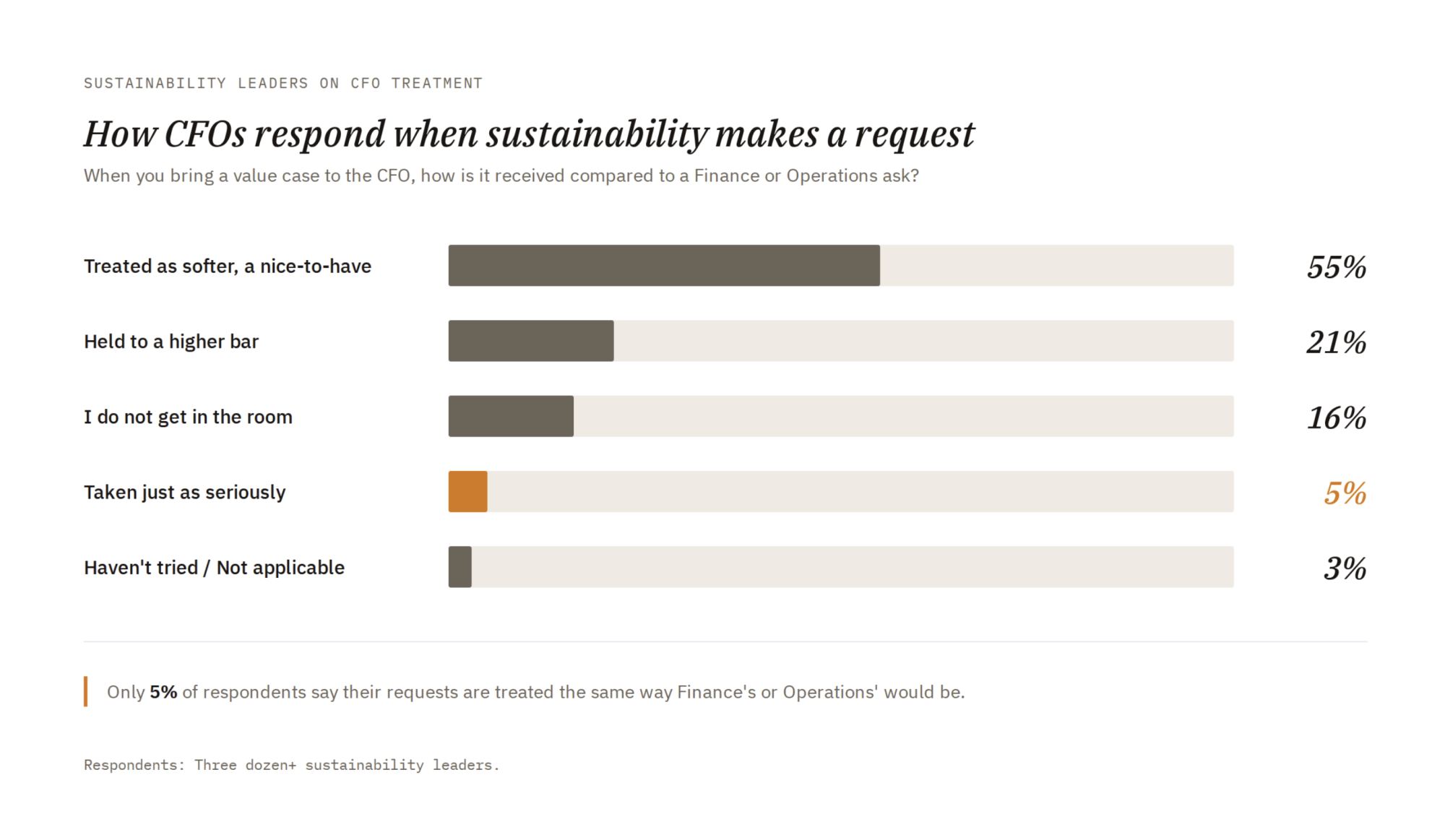
Recent research conducted across more than three dozen organizations reveals a stark reality. When sustainability leaders request funding, their proposals are rarely weighed with the same rigor or respect afforded to traditional corporate pillars.
The data is sobering:

- 5% of sustainability leaders report that their funding requests are treated with equal gravity to those from finance or operations.
- 55% of leaders report that their proposals are dismissed as "fluffy" or merely "nice to have."
- 21% report that their projects are held to a much higher standard of proof than other departments.
- 16% of sustainability professionals state they are never even granted a seat at the table with the Chief Financial Officer (CFO).
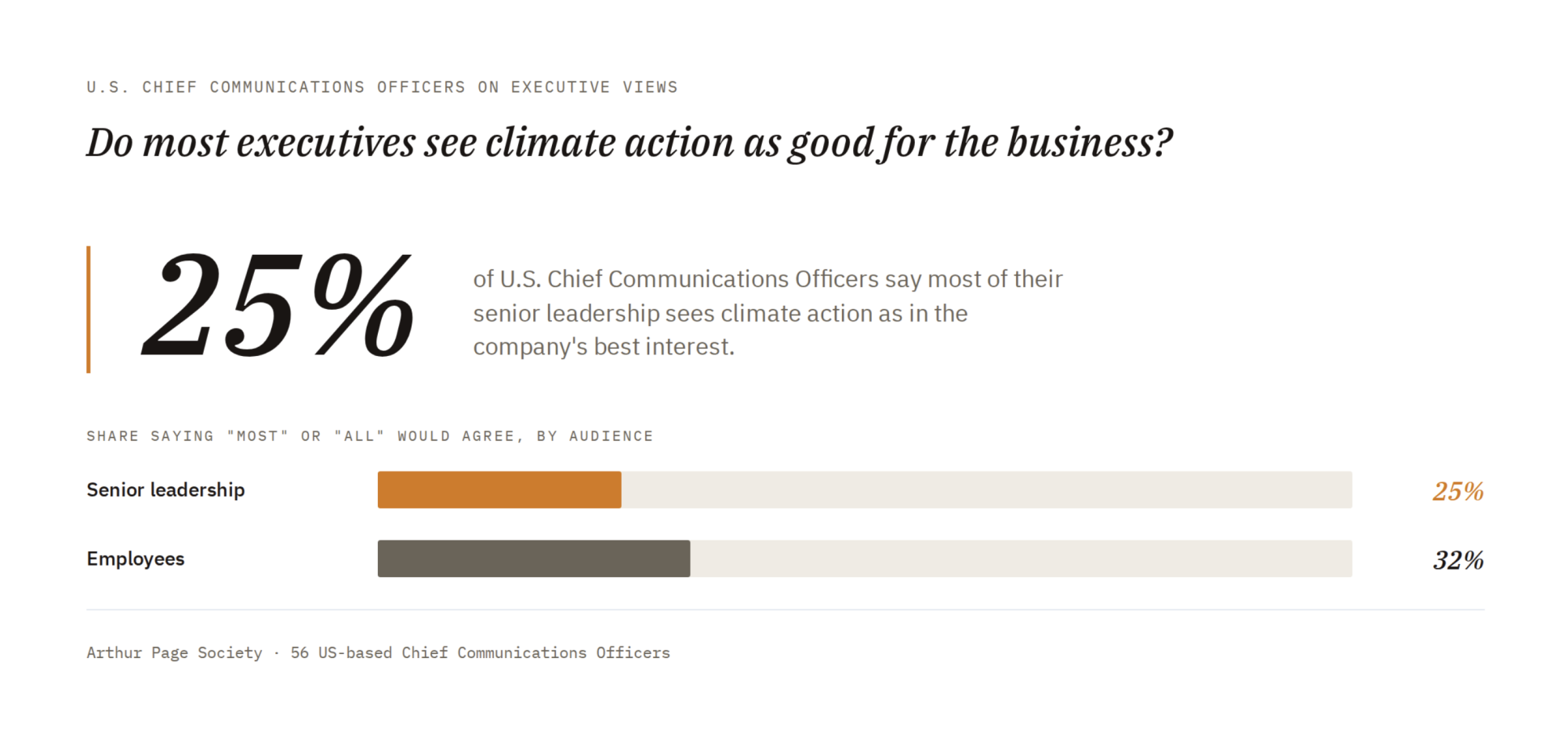
This "credibility deficit" is further evidenced by a study from the Arthur Page Society, which surveyed 56 U.S.-based chief communications officers. When asked whether their executive peers viewed climate action as being in the "best interest" of the organization, only 25% responded in the affirmative. When the same question was posed to the general employee base, 32% agreed. The fact that top-tier leadership is, on average, more skeptical than the general workforce suggests that the barrier to entry for sustainability projects is not just financial, but psychological.
Institutional Visibility: The "About Us" Test
The perceived lack of status for the sustainability function is not merely a subjective feeling held by practitioners; it is objectively verifiable in how companies present themselves to the world.
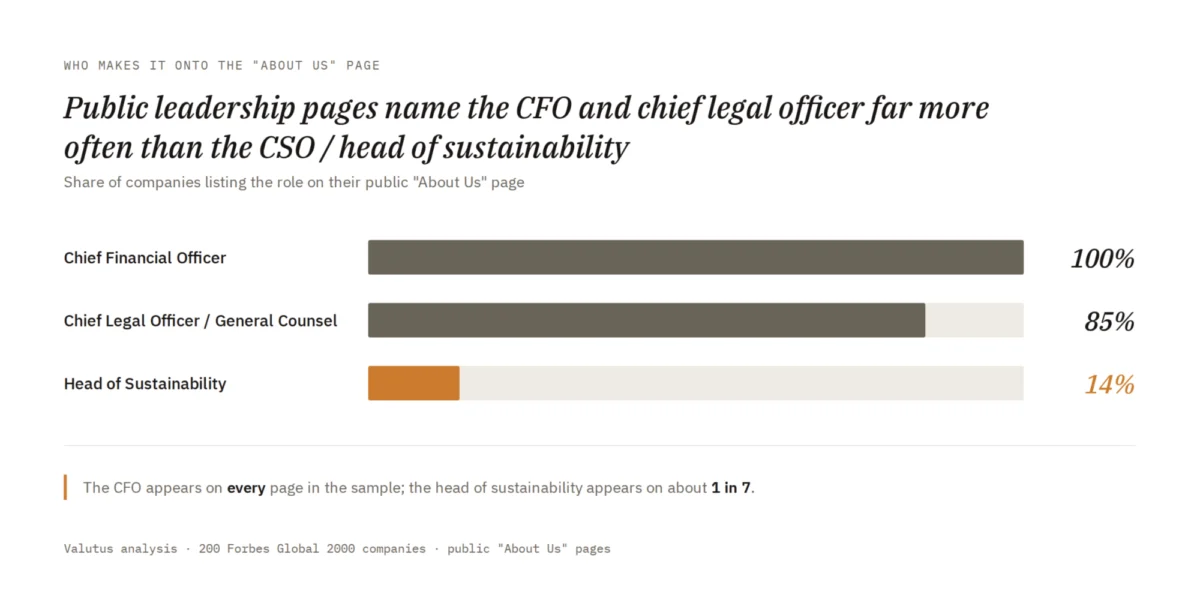
In a recent analysis of 200 top global companies, Valutus examined the "About Us" or "Leadership" pages of corporate websites to see how sustainability heads were positioned compared to other C-suite executives. The results were telling:
- 100% of the companies listed their CFO.
- 85% of the companies listed their Chief Legal Officer.
- Only 14% listed their Head of Sustainability.
This lack of parity raises a critical question: is this simply the fate of non-revenue-generating departments? While it is true that the legal department does not generate revenue in the traditional sense, the head of the legal function is more than six times more likely to be featured as a key member of the management team than the sustainability lead. This disparity indicates that sustainability has yet to earn the institutional "institutional trust" required to be viewed as a mission-critical function.
How Sustainability Professionals Are Undermining Their Own Credibility
While some of this skepticism is rooted in legacy corporate culture and external perceptions, the sustainability community must acknowledge that common habits within the profession are actively exacerbating the problem. To bridge the gap, practitioners must move away from four self-defeating behaviors.
1. Conflating Intent with Action
One of the most frequent errors in sustainability reporting is the reliance on consumer sentiment surveys. When a report states that "consumers are willing to pay 9.7% more for sustainable goods," it is presenting an expression of intent, not an observation of behavior.
Sophisticated financial executives know that what people say in a survey and what they do at the point of sale are two different things. By presenting survey data as if it were hard, predictive market data, sustainability professionals inadvertently signal a lack of business acumen. Acknowledging the gap between "stated preference" and "revealed preference" is essential to maintaining professional credibility.
2. Disowning the Function
There is a strange trend of sustainability professionals framing their own roles as "eventually unnecessary." While the aspiration for a company to be inherently sustainable is noble, suggesting that the function itself should be phased out is a strategy rarely employed by other leaders. A CFO would never argue that their department should eventually become redundant. As Yalmaz Siddiqui of Disney noted at GreenBiz 26, the narrative that a company "doesn’t need a CSO" devalues the unique, specialized expertise that these professionals bring to the table.
3. Avoiding Vague, "Mealy-Mouthed" Language
Sustainability is often discussed in abstract, high-level terms, such as "improving resource efficiency." While technically accurate, such phrases lack the granularity that operations or finance teams demand.
Instead of vague promises, practitioners should pivot to concrete, causal language. For example, rather than speaking about "efficiency," a leader should present a specific risk: "Rising insurance premiums and unpredictable seasonal weather patterns are causing supply chain volatility. This directly impacts our ability to keep inventory in stock, leading to a 3% dip in quarterly revenue. We can mitigate this by investing in [x] climate-resilient infrastructure."
4. The Measurement Myth
The most dangerous narrative in sustainability is the claim that environmental or social benefits are "unmeasurable." In an environment where "if you can’t measure it, you can’t manage it" is the gold standard, claiming that sustainability cannot be quantified is an admission of failure.
When a CSO tells a CFO that they "might not be able to prove the financial benefits" of a project, they are effectively telling that executive that they are incapable of managing the project.
The Case for Quantifiable Value: A Case Study
The belief that sustainability is inherently unmeasurable is false. A prominent $20 billion apparel company recently challenged this notion by analyzing the performance of suppliers based on wage practices. By comparing suppliers with high wage standards against those without, the company discovered significant differences in staff attrition, work stoppages, and on-time delivery rates.
When the company crunched the numbers, they found that the operational savings—the reduction in turnover costs and the increase in shipping reliability—substantially outweighed the cost of the higher wages.
As MIT management professor John Sterman has pointed out, when an organization treats the benefits of a sustainability project as "unmeasurable," it is effectively assigning them a value of zero. In a boardroom, zero is the one value that a project cannot recover from.
Implications: Moving Toward a Data-Driven Future
The path forward for sustainability professionals is clear: stop relying on the moral argument and start relying on the operational argument. The credibility tax currently being paid by the function is heavy, but it is not permanent.
By mirroring the language of finance, providing concrete data, and refusing to settle for the "unmeasurable" label, the sustainability function can move from the periphery of the "About Us" page to the center of the strategic agenda. The shift requires moving from being a department of advocacy to becoming a department of value creation. Only then will the nodding heads in the boardroom turn into meaningful, long-term capital commitments.