For eons, humanity has looked up at the band of light stretching across the night sky, perceiving the Milky Way as a stable, majestic, and unchanging spiral. We view our solar system as a passenger on a steady, predictable carousel circling the galactic center. However, new research suggests that our cosmic address is far more dynamic—and volatile—than previously imagined.
Groundbreaking supercomputer simulations led by Kirill Batrakov of the University of Durham indicate that the Milky Way’s spiral disk may have undergone a dramatic 90-degree flip at some point in its ancient history. This radical reorientation not only challenges our understanding of galactic evolution but suggests that the solar system’s path through the galaxy may have been significantly more turbulent than our current "stable" orbit implies.
The Galactic Oddity: Why the Halo Doesn’t Spin
To understand the significance of this discovery, one must first look at the anatomy of the Milky Way. Like most spiral galaxies, our home consists of two primary structural components: a luminous, rotating disk containing the bulk of our stars, gas, and dust, and a diffuse, spherical "halo" of older stars that surrounds the disk like a gargantuan cloud.
For years, astronomers have puzzled over the behavior of this stellar halo. Data from the European Space Agency’s Gaia mission—a space observatory designed to create the most precise 3D map of our galaxy—revealed an anomaly. The stars within the halo rotate at a significantly slower pace than the material within the galactic disk. While the disk spins with coherent, high-velocity motion, the halo stars appear sluggish and disorganized.
"The Milky Way’s stellar halo has always been a bit of an oddity," explains Batrakov. By utilizing advanced supercomputer models to track the evolution of 25 Milky-Way-like galaxies over billions of years, his team identified the mechanism behind this strange rotational discrepancy: a history of violent galactic mergers and, most surprisingly, the physical "flipping" of the galactic disk.
A Chronology of Chaos: From Collision to Flip
The story of the Milky Way is not one of peaceful isolation; it is a history of cannibalism and collision. Between 8 and 11 billion years ago, the Milky Way experienced a massive, head-on impact with a dwarf galaxy known as Gaia-Sausage-Enceladus (GSE).
The Gaia-Sausage-Enceladus Impact
The collision with GSE was a transformative event. As the dwarf galaxy—which possessed a mass exceeding 10 billion suns—slammed into the Milky Way, it was shredded by our galaxy’s immense gravitational tidal forces. The stars from the dwarf galaxy were flung into the Milky Way’s halo, where they remain today, moving in elongated, "sausage-shaped" orbits. This event left an indelible fingerprint on our galaxy, visible in the star motions captured by the Gaia telescope.
The Great Tilt
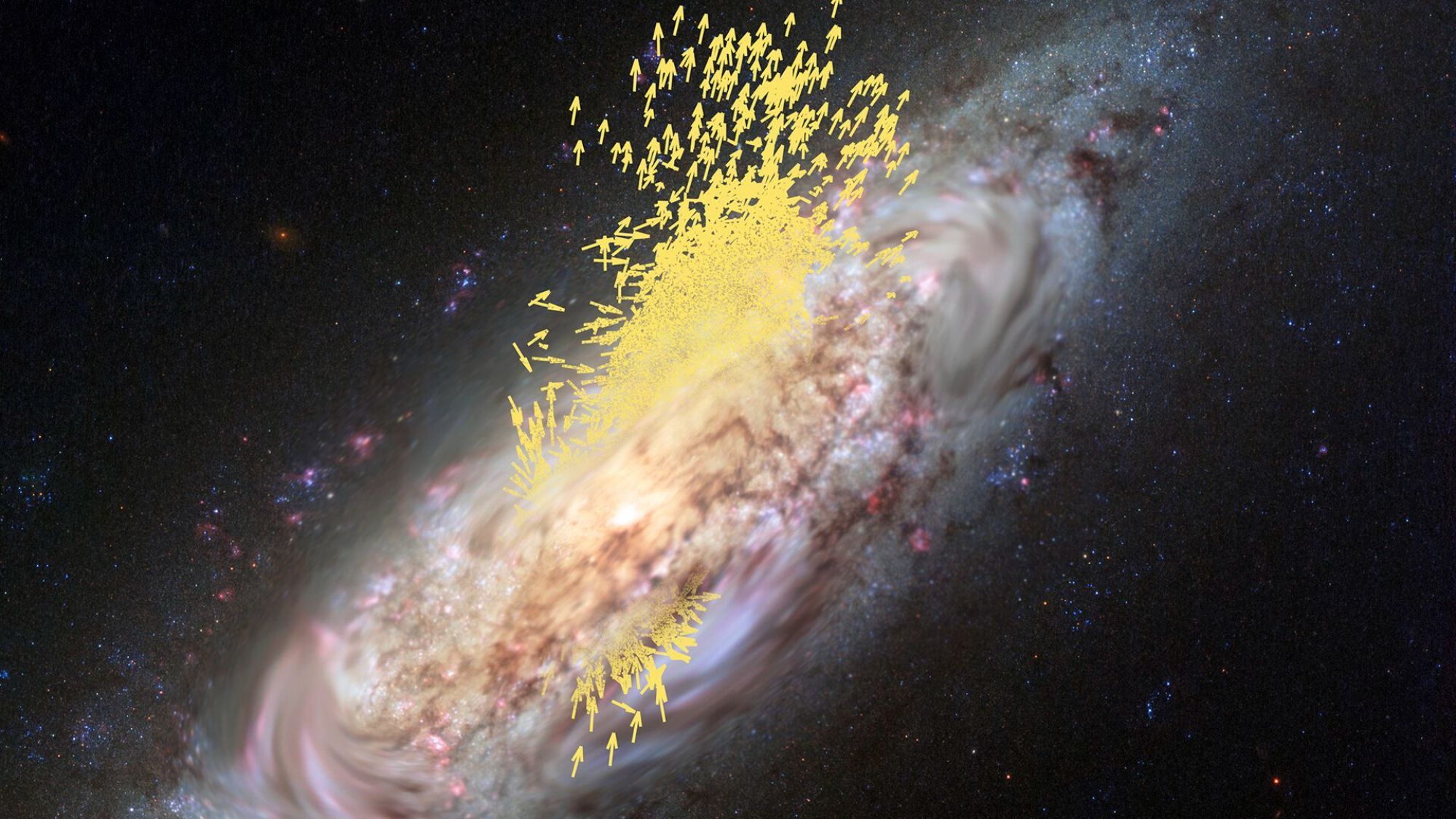
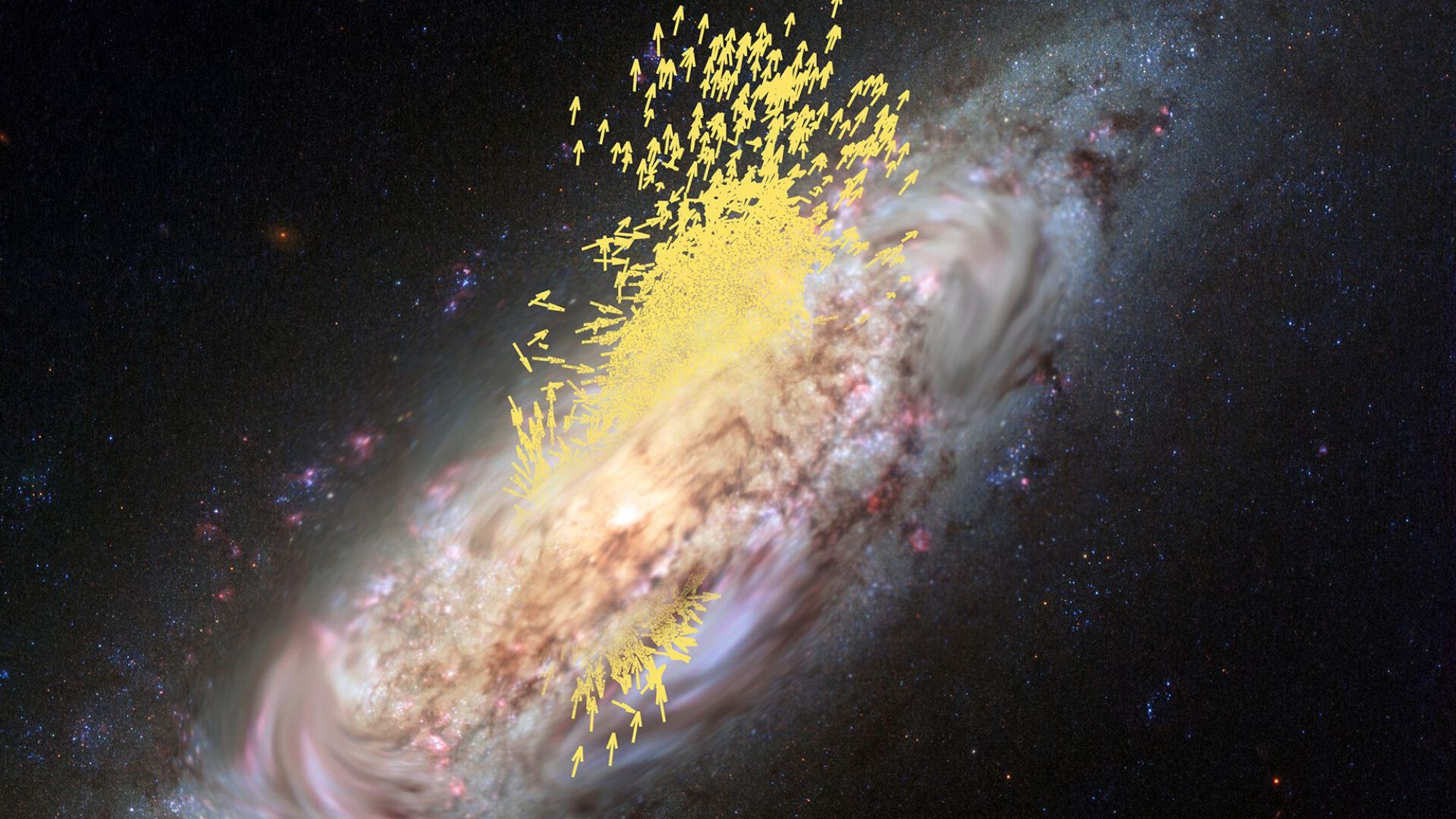
While the GSE merger is well-documented, the new simulations reveal that the aftermath of such a collision often triggers a secondary, more mysterious phenomenon: the disk flip. In the simulations, galaxies that experienced head-on mergers frequently saw their massive disks rotate and reorient by nearly 90 degrees.
This process is not instantaneous. As the disk changes its orientation relative to the surrounding space, the halo—composed of stars and dark matter—does not immediately adapt. It remains "stuck" in its original plane of motion. This misalignment creates a "lag," where the halo appears to be rotating slowly or inconsistently when measured against the new, flipped orientation of the disk.
Supporting Data: The Mechanics of the Flip
The researchers behind the study, presenting their findings at the Royal Astronomical Society’s National Astronomy Meeting in Birmingham, emphasized that while mergers are a primary driver, they are not the only possible cause of such a tilt.
"We think that there might possibly be different mechanisms driving the disk flips," Batrakov noted. "At this point, we are not sure which scenario applies to the Milky Way specifically and a further investigation is needed on the precise mechanics of disk flips."
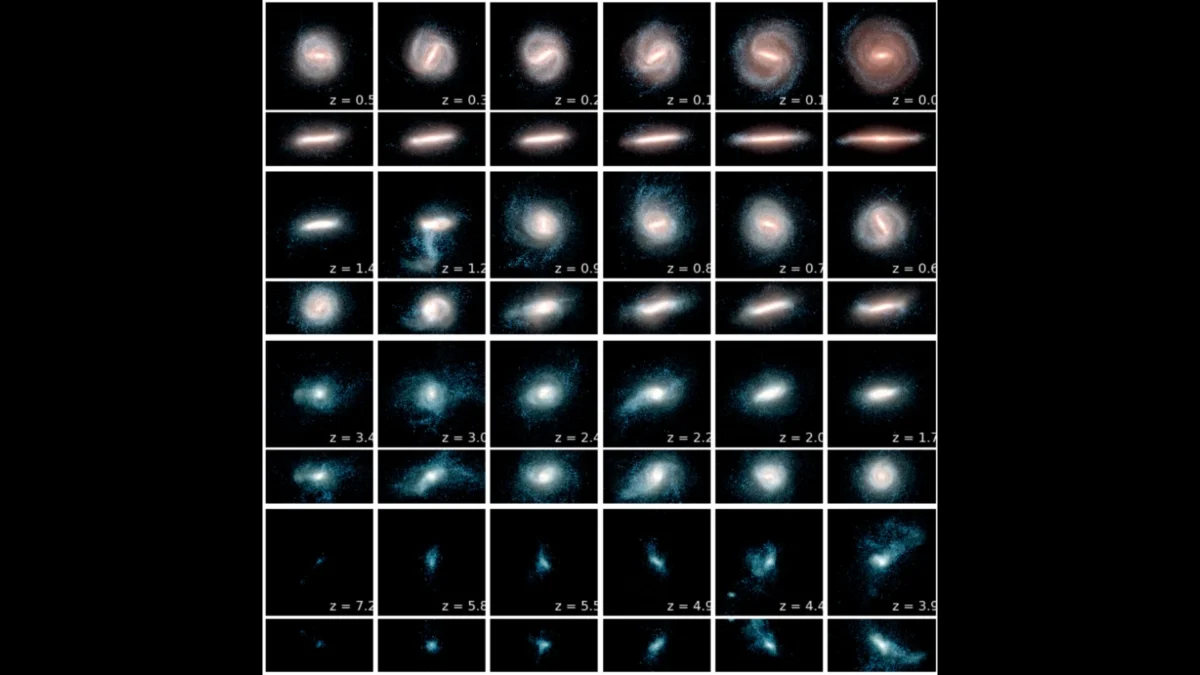
The simulation data provides a compelling visual narrative. By tracking the evolution of galaxies through various "redshifts" (a measure of time and cosmic distance), the team observed the disk transition from one plane to another. The resulting state—a galaxy with a disk misaligned with its halo—perfectly mirrors the kinematic signatures observed by the Gaia mission within our own neighborhood. The stars of the GSE, thrown into the halo, provide the "smoking gun" for the chaotic past, while the slow-spinning halo confirms the subsequent structural upheaval.
Expert Perspectives: Re-evaluating the Milky Way
The implications of this discovery are profound for the field of galactic archaeology. For decades, the Milky Way has served as the "Rosetta Stone" for understanding the universe. Because we reside within it, we can study it in a level of detail impossible for distant galaxies.
"Finding that its disk flipped adds a new chapter to that story, one we must account for when placing the Milky Way in a broader context of other galaxies," says Batrakov. He expressed genuine awe at the fact that modern technology allows us to reconstruct such a violent, ancient history simply by observing the present-day motions of stars. "What excites me most is that this complex history can be reconstructed just from present-day observations."
The research has sparked a conversation among astrophysicists regarding how many other spiral galaxies may have undergone similar "flips." If this process is common, it suggests that the "spiral" structure we see in the universe is a transient state, prone to dramatic shifts triggered by gravitational interactions and mergers.
Implications for the Solar System
Perhaps the most unsettling aspect of this research for the average observer is the implication for our own home. If the Milky Way’s disk flipped during the lifetime of the solar system, it implies that the Sun’s current, stable orbit around the galactic center is a relatively recent development.
"A disk flip means that most of the Milky Way’s stars once moved on very different trajectories than they do today, possibly even our Sun," Batrakov explains. This suggests that the "stable" spot we occupy in the galaxy might be a temporary luxury. Over billions of years, our Sun may have been forced into a drastic change of direction, potentially altering the gravitational environment and the flux of radiation and cosmic debris experienced by the early solar system.
While this does not pose a threat to our current existence, it recontextualizes the history of life on Earth. If the galactic environment was fundamentally different in the past, it could change our models regarding the formation of the solar system and the stability required for life to emerge.
Conclusion: A Living, Breathing Galaxy
The study of the Milky Way has transitioned from viewing it as a static collection of stars to understanding it as a dynamic, evolving system with a complex, often violent biography. The possibility of a 90-degree disk flip serves as a humbling reminder of the sheer scale and power of cosmic forces.
As researchers continue to analyze data from the Gaia mission and refine their supercomputer simulations, the picture of our galactic home will only become clearer. We now know that our galaxy has been hit, shredded, and tilted—a survivor of ancient cosmic cataclysms. The next time you look at the Milky Way, you are not just seeing a band of stars; you are looking at the remnants of a titanic transformation that rearranged the very architecture of our universe.