The rapid ascent of generative AI has fundamentally altered the landscape of data science and software engineering. Only a few years ago, a practitioner’s toolkit was defined by recurrent neural networks, long short-term memory (LSTM) cells, and standard classification algorithms. Today, the ubiquity of Large Language Models (LLMs) has necessitated a paradigm shift. We have moved from the era of "feature engineering" to an era of "architectural understanding."
For many, the current workflow consists of interacting with proprietary APIs—sending a prompt and receiving a completion. However, true mastery of the generative AI ecosystem requires moving beyond the interface. To train, fine-tune, and deploy production-grade models, professionals must cultivate a rigorous, systems-level understanding of the transformer architecture and the underlying mathematics of high-dimensional data.
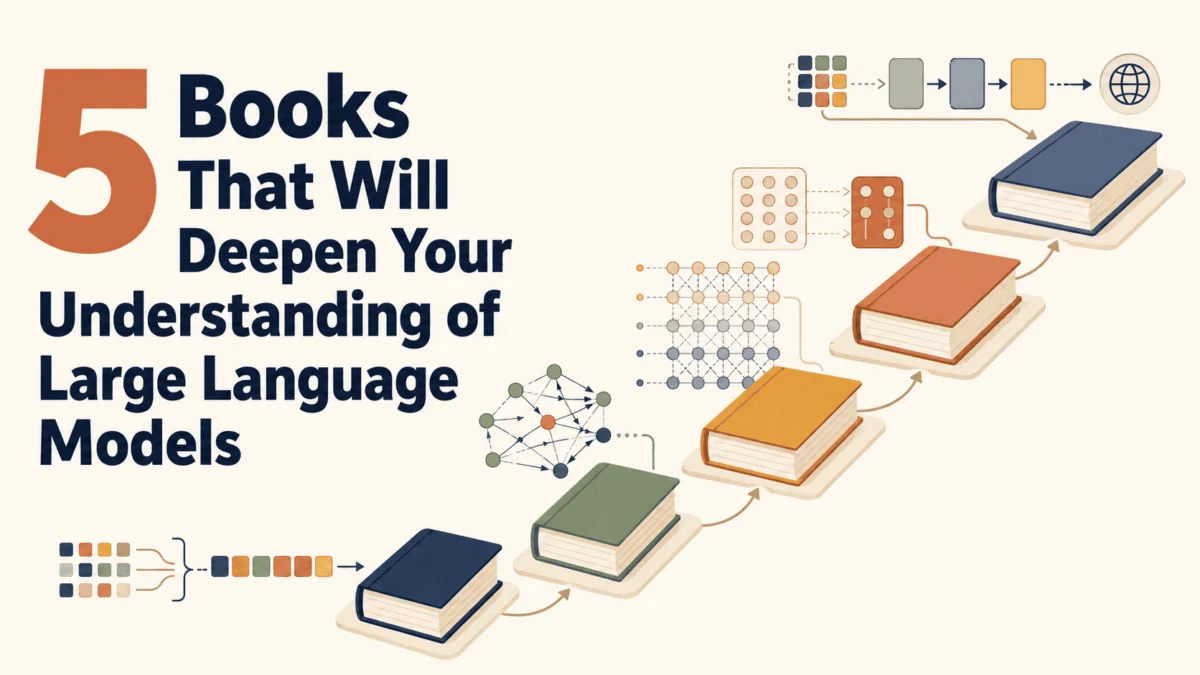
To bridge this gap, we have curated five essential texts. These books transcend superficial tutorials, offering a structured roadmap for those who wish to move from casual user to AI architect.
1. The Foundational Blueprint: Build a Large Language Model (From Scratch) by Sebastian Raschka
The "First Principles" Approach
There is no better way to demystify a complex system than to disassemble it and rebuild it component by component. Sebastian Raschka’s Build a Large Language Model (From Scratch) serves as the definitive manual for those who refuse to treat LLMs as "black boxes."
Technical Core and Implementation
Raschka avoids the temptation to rely on high-level libraries that obscure the logic. Instead, the book guides readers through the granular process of building a GPT-like model using PyTorch. By implementing the attention mechanism, the feed-forward layers, and the training loop manually, the reader gains an intimate understanding of why these models "hallucinate," how they learn context, and how to optimize them for specific tasks.
Key Takeaways:
- Mathematical Intuition: A deep dive into the linear algebra and probability theory that enables next-token prediction.
- Architecture Construction: Step-by-step guidance on implementing the transformer block, the backbone of modern AI.
- Data Preparation: Essential insights into tokenization, embedding strategies, and dataset curation—the unsung heroes of model performance.
2. Navigating the Landscape: The Hundred-Page Language Models Book by Andriy Burkov
High-Signal Conceptual Mapping
Before diving into code, one must possess a high-quality map of the territory. Andriy Burkov, renowned for his concise technical writing, offers a high-signal, low-noise introduction to the field. For busy professionals, this book serves as an indispensable primer.
Why It Remains Essential
Burkov strips away the fluff. He focuses on the "why" and "how" of language modeling, covering the evolution from word embeddings like Word2Vec to the sophisticated attention-based architectures of today. It is a dense, yet remarkably readable, guide that ensures the reader understands the terminology and the theoretical constraints of current state-of-the-art models.
Key Takeaways:
- NLP Evolution: A succinct history of natural language processing that provides context for current breakthroughs.
- Technical Accuracy: Clear definitions of complex concepts like self-attention, cross-attention, and positional encoding.
- Strategic Overview: Insights into the limitations of current models, helping practitioners manage expectations when building real-world solutions.
3. The Visual Practitioner’s Guide: Hands-On Large Language Models by Jay Alammar and Maarten Grootendorst
Bridging Theory and Application
Once the foundations are set, the focus must shift to application. Jay Alammar—whose visual essays on transformers have become industry standard—teams up with Maarten Grootendorst to create a guide that is as practical as it is intuitive.
Applying Knowledge to Real-World Tasks
This book is designed for data scientists who need to translate theory into production. It covers the entire lifecycle of an LLM project, from semantic search and information retrieval to fine-tuning models for classification and generation. By utilizing visual intuition, the authors demystify how models interpret meaning, making it easier for practitioners to troubleshoot and iterate on their own projects.
Key Takeaways:
- Visual Learning: Using Alammar’s signature diagrams to simplify complex tensor transformations.
- Semantic Search: Techniques for implementing RAG (Retrieval-Augmented Generation) pipelines.
- Tooling: Practical introductions to the libraries that dominate the modern data science workflow.
4. The Engineering Gold Standard: Natural Language Processing with Transformers by Lewis Tunstall, Leandro von Werra, and Thomas Wolf
The Hugging Face Reference Manual
If there is a "bible" for the modern AI engineer, this is it. Authored by the key figures behind the Hugging Face ecosystem, this book provides the engineering rigor required to operate in the open-source AI world. It is not merely a book; it is a guide to the tools that power the vast majority of current research and production deployments.
Engineering for Scale
The authors emphasize the "Hugging Face way" of working: utilizing the transformers, datasets, and tokenizers libraries to build efficient, scalable pipelines. Whether you are dealing with multilingual models or optimizing for specialized hardware, this text provides the necessary depth.
Key Takeaways:
- Library Mastery: A comprehensive walkthrough of the Hugging Face ecosystem.
- Model Optimization: Techniques for knowledge distillation, quantization, and pruning to make models run faster and cheaper.
- Domain Adaptation: Strategies for fine-tuning pre-trained models on specialized, proprietary datasets.
5. From Model to Product: The LLM Engineering Handbook by Paul Iusztin and Maxime Labonne
Addressing the Production Gap
Training a model is a research challenge; deploying it is an engineering nightmare. Many projects stall at the prototype stage because they lack a robust production architecture. The LLM Engineering Handbook bridges this critical gap, acting as an operations manual for moving models into the hands of real users.
Operations and Scalability
Iusztin and Labonne focus on the "LLMOps" lifecycle. They cover everything from data pipelines and evaluation frameworks to monitoring for drift and ensuring cost-effectiveness. This is the definitive resource for engineers tasked with moving an LLM from a Jupyter notebook to a reliable, user-facing application.
Key Takeaways:
- Production Readiness: How to handle latency, throughput, and server-side optimization.
- Monitoring and Evaluation: Implementing rigorous testing to ensure your model doesn’t break in production.
- Scalability: Best practices for deploying on cloud infrastructure and managing complex RAG architectures.
Implications: The Future of the AI Professional
The rise of LLMs has created a significant divide between those who simply "consume" AI and those who "build" it. As the technology continues to mature, the premium on foundational knowledge will only increase. Organizations are no longer looking for developers who can write a clever prompt; they are looking for engineers who understand the underlying architecture, the nuances of fine-tuning, and the intricacies of production deployment.
A Strategic Learning Path
For those entering the field, the path is clear:
- Build your intuition: Start with Burkov to understand the "what" and Raschka to understand the "how."
- Develop visual and practical skills: Use Alammar and Grootendorst to visualize the architecture and start building small-scale applications.
- Master the tools: Use Tunstall et al. to gain proficiency with the industry-standard Hugging Face ecosystem.
- Operationalize: Finally, use Iusztin and Labonne to master the lifecycle of production-grade LLM engineering.
By engaging with these resources, you are not just learning a set of tools; you are internalizing a framework for thinking about intelligence at scale. In an industry defined by rapid turnover, this fundamental understanding is the only true competitive advantage. As Vinod Chugani, an expert in AI and data science education, notes: "The field rewards people who engage seriously with how these systems actually work, not just how to call them."
Whether you are a seasoned data scientist looking to pivot or a developer aiming to integrate LLMs into your product, the journey toward expertise is one of constant learning. The bookshelf provided here is a testament to the fact that while the technology changes rapidly, the mathematical and engineering principles that drive it remain the constant foundation upon which the future of AI will be built.