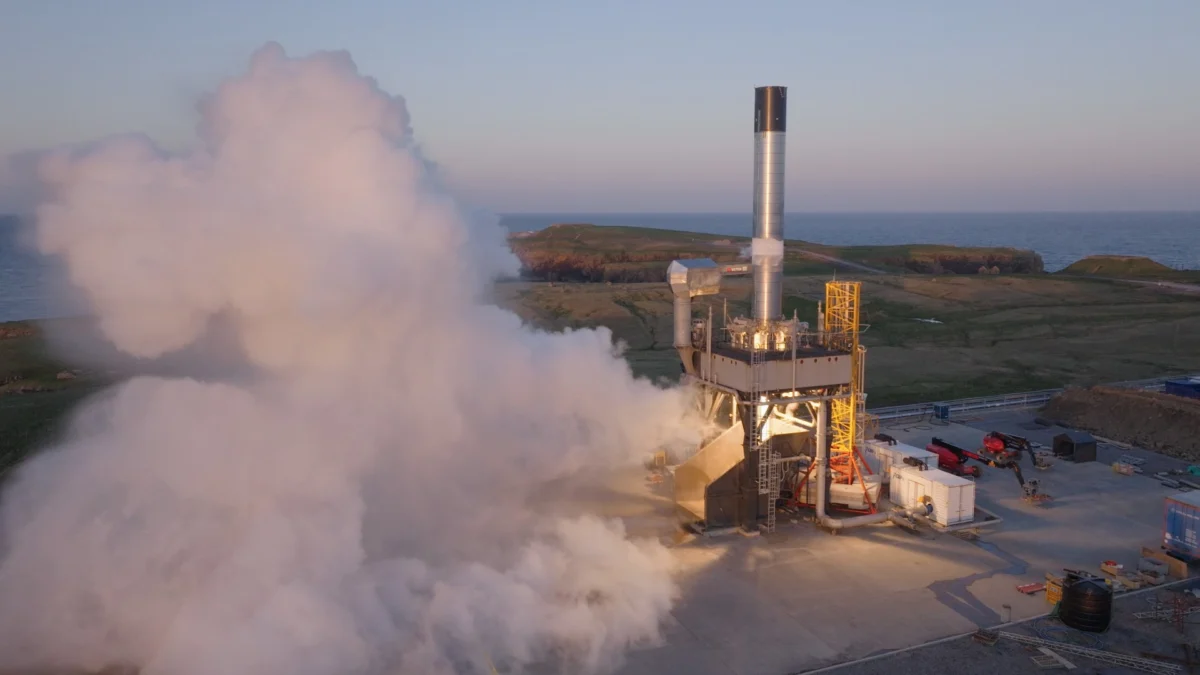
In a development that underscores the complex realities of the modern “NewSpace” race, German aerospace startup Rocket Factory Augsburg (RFA) has officially hit the brakes on its inaugural launch campaign. The company, which is vying to become a cornerstone of European sovereign space capability, announced on Wednesday, July 28, that it is suspending launch preparations for its RFA One vehicle currently situated at the SaxaVord Spaceport on the Shetland Islands, Scotland.
The decision follows the identification of an unspecified technical issue discovered during pre-flight integration testing on the pad. For a nascent industry under immense pressure to deliver, the pause serves as a sobering reminder that while the demand for orbital access is at an all-time high, the physics of rocketry remains an unforgiving discipline.
A Crucial Delay for European Sovereignty
The RFA One mission is highly anticipated not just by the company, but by the United Kingdom and the European Union at large. The United Kingdom is currently working to establish itself as a premier destination for vertical small-satellite launches. A successful lift-off from SaxaVord would mark a watershed moment, potentially establishing the site as a permanent alternative to the European Space Agency’s (ESA) primary hub at the Guiana Space Centre in Kourou, French Guiana.
While RFA has confirmed they are “de-stacking” the rocket to facilitate a deeper investigation into the vehicle’s health, they have stopped short of providing a revised launch window. Previously, the mission was slated for late summer, likely August or September. This delay extends the period of waiting for the U.K. to achieve its first-ever orbital launch from home soil, a milestone that has proven elusive despite significant investment in infrastructure and licensing.
Chronology of the RFA One Program
The journey to the launch pad in Shetland has been a calculated, multi-year endeavor for the Augsburg-based team.
- Developmental Phase: RFA focused heavily on a three-stage design, prioritizing cost-efficiency and high-cadence flight. The company’s architecture includes a plan for a reusable first stage, a feature intended to disrupt the small-launch market by lowering the barrier to entry for commercial and research satellites.
- Regulatory Milestone: In January 2024, the U.K. Civil Aviation Authority (CAA) granted RFA a spaceflight operator license. This was a landmark regulatory achievement, signifying that the startup had met stringent safety and operational criteria required for commercial launch activities in British territory.
- Testing at SaxaVord: Throughout the spring and early summer, RFA successfully navigated the logistical hurdles of transporting hardware to the remote Shetland Islands. In November 2024, the company conducted successful hot-fire tests of the RFA One stage, proving the viability of their propulsion systems in the harsh, wind-swept environment of the North Sea.
- The July 2024 Stand-down: During final integration and pre-flight checkouts, telemetry or physical inspection revealed an anomaly. Following standard safety protocols, the team moved to secure the vehicle, resulting in the current de-stacking operation to return the rocket to a hangar for further diagnostics.
The Technical Architecture: Why RFA One Matters
The RFA One vehicle is designed specifically to address the "last mile" of the space economy. As large-scale constellations like SpaceX’s Starlink saturate low-Earth orbit (LEO), there remains a desperate need for "bespoke" launches—missions where a small satellite needs a specific orbital inclination or a precise altitude that a heavy-lift "rideshare" mission cannot accommodate.

The RFA One is capable of reaching a variety of critical orbits:
- Geosynchronous Orbits (GEO): Vital for telecommunications and weather monitoring, allowing a satellite to remain fixed over a single point on the Earth’s surface.
- Polar Orbits: Essential for earth observation and environmental monitoring, as the satellite passes over the poles, allowing it to scan the entire planet as it rotates underneath.
- Sun-Synchronous Orbits (SSO): A specific type of polar orbit that ensures a satellite passes over any given point on the planet at the same local solar time, providing consistent lighting for high-resolution imagery.
By utilizing a three-stage design, RFA hopes to optimize the mass-to-orbit ratio, making these specialized orbits economically viable for universities, private startups, and defense agencies.
The Global Context: Launch Capacity and Defense Needs
The pressure on RFA and other small-launch providers is exacerbated by a global supply crunch. The industry is currently facing a bottleneck in launch availability. Reports suggest that even industry behemoth SpaceX may be tightening its schedule, with whispers in the industry that its highly popular Transporter rideshare missions may be fully booked through 2028 or 2029.
This creates a vacuum that companies like Rocket Lab and RFA are desperate to fill. Simultaneously, the geopolitical landscape has shifted. The ongoing conflicts in Ukraine and the Middle East have highlighted the strategic importance of "tactical space." The U.S. Department of Defense has pioneered the concept of "responsive space"—the ability to launch a replacement satellite on demand. A prime example is the VICTUS HAZE mission, where Rocket Lab successfully launched a payload just 16 hours and 42 minutes after the military’s request.
For Europe, this is no longer a matter of mere commercial competition; it is a matter of national and regional security. ESA leadership has increasingly called for greater space autonomy, arguing that Europe must not rely solely on U.S. providers for its strategic orbital needs.
Official Responses and Industry Outlook
In the wake of the announcement, the sentiment from RFA leadership remains focused on long-term reliability over short-term speed. Jörn Spurmann, RFA’s Chief Commercial Officer, previously characterized the license to launch from SaxaVord as a "powerful endorsement of our technical excellence." While the current delay is undoubtedly a setback, it is one that the company views as necessary to ensure the vehicle’s long-term viability.

Industry analysts note that while the public might see a delay as a "failure," those within the aerospace sector categorize it differently. "Spaceflight is inherently hard," says one industry observer. "The margin for error is zero. When you see a company halt a launch for an investigation, it is almost always better than the alternative: a failure on the pad or, worse, an explosion during the first minutes of flight."
Implications for the Future
The path forward for RFA involves a rigorous root-cause analysis. Once the rocket is de-stacked, engineers will inspect the suspect components, conduct simulations, and potentially perform additional static fire tests. Only after the technical team is satisfied that the anomaly is resolved will they clear the vehicle to be re-stacked for flight.
For the SaxaVord Spaceport, this delay is merely a part of the learning curve. As a new facility, the port is working to build a reputation as a reliable, high-cadence launch site. Every challenge overcome during this campaign adds to the institutional knowledge of the site’s operations team.
As the global space economy continues to grow, the ability to launch on time and on budget will separate the winners from the losers. RFA, by choosing to pause now, is betting that the integrity of its first mission is more important than the calendar date. For the U.K. and the broader European space sector, the wait for the first vertical launch continues, but the momentum toward achieving that goal remains, for now, undeterred.