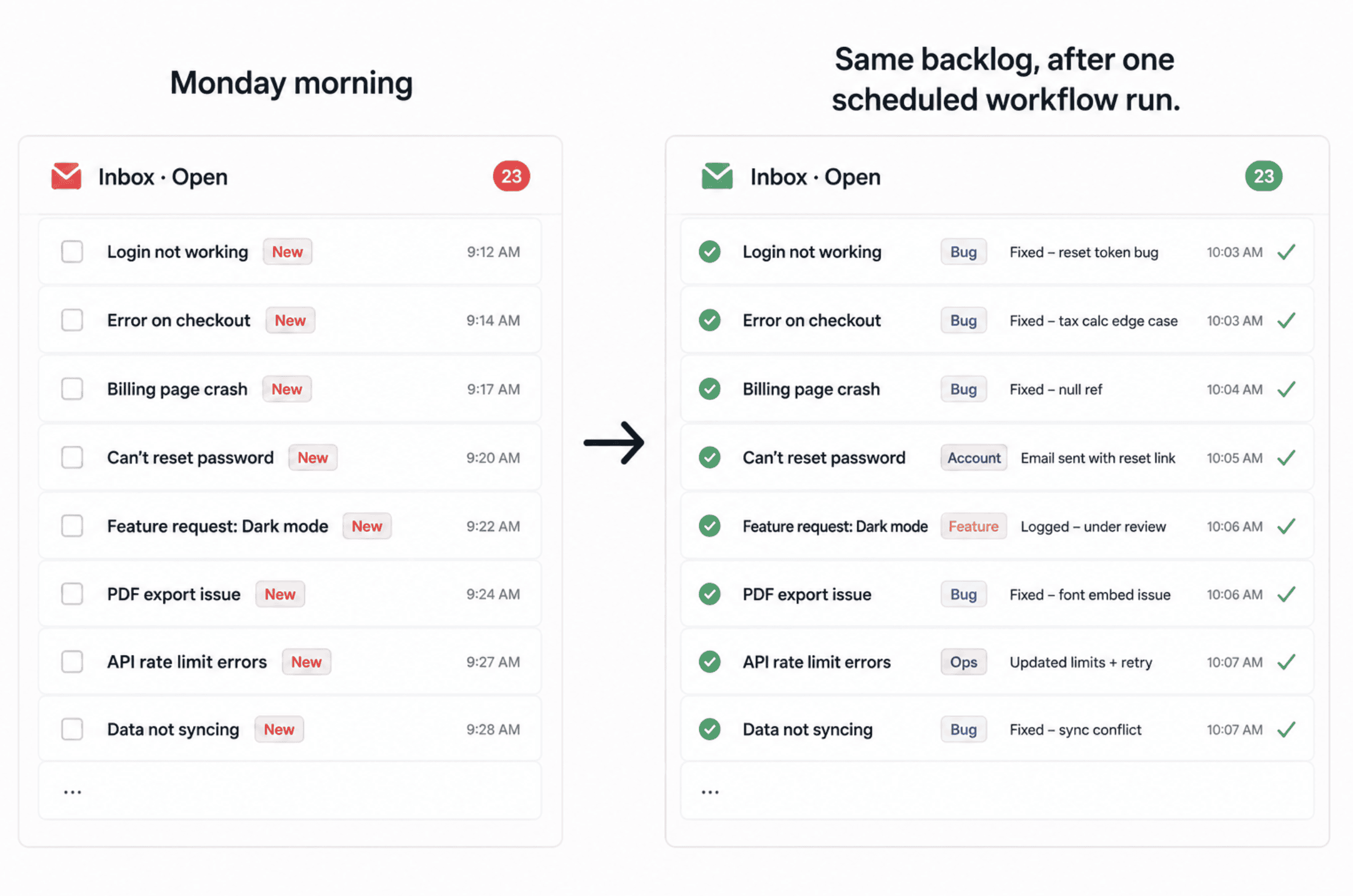
It is 9:00 AM on a Monday. For many engineering leads, this is the "triage hour"—a period of time dedicated to sifting through a mountain of notifications. In a busy repository, the backlog is often a chaotic mix of critical bug reports, duplicate feature requests, off-topic commentary, and requests for information. Before any actual development can occur, a human engineer must manually read, label, categorize, and respond to these items. It is high-cognitive-load, repetitive work that acts as a significant tax on developer productivity.
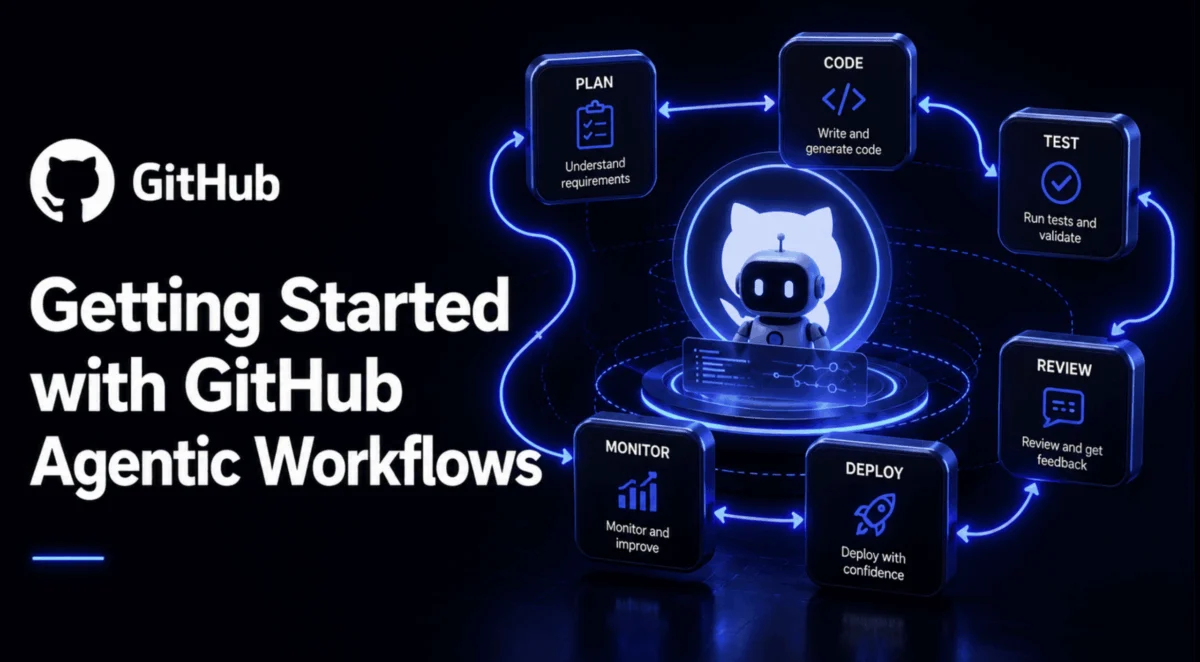
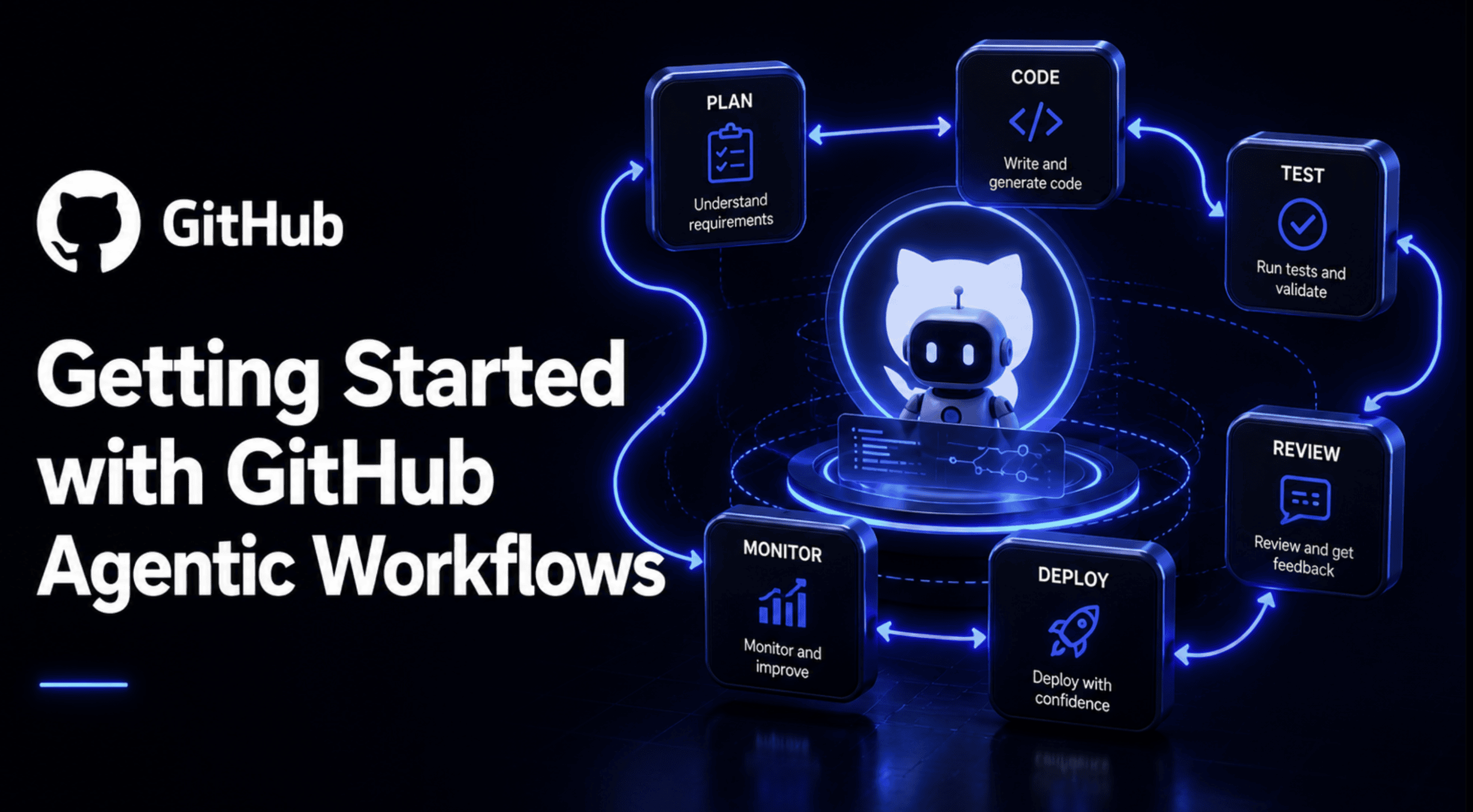
On June 11, 2026, GitHub officially transitioned its "Agentic Workflows" into public preview, signaling a shift in how the platform handles repository maintenance. By integrating AI agents directly into the GitHub Actions pipeline, the company is moving beyond the "chat assistant" paradigm toward a future of autonomous, event-driven software stewardship.
The Evolution of Automation: From Rules to Reasoning
To understand why Agentic Workflows matters, one must distinguish it from existing automation tools. Traditional GitHub Actions are deterministic: they follow a rigid "if-this-then-that" structure. If a file changes, run a linter. If a test fails, block the merge. These tools excel at binary tasks where the outcome is predictable.
Agentic Workflows, however, introduce reasoning into the loop. Built by GitHub Next and Microsoft Research, these workflows allow developers to embed AI-powered decision-making into the lifecycle of a repository. Instead of just checking if a PR follows a style guide, an agent can "read" the code, compare it against the project’s stated security policies, and determine if it warrants a senior maintainer’s immediate attention.
Chronology of a Shift
- Early 2026: Initial technical preview phases begin, requiring complex manual configuration, including the generation of fine-grained Personal Access Tokens (PATs) and manual secret management.
- June 11, 2026: GitHub announces the public preview of Agentic Workflows. This update significantly lowers the barrier to entry by removing the need for manual PATs for organization-owned repositories using GitHub Copilot.
- Post-Launch: The platform begins building out a catalog of pre-configured, community-driven "agentic patterns," allowing teams to import complex triage and maintenance logic with a single command.
Architecture: How it Works Under the Hood
Strip away the marketing, and Agentic Workflows is a clever abstraction layer built on existing infrastructure. The system utilizes a Markdown-based configuration file located in .github/workflows/.
The file begins with a YAML frontmatter block that defines the trigger (the "when"), the permissions (the "scope"), and the engine (the "brain"). Below this, developers provide plain-English instructions that the AI interprets to execute tasks.
The Compilation Process
A dedicated CLI tool, gh-aw, acts as the bridge. It reads the Markdown source and compiles it into a lock.yml file. This lock file is effectively a standard GitHub Actions workflow. Because it leverages existing runners and branch protection rules, it does not require a proprietary, bolted-on runtime. It is, by design, native to the GitHub Actions ecosystem.
This architecture is intentional. By reusing the infrastructure that already manages the world’s largest repositories, GitHub ensures that these agents inherit the security, logging, and auditability features that teams already trust.
Security by Design: The Five Layers of Trust
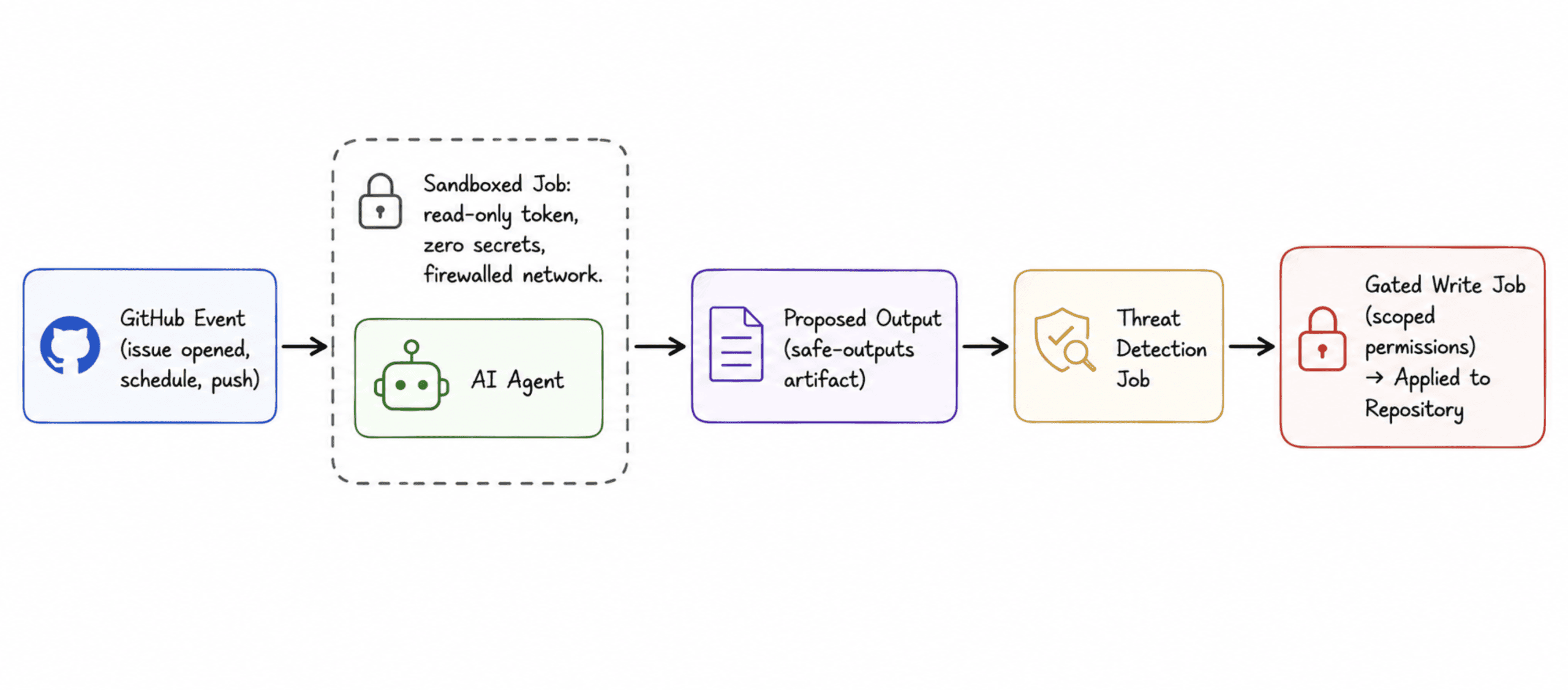
The primary barrier to adopting autonomous agents in production is the fear of "hallucination" or malicious exploitation—the "what if the agent deletes my repo?" scenario. GitHub addresses this by implementing a rigid security model designed to contain the agent’s influence.
- Read-Only Tokens: By default, agents operate with minimal permissions. They can read context, but they cannot initiate broad changes.
- Zero-Secret Exposure: The architecture is designed to prevent agents from accessing sensitive environment variables or API keys unless explicitly permitted through strict scoping.
- Network Firewalls: Outbound traffic is restricted to a curated allowlist, preventing the agent from communicating with unauthorized third-party servers.
- Safe Outputs: This is the most critical layer. The agent cannot perform "arbitrary" actions. Instead, it is limited to a narrow set of "safe" outputs, such as
add-label,add-comment, orcreate-issue. Even if the AI becomes confused, it is physically constrained from performing unauthorized destructive actions. - Threat Detection: The system monitors the agent’s reasoning traces for signs of prompt injection or anomalous behavior, providing a layer of oversight that is absent in traditional scripts.
Supporting Data: By the Numbers
The public preview launch came with significant validation from enterprise partners. GitHub provided the following metrics to demonstrate the capability of the system as it stands:
| Metric | Capacity / Feature |
|---|---|
| Supported AI Engines | Copilot, Claude, Codex, Gemini + Custom |
| Security Layers | 5 (Read-only, Zero secrets, Firewall, Output caps, Threat detection) |
| Documented Patterns | 18+ (IssueOps, ChatOps, DailyOps, BatchOps) |
| Trigger Types | 10+ (Issues, PRs, Push, Schedule, Discussion) |
| Safe Output Types | 8+ (Labeling, Commenting, PR creation, etc.) |
Official Perspectives and Industry Adoption
GitHub has been aggressive in securing early, high-profile testimonials to signal that this technology is ready for enterprise-grade use.
Carvana noted that the built-in controls provided the confidence necessary to deploy agents across complex, multi-repository systems—a level of trust that few AI-driven DevOps tools currently enjoy. Marks & Spencer highlighted the "human capital" argument: by automating the "boring stuff"—dependency management, routine reviews, and vulnerability remediation—their engineers gained back significant hours of sprint time, shifting focus from maintenance to innovation.
Perhaps the most poignant observation came from Hud.io, who pointed out that the challenge of AI agents has never been the ability to generate code or comments. The challenge is "trusting the output enough to merge it." This realization is the cornerstone of the security-first design philosophy GitHub has adopted for the preview.
Implications for the DevOps Lifecycle
The introduction of Agentic Workflows fundamentally alters the relationship between human engineers and their tools.
1. From "Prompting" to "Policing"
In the current era of AI coding assistants, the developer is the "pilot," manually triggering an agent to solve a specific, immediate problem. With Agentic Workflows, the developer becomes a "policy maker." You are no longer asking the AI to fix a bug; you are setting a policy that instructs the AI to identify, categorize, and propose fixes for bugs as they appear.
2. Continuous AI
GitHub describes this as "Continuous AI." It is the practice of embedding intelligence into the repository itself, ensuring that the software lifecycle is continuously monitored, regardless of whether a human is currently active at their keyboard.
3. The End of the "Blank Page" Problem
By providing a catalog of pre-built workflows—such as the daily-repo-status or automated compliance auditors—GitHub is reducing the barrier to entry. Teams can now "clone" the automation patterns of successful projects, effectively importing best practices alongside their codebase.
Challenges and Future Outlook
Despite the excitement, the feature is still in a "rough" state, as acknowledged by early adopters. Debugging an agent’s logic remains difficult. If an agent misclassifies an issue, the developer is currently limited to inspecting standard GitHub Actions logs, which lack the "reasoning traces" that would explain why the AI made its specific choice.
Furthermore, there is a lack of granular, real-time cost visibility. In an enterprise setting, managers need to understand the token usage—and subsequent billing—of individual workflows before they can safely scale these agents across hundreds of repositories.
Finally, the current two-file system (Markdown source and lock.yml output) feels like a temporary bridge. The industry expectation is that GitHub will eventually move toward a fully native integration where the platform handles the compilation, allowing for a cleaner developer experience.
Conclusion: A New Standard for Repository Maintenance
The most significant takeaway from GitHub’s Agentic Workflows is that it moves the needle on what we consider "automation." For years, we have been limited to rigid, rule-based scripts. Today, we are entering an era where we can encode "judgment" into our repositories.
While the current implementation is a fast-moving preview, the core value proposition is clear: by combining a rigorous security contract with the power of LLM-based reasoning, GitHub is giving teams the tools to build "self-driving" repositories. For the developer, this means less time spent in the triage queue and more time focusing on the creative, high-level architecture that AI is not yet equipped to handle. As the preview matures, the question for teams will not be if they should use these agents, but how quickly they can offload their routine burdens to them.