The digital landscape is bracing for a tectonic shift. As the European Union’s Cyber Resilience Act (CRA) moves toward its full enforcement date of December 11, 2027, a significant portion of the global manufacturing sector remains dangerously misinformed. While many industry leaders perceive the CRA as a future-focused regulation targeting next-generation IoT gadgets, the reality is far more pervasive. The CRA is a retrospective mandate that captures not just tomorrow’s innovations, but the vast, sprawling legacy portfolios that have powered global industry for the last decade.
For manufacturers of hardware and software with digital elements, the question is no longer "Will my products be ready for the future?" but rather "Can my existing portfolio survive the transition to the European market?" As organizations begin to grapple with the immense technical documentation and risk assessment requirements mandated by the act, it is becoming clear that manual compliance is not just inefficient—it is mathematically impossible.
The Scope of the CRA: A Wide-Reaching Regulatory Net
The European Commission has framed the CRA as a comprehensive framework for "products with digital elements." This phrasing is intentionally broad. If a product contains software or hardware and maintains a data connection—whether that connection is physical, logical, direct, or indirect—it falls under the scope of the act.

This definition effectively dismantles the common misconception that the CRA is merely an "IoT regulation." It encompasses industrial control systems, networking hardware, semiconductors, embedded systems, and consumer electronics. Unless a product is specifically governed by existing sector-specific regulations, such as the UNECE R.155 cybersecurity standard for vehicles or the EU’s Medical Device Regulation (MDR), it must adhere to the CRA.
For large enterprises, this means thousands of products, many designed long before cybersecurity was a standard engineering requirement, are now subject to strict compliance oversight. The regulatory burden is not triggered by a product’s release date, but by its presence on the EU market after December 2027.
Chronology and Key Milestones
The path to the December 2027 enforcement deadline is punctuated by critical phases that manufacturers must navigate:

- The Transition Period (Current Phase): Manufacturers should be conducting gap analyses and identifying their in-scope product portfolios. This is the period for establishing internal governance, training teams on cybersecurity methodologies, and selecting automation tools to manage the impending documentation workload.
- The Development Phase (2025–2026): During this stage, companies must begin integrating "security-by-design" principles into their development lifecycle. This involves mapping product architectures against the essential cybersecurity requirements found in Annex I.
- The Compliance Window (2027): By December 11, 2027, all products placed on the EU market must carry the CE marking, signifying that they meet the stringent cybersecurity requirements of the CRA.
- The Post-Market Surveillance Era (2028 and beyond): Compliance does not end at the point of sale. Manufacturers are required to maintain vulnerability-handling processes and provide security support for the expected lifetime of the product—or a minimum of five years.
The Annex I and Annex VII Burden: Quantifying the Workload
To understand why the CRA is causing such alarm, one must look at the specific requirements outlined in the legislation’s annexes.
Annex I serves as the bedrock of the CRA, detailing the essential cybersecurity requirements that must be integrated throughout a product’s lifecycle—from design and development to production and maintenance. These requirements are not passive; they demand active risk management, the implementation of robust security controls, and a commitment to transparency in vulnerability disclosure.
Annex VII defines the technical documentation that must be maintained. This is not a simple checklist; it is an extensive "evidence package" that includes a detailed cybersecurity risk assessment, documentation of security features, and evidence of technical conformity. The CRA mandates that this documentation be kept available for market surveillance authorities for 10 years after the product is placed on the market. For a portfolio of 1,000 products, the volume of data and the complexity of maintaining that data represents a massive operational overhead.

Supporting Data: The Mathematical Reality of Compliance
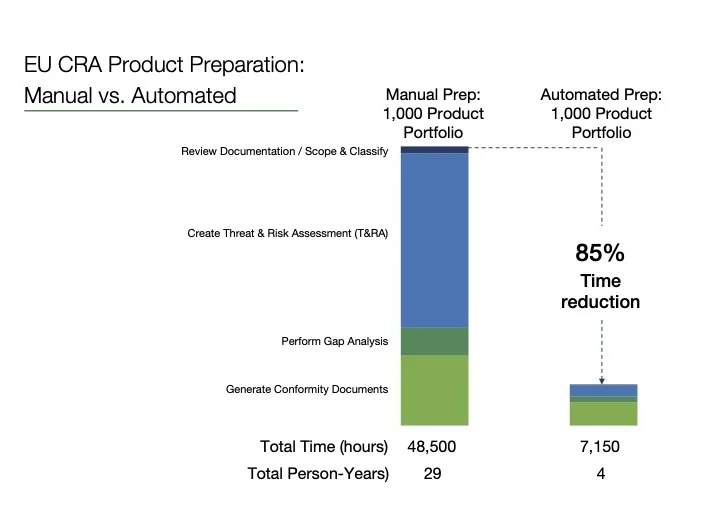
For a company with a modest portfolio of 1,000 products, the math is daunting. Industry analysis suggests that a single product requires, on average, 30 to 50 hours of dedicated effort to reach CRA conformity. This includes:
- Category determination.
- Threat and risk assessments.
- Requirement mapping (Annex I).
- Evidence management.
- Internal compliance reviews.
At 1,000 products, this equates to 30,000 to 50,000 hours of labor. Given that a typical full-time employee contributes roughly 1,700 productive hours per year, a company would need to dedicate 18 to 30 person-years of effort just to achieve initial compliance. This estimate assumes the staff is already expert in cybersecurity engineering and the nuances of the CRA—a rare and expensive skill set in the current labor market.
When you add the costs of potential product redesigns triggered by failing a risk assessment, the financial impact for large multinationals can easily stretch into the tens of millions of dollars.

Official Responses and Industry Sentiment
The European Commission maintains that these requirements are necessary to protect the internal market from the escalating threat of cyberattacks. They argue that by forcing manufacturers to take responsibility for the security of their products throughout their entire lifecycle, the EU will see a significant reduction in the surface area available for malicious actors.
However, industry bodies and trade associations have expressed concerns about the feasibility of the timeline. Many manufacturers feel caught between the need to innovate and the massive redirection of resources required to retroactively secure legacy portfolios. There is a growing consensus that the only way to meet these demands is through the widespread adoption of automation and AI-driven compliance platforms.
The Strategic Pivot: Why Automation is the Only Path Forward
The sheer scale of the task makes manual, spreadsheet-based compliance obsolete. The solution lies in AI-driven automation, which allows companies to move from artisanal, product-by-product assessment to a scalable, systematic approach.

Modern compliance platforms can process technical documentation, datasheets, and user manuals to determine whether a product falls within the scope of the CRA. By leveraging AI to generate threat models and map security requirements, companies can eliminate the most repetitive aspects of the process.
The Benefits of an Automated Operating Model:
- Consistency: Automation ensures that every product in a portfolio is assessed using the same rigor and methodology, reducing the risk of human error or regulatory oversight.
- Scalability: Once a product family is mapped, the analysis can be reused for derivatives, drastically reducing the labor-hours required for minor variations in a product line.
- Centralized Governance: A central compliance team can set the standards and oversee the documentation, while distributed development teams use the platform to input product-specific data. This bridges the "expertise gap" between high-level policy and technical execution.
- Audit Readiness: Automated platforms create structured, searchable databases of all compliance artifacts, ensuring that manufacturers can produce the required documentation for surveillance authorities in minutes, not months.
Implications for Global Trade
The implications of the CRA extend far beyond the borders of the European Union. Because the EU is a global regulatory trendsetter, the CRA is likely to influence cybersecurity standards worldwide, similar to how the GDPR reshaped global privacy laws. Manufacturers that ignore the CRA risk being locked out of one of the world’s largest and most lucrative markets.
Furthermore, the "security-by-design" requirement will force a fundamental change in how companies approach product development. The era of shipping products and patching vulnerabilities as they appear is coming to an end. In the future, a product’s security posture will be as critical a competitive differentiator as its performance, power consumption, or physical design.

Preparing for the Future
For organizations feeling overwhelmed, the time to act is now. The most effective strategy is not to attempt an all-at-once migration, but to follow a phased, iterative approach:
- Step 1: Inventory. Gather all available documentation for every product in the portfolio.
- Step 2: Automated Classification. Utilize AI-powered tools to identify which products are in-scope, saving thousands of hours of manual sorting.
- Step 3: The Pilot Program. Select a representative set of products to run through the full CRA conformity workflow. This allows the organization to build muscle memory, identify documentation gaps, and refine the process before scaling to the entire portfolio.
The EU Cyber Resilience Act is a challenge, but it is also an opportunity to modernize product security architectures. By moving away from manual, reactive processes and embracing an automated, data-driven strategy, manufacturers can turn a daunting regulatory hurdle into a robust competitive advantage. In the digital economy, security is no longer a feature—it is the foundation upon which all future growth will be built.