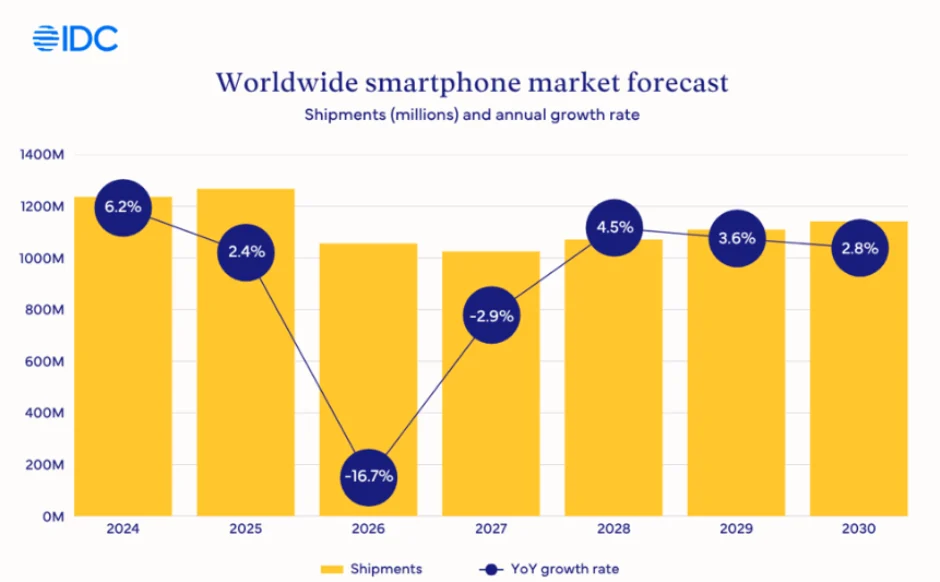
The global smartphone industry is bracing for an unprecedented annual contraction, with a severe and escalating memory shortage driving up component costs by over 300%. This seismic shift is forcing major manufacturers like Apple, Samsung, and Xiaomi to implement significant price hikes, curtail entry-level offerings, and strategically pivot towards the premium smartphone segment. Industry analysts predict the most substantial shipment decline on record for 2026, fundamentally altering the market’s dynamics and consumer purchasing habits.
The Unfolding Crisis: A Record Shrinkage in Shipments
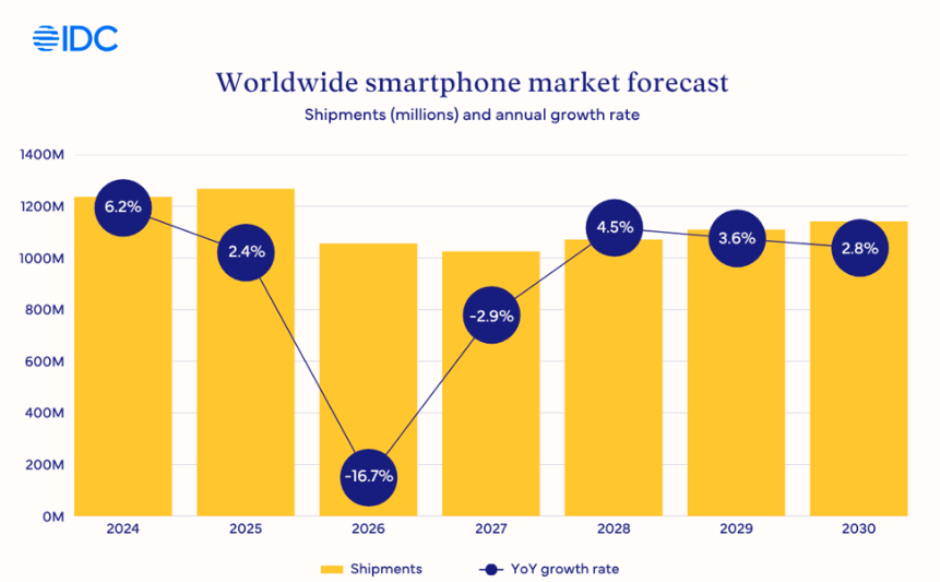
Leading market research firm IDC has issued a stark forecast, predicting that global smartphone shipments will decline by a staggering 16.7% in 2026, falling to just over 1 billion units. This revised projection represents a significant acceleration of the downturn, exceeding IDC’s earlier forecast of a 13.9% contraction. The magnitude of this expected decline underscores the severity of the challenges facing the industry.
"A drop of 16.7 percent in smartphone shipments represents the largest annual shipment contraction recorded by the industry," stated Nabila Popal, Senior Director of Data & Analytics at IDC. This historic downturn is not merely a blip but a fundamental reshaping of the market, driven by forces that are fundamentally altering the cost structure of device manufacturing.
Despite the dramatic fall in unit sales, the overall value of the smartphone market is projected to experience growth. IDC’s analysis indicates that global smartphone sales value will rise by 6.3% to reach an impressive $613 billion. This seemingly paradoxical trend—falling volumes but rising value—is a direct consequence of manufacturers significantly increasing the price of each individual device.
Escalating Costs and the Premium Pivot
The primary catalyst for this industry-wide upheaval is the escalating cost of essential memory components. The memory shortage, which began its intensification in late 2025 and has become acute in the latter half of 2026, has seen the prices of NAND flash and DRAM surge by more than 300% year-over-year. This dramatic increase has made the manufacturing of smartphones considerably more expensive.
The impact of these soaring memory prices is profound, forcing device makers to redesign their product portfolios around a permanently higher cost structure. This trend is expected to persist, with memory prices anticipated to continue their upward trajectory at least until 2028.
Consequently, the average selling price (ASP) of a smartphone is projected to reach a record $581 in 2026, marking a substantial 27.6% increase within a single year. This upward revision is even more pronounced than previous forecasts, with IDC having projected an average price of $550 in the preceding quarter. Manufacturers are now passing on the increased costs of memory and other components to consumers at a pace that has surpassed earlier expectations.
The Domino Effect: Sub-$100 Market Faces Extinction
The most vulnerable segment of the smartphone market, devices priced below $100, is facing an existential threat. Historically, manufacturers of entry-level Android phones have operated with very thin margins, making them ill-equipped to absorb significant increases in component costs. With memory prices more than tripling, many of these affordable models are becoming commercially unviable.
IDC reports a dramatic decline in this segment, with shipments in the sub-$100 category dropping by nearly 60% in the second quarter of 2026. This downward trend is expected to accelerate in the latter half of the year. Consumers in price-sensitive regions such as Africa, Latin America, and Southeast Asia will bear the brunt of this shift, as vendors are phasing out their least expensive models and reallocating production towards mid-range and premium devices.
The impact on emerging markets is projected to be severe, with smartphone shipments in these regions expected to fall by over 20% in 2026. Consumers unable to afford the higher prices may be forced to postpone upgrades, opt for refurbished devices, or extend the lifespan of their existing handsets. The average smartphone now costs approximately $147 more than it did two years ago, fundamentally altering the economics of device upgrades for a significant portion of the global population.
Manufacturer Responses: A Tale of Two Strategies
The market contraction and cost pressures are forcing manufacturers to adopt distinct strategies, with premium-focused companies like Apple appearing more resilient, while those heavily reliant on the entry-level market are facing significant challenges.
Xiaomi’s Challenging Transition:
Xiaomi, a company traditionally strong in the sub-$200 market, is providing clear evidence of the difficulties posed by memory inflation. In the second quarter of 2026, Xiaomi shipped 31.2 million smartphones, a substantial decline of approximately 26.5%. While smartphone revenue only fell by 7.5% to RMB42.1 billion, this was achieved through a significant 25.9% jump in its average smartphone selling price, reaching a record RMB1,351.
This pivot towards higher-priced devices is also evident in Xiaomi’s domestic market. Smartphones priced at RMB3,000 or more now constitute 32.1% of its mainland China sales, an increase of 4.5 percentage points. The company has also improved its standing in the RMB3,000-RMB4,000 segment, capturing 16.2% of this category. Despite these efforts, Xiaomi’s overall shipment targets have been impacted, with its full-year 2025 target revised downwards and actual shipments falling short. The company’s historical reliance on the sub-$200 segment has left it particularly exposed to memory cost increases.
Samsung’s Flagship Focus and Memory Dominance:
Samsung, a dominant player across various price points, is navigating the crisis with a dual strategy. Its Memory Business reported an all-time quarterly revenue high in the second quarter of 2026, benefiting from limited supply and rising prices. Despite weaker demand in the smartphone and PC sectors, Samsung anticipates continued undersupply in server DRAM, enterprise SSDs, and high-bandwidth memory, driven by robust AI infrastructure spending.
Samsung’s Mobile eXperience and Networks businesses generated KRW33.2 trillion in revenue for Q2 2026, supported by its Galaxy S26 series and Galaxy A devices. The company acknowledges that elevated industry-wide component costs have impacted its mobile division. Its strategic response involves a flagship-led approach, centering on the Galaxy S26 and the upcoming Galaxy Z8 series, an increased mix of premium devices, and the integration of expanded AI experiences. Samsung’s strong supply-chain relationships and established premium brands position it well to weather the current storm.
Apple’s Resilient Premium Performance:
Apple, with its deeply entrenched premium market positioning, is demonstrating remarkable resilience. The company’s fiscal Q3 2026 financial results show a significant surge in iPhone revenue, reaching $54.25 billion, a 21.7% increase year-over-year. For the first nine months of fiscal 2026, iPhone revenue climbed to $196.52 billion, up 22.4% from the previous year.
Apple’s overall quarterly revenue also saw a healthy 16% increase to $109.4 billion, with iPhone revenue hitting a June-quarter record. This performance is attributed to its customer base already being concentrated in the premium segment, where consumers are more likely to absorb higher prices, often utilizing trade-in programs and financing options available in markets like the United States and the United Kingdom. Apple’s installed base now surpasses 2.5 billion active devices, providing a stable foundation for its premium strategy.
The AI Factor: A Shift in Memory Prioritization
The current memory crisis is not solely a consumer electronics issue; it is intrinsically linked to the burgeoning demand for artificial intelligence (AI) infrastructure. Memory suppliers are increasingly prioritizing the production of higher-value products for AI servers and data centers. This strategic reallocation of resources has led to a reduced capacity available for smartphones, particularly for the less profitable, inexpensive Android devices.
The unprecedented demand for AI-powered computing is effectively siphoning off critical memory components, exacerbating the shortage for consumer-facing devices. This highlights a significant shift in supply chain priorities, where the cutting-edge demands of AI are directly impacting the availability and cost of everyday technology.
Operating System Divide: iOS Gains, Android Plummets
The market contraction is disproportionately affecting the Android operating system, while iOS is expected to see a significant market share gain. IDC forecasts a substantial 24.3% decline in Android shipments for 2026, leading to a seven-percentage-point drop in its overall market share within a single year.
This drastic decline is a direct consequence of Android’s dominance in the sub-$100 and mass-market categories, which are most susceptible to memory inflation. Manufacturers are finding it unsustainable to absorb the escalating component costs without either significantly raising retail prices or eliminating these popular models.
In contrast, Apple’s iOS is projected to experience only a 1.3% decline in shipments, while its market share is expected to increase by almost four percentage points to a record 23.6%. This divergence does not necessarily reflect an increase in consumer purchasing power but rather the collapse of inexpensive Android shipments and the relative stability of demand for premium devices.
Huawei’s Strategic Ascent: HarmonyOS Gains Traction
Amidst the disruption, Huawei is emerging as a notable beneficiary. IDC projects a near tripling of HarmonyOS smartphone shipments in 2026, reaching an estimated 51 million units. While HarmonyOS remains a smaller player globally compared to Android and iOS, Huawei is leveraging disciplined pricing and strong brand recognition, particularly within China, to capture market share as competing Android vendors reduce their volumes.
Huawei’s Consumer Business, encompassing smartphones and other connected devices, reported approximately RMB344.5 billion in revenue for 2025, a 1.6% increase. The company’s substantial investment in research and development, totaling RMB192.3 billion in 2025 (21.8% of annual revenue) and RMB1.382 trillion over the past decade, underscores its commitment to innovation and domestic supply chain development. The projected growth of HarmonyOS shipments suggests that Huawei’s software ecosystem and its control over its supply chain are becoming increasingly crucial competitive advantages in a volatile market.
The coming years will undoubtedly be a period of significant recalibration for the global smartphone industry. The memory crisis, fueled by the insatiable appetite for AI, has fundamentally altered the economic landscape, forcing manufacturers to adapt and consumers to reconsider their purchasing decisions. The era of ubiquitous cheap smartphones may be drawing to a close, ushering in a new chapter defined by premiumization and a stark divide between those who can afford the escalating costs and those who cannot.