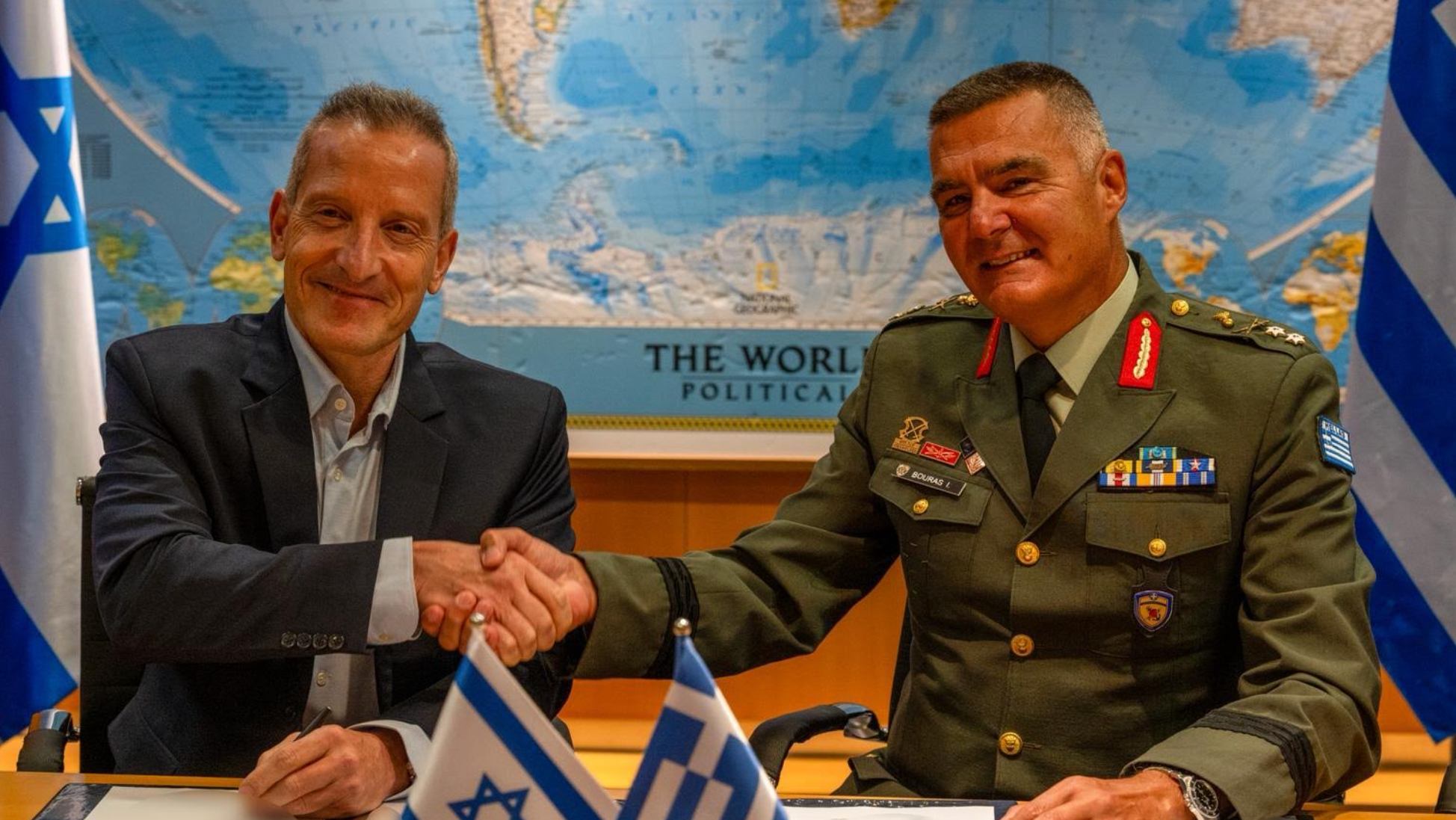
TEL AVIV – In a landmark development for Mediterranean security and regional defense industrial cooperation, Israel and Greece have officially signed a $3.4 billion (€3 billion) agreement to procure a comprehensive, multi-layered air defense architecture. The deal, finalized today at the Israeli Ministry of Defense headquarters in Tel Aviv, marks the largest defense export agreement in the history of the two nations and signals a profound shift in the strategic military alignment between Jerusalem and Athens.
Dubbed “Achilles’ Shield” by Greek authorities, the initiative is designed to provide a holistic, network-centric umbrella capable of neutralizing threats ranging from low-altitude tactical drones to long-range, exo-atmospheric ballistic missiles.
The Core Components: A Network-Centric Fortress
At the heart of the agreement is the integration of battle-proven Israeli technologies into a unified, interoperable grid. The Ministry of Defense in Israel confirmed that this is the first time it will provide an entire, end-to-end defense array to a foreign partner, utilizing operational lessons learned during the intense, multi-front conflicts Israel has faced over the past year.
The system relies on three primary pillars of Israeli defense technology:
- David’s Sling: Developed by Rafael Advanced Defense Systems in collaboration with the United States, this medium-to-long-range system is designed to intercept advanced aerial threats, including cruise missiles and heavy rockets. Since its successful combat debut in 2023, it has become a centerpiece of European procurement interests, including a notable acquisition by Finland.
- Barak MX: Produced by Israel Aerospace Industries (IAI), this modular system provides versatile protection against a variety of airborne targets. Its ability to be deployed across naval and land-based platforms makes it a flexible cornerstone for Greece’s diverse geography.
- Spyder: Also from Rafael, the Spyder system offers a quick-reaction capability against short-to-medium-range threats, including attack aircraft, helicopters, and unmanned aerial vehicles (UAVs). The inclusion of Spyder complements the broader, long-range systems, creating a "no-gap" coverage zone.
Beyond the interceptors, the deal includes the supply of advanced Multi-Mission Radars (MMR) manufactured by IAI’s subsidiary, Elta. These radars will act as the "eyes" of the Achilles’ Shield, feeding real-time target data into a centralized command structure.
Chronology of a Strategic Partnership
The signing of the Achilles’ Shield agreement is the culmination of years of deepening military, political, and industrial ties between Israel and Greece.
- Early 2020s: Greece and Israel begin conducting more frequent joint aerial and naval exercises in the Eastern Mediterranean, prompted by mutual security concerns and the need to protect offshore energy infrastructure.
- 2023: Israel’s defense industry sees a surge in international interest following the combat performance of the David’s Sling and the Iron Dome systems. Finland signs for David’s Sling, marking a turning point for Israeli export credibility in Europe.
- Late 2024: Negotiations for the Greek package intensify, with Athens signaling a desire to reform its armed forces to meet modern geopolitical challenges.
- 2025-2026: Throughout this period, Israel finalizes massive deals with Germany (the Arrow system) and Romania (the Spyder system), setting the stage for the Greek deal.
- Today: The $3.4 billion deal is signed in Tel Aviv, formalizing the most significant defense export in Israeli history.
Official Responses and Strategic Vision
Greek Minister of National Defense Nikos Dendias described the project not merely as a purchase, but as a critical evolution of the Hellenic Armed Forces. “Achilles’ Shield is an important link in the reform of our Armed Forces and an imperative response to the geopolitical and technological challenges of our time,” Dendias stated.
He emphasized that the system is “holistic,” noting that it creates a unified network where ships, aircraft, ground assets, and satellites act as a single, cohesive unit. This network-centric approach is intended to allow the Greek military to detect, track, and engage threats with unprecedented speed and accuracy.
From the Israeli perspective, the deal is a triumph of strategic policy. Major General Amir Baram, director-general of the Israeli Ministry of Defense, highlighted the broader economic and diplomatic implications.
“It is a direct application of the Ministry’s strategy: growing defense exports as a key driver of IDF force buildup, of Israel’s foreign policy influence, and of a stronger national defense industry and economy,” Baram stated. He further noted that the deal would help expand Israeli production lines—a necessity given the global strain on munitions and defense hardware caused by the ongoing conflicts in Ukraine and the Middle East.
IAI Chairman Boaz Levy echoed these sentiments, stressing that the company’s recent activity in Europe—including the landmark $6.5 billion Arrow deal with Germany—has paved the way for this deeper integration with Greece. “IAI’s operational air defense systems proved their capabilities in the recent fighting against Iran and its proxies, successfully intercepting a range of threats, chief among them exo-atmospheric ballistic missiles,” Levy noted.
Implications: The Geopolitical Shift
Strengthening Industrial Ties
The agreement includes a significant provision for the transfer of knowledge and technology to the Greek defense industry. This is a vital component for Athens, which seeks to modernize its domestic manufacturing base. By working alongside Israeli engineers and technicians, Greek firms will gain invaluable experience in integrating high-end sensor arrays and command-and-control software.
A Reliable Partner in the Eastern Mediterranean
For years, Israel has viewed Greece as a critical strategic partner. As the geopolitical landscape of the Eastern Mediterranean becomes increasingly complex—marked by shifting alliances and maritime border disputes—the ability for two NATO and non-NATO allies to share a common technological language in air defense creates a powerful deterrent.
Meeting Global Demand
The deal serves as a barometer for the current global defense market. Western nations, facing depleted stockpiles, are looking to Israel as a provider of "combat-proven" systems that have undergone the "ultimate test" of modern, high-intensity warfare. By securing this deal, Israel not only stabilizes its own defense supply chains but also cements its role as a primary security provider for European nations looking to bolster their Eastern and Southern flanks.
The "Holistic" Deterrence Concept
The shift toward a "network-centric architecture" represents the future of warfare. By integrating satellites, ground-based radars, and mobile interceptor batteries into one "brain," Greece is moving away from fragmented, platform-specific defense toward an intelligent, unified system. This prevents the "siloing" of information, ensuring that a threat detected by a naval radar can be neutralized by a ground-based interceptor miles away.
Conclusion
The Achilles’ Shield agreement is more than a commercial transaction; it is a long-term commitment to shared security. As Greece prepares to implement these systems, the Mediterranean theater will see a significant shift in defensive capability. For Israel, the deal confirms that its defense industry—tempered in the fires of recent regional conflict—is now the preferred choice for nations seeking to secure their sovereignty against the complex, multi-dimensional threats of the 21st century.
As the implementation phase begins, observers will be watching closely to see how quickly the network-centric architecture is integrated into the Hellenic Armed Forces, and whether this partnership sparks further collaborative efforts in maritime security and space-based surveillance between the two nations. In an era of profound uncertainty, Achilles’ Shield stands as a testament to the power of technological cooperation in the pursuit of regional stability.