The global telecommunications industry has unequivocally entered a pivotal era in 2026, marking a decisive phase in 5G monetisation. The initial fervor around network deployment and population coverage has receded, replaced by a laser focus on tangible financial returns. Operators are no longer solely measuring 5G’s success by the breadth of their spectrum holdings or the number of network launches. Instead, the metrics that truly define success are now Average Revenue Per User (ARPU) growth, overall service revenue, subscriber upgrades, soaring data consumption, and the strategic ability to bundle core connectivity with an array of digital services and sophisticated enterprise solutions.
This profound shift is underscored by a comprehensive analysis from GSMA Intelligence, which delves into the evolving 5G consumer trends and the burgeoning monetisation opportunities they present. The report, "5G User Trends and Behaviours Defining Monetisation Opportunities," highlights how the dynamic nature of 5G user behaviour is actively shaping new and significant revenue streams for telecom operators worldwide.
The Evolving Metrics of 5G Success
The early days of 5G were characterized by an arms race of network deployment. Operators vied to achieve widespread population coverage, secure vast spectrum licenses, and announce ambitious network launch timelines. While these foundational elements remain crucial, the industry’s maturity in 2026 has necessitated a re-evaluation of what constitutes genuine 5G success. The focus has decisively shifted from infrastructure build-out to revenue generation and customer value.
The key performance indicators (KPIs) that now dictate success are multifaceted and interconnected:
- ARPU Growth: The ability to increase the average revenue generated from each subscriber is paramount. This signifies that customers are finding enough value in 5G services to warrant higher spending.
- Service Revenue: This encompasses all revenue derived from the provision of telecom services, including voice, data, messaging, and value-added services. A healthy increase in service revenue directly reflects successful 5G adoption and monetisation.
- Subscriber Upgrades: The migration of customers from older technologies (like 4G) to premium 5G plans or devices is a strong indicator of perceived value and willingness to pay more for enhanced capabilities.
- Data Consumption: The exponential increase in data usage is a direct consequence of 5G’s enhanced speeds and capacity. Operators are finding ways to monetize this increased consumption through higher data allowances, tiered plans, and specialized data-intensive services.
- Bundling and Convergence: The strategic integration of 5G connectivity with broadband services, a growing ecosystem of digital services (streaming, gaming, cloud storage), and tailored enterprise solutions is proving to be a powerful revenue driver. This convergence creates stickier customer relationships and unlocks new profit pools.
The GSMA Intelligence report serves as a critical compass, guiding operators through the intricate landscape of 5G user behaviour and illuminating the pathways to unlocking new revenue streams. It emphasizes that understanding and adapting to how consumers are actually using 5G is no longer a secondary consideration but a primary driver of financial success.
Diverse Strategies: No Single Winning Model in 2026
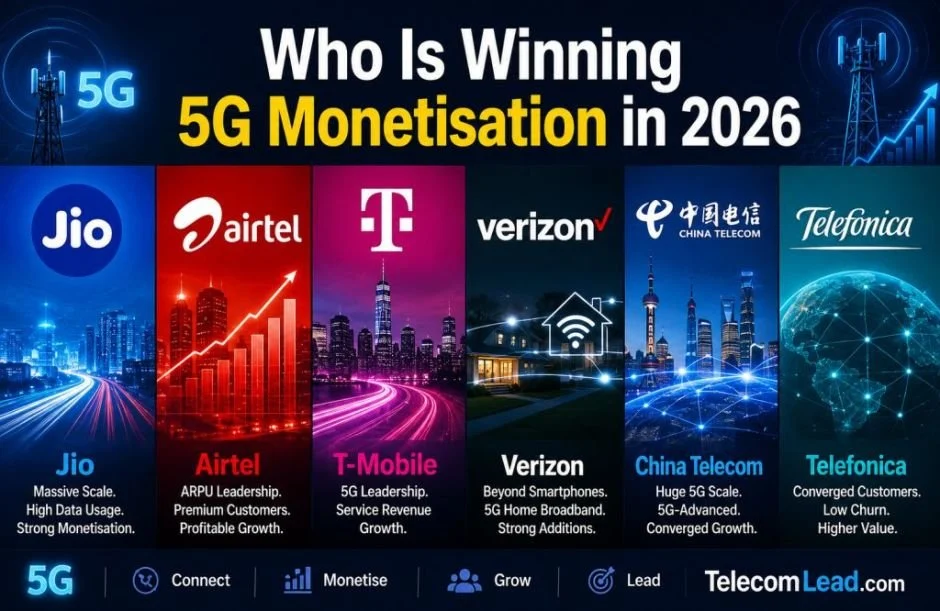
The evolving market in 2026 reveals a compelling truth: there is no monolithic "winning" model for 5G monetisation. Instead, operators are demonstrating a spectrum of successful strategies, each tailored to their unique market position, customer base, and technological strengths.
- Reliance Jio: This Indian telecommunications giant is showcasing the potent economics of sheer 5G scale. By rapidly acquiring and retaining a massive 5G subscriber base, Jio is creating an unparalleled platform for upselling higher-value connectivity and digital services.
- Bharti Airtel: In contrast, Bharti Airtel is excelling at extracting higher ARPU from its premium customer segments. Their strategy focuses on delivering superior network experiences and bundled offerings that appeal to customers willing to pay a premium.
- T-Mobile US: The American operator is a prime example of how network leadership can be directly translated into robust service revenue growth. T-Mobile’s focus on delivering a superior 5G experience has allowed them to command a loyal customer base and drive revenue.
- China Telecom: This Chinese powerhouse is forging ahead by embracing 5G-Advanced (5G-A) and developing sophisticated converged services. Their approach integrates connectivity with a wider range of digital and enterprise solutions, creating a more holistic value proposition.
- Telefónica: Telefónica’s strategy highlights how 5G can act as a catalyst for premium converged propositions, rather than being treated as a standalone revenue product. Their success lies in weaving 5G into broader bundles of mobile, broadband, and digital services.
These diverse approaches underscore the dynamic and adaptive nature of the 5G monetisation journey. Operators that are thriving are those that are not only investing in technology but also in understanding their customers and innovating their business models.
Reliance Jio: The Unmatched Power of 285 Million 5G Users
Reliance Jio has emerged as a global exemplar of mass-market 5G monetisation, leveraging an astonishing scale to drive revenue. As of the end of June 2026, Jio boasted approximately 285 million 5G subscribers, a significant increase from 268.5 million at the close of the previous quarter. This impressive figure is part of an even larger overall subscriber base exceeding 533 million, providing Jio with an enormous platform for cross-selling higher-value connectivity and digital services.
The impact of this 5G surge is clearly reflected in Jio’s financial performance. The operator’s ARPU increased to ₹215.6 in the June quarter. More critically for long-term monetisation, average monthly data consumption per customer reached an impressive 43.7 GB, the highest among India’s major telecom operators. This staggering data usage, with 5G traffic approximately 1.5 times that of 4G, unequivocally demonstrates that the migration to 5G is fundamentally reshaping network consumption patterns.
Entering fiscal year 2027 from a position of considerable strength, Jio’s performance in fiscal year 2026 was equally robust. The company generated ₹1.47 trillion in revenue from operations and ₹763 billion in EBITDA, while serving 524.4 million customers by the end of March. These figures paint a clear picture of Jio’s monetisation strategy: to migrate hundreds of millions of users to 5G, thereby dramatically increasing data consumption and subsequently monetising these enhanced relationships through a sophisticated ecosystem of broadband, cloud, AI, and digital platforms.
Bharti Airtel: ARPU Leadership as a Testament to Premiumisation
While Reliance Jio leads in the sheer volume of 5G subscribers, Bharti Airtel stands out for its exceptional performance in revenue generated per customer. Airtel’s India mobile ARPU rose by a notable 5.6 percent to ₹264 in the June 2026 quarter, comfortably surpassing Jio’s ₹215.6 and Vodafone Idea’s ARPU of ₹195. This premiumisation strategy is yielding tangible results, with Airtel’s overall revenue increasing by 18.4 percent to ₹585.39 billion, while its high-speed 4G and 5G customer base expanded by 7.5 percent.
Average mobile data consumption per customer reached 34.4 GB per month, indicating a healthy uptake of data-intensive services among Airtel’s subscribers. Airtel’s monetisation approach thus diverges from a pure volume play; it is increasingly focused on attracting and retaining premium customers through higher-value plans and a consistently superior network experience.
The company’s overall scale also plays a significant role in its success. Airtel crossed 650 million customers globally in April 2026 across its various operations, reinforcing its capacity to spread network and digital-service investments across a vast subscriber base, thereby optimizing cost efficiencies and enhancing return on investment.
The broader economic implications of mobile network transformation are further illuminated in the GSMA Mobile Economy 2026 report. This report meticulously details the escalating economic contribution of mobile connectivity as the adoption of 5G, digital services, and Artificial Intelligence (AI) continues its upward trajectory.
Vodafone Idea: Early Monetisation Signals from ARPU Growth
Vodafone Idea (Vi) presents a particularly compelling case study, given that its 5G network is considerably younger than those of its main competitors, Jio and Airtel. Despite this, Vi has begun to show encouraging signs of early monetisation. The company reported 193.1 million customers in the first quarter of fiscal year 2027, a slight increase from 192.8 million in the preceding quarter. This marks Vi’s first quarter of positive net subscriber additions since the merger of Vodafone India and Idea Cellular, a significant milestone in its turnaround journey.
The operator’s 4G/5G subscriber base saw an increase to 130.1 million from 127.4 million a year prior. Concurrently, data usage surged by an impressive 27.9 percent, escalating from 69.1 PB per day to 88.4 PB per day.
However, the most significant indicator from a monetisation perspective is the growth in customer ARPU. Vi’s ARPU increased by 10.2 percent to ₹195. While this absolute figure remains lower than that of Airtel and Jio, the accelerated growth rate strongly suggests that Vi’s strategic combination of tariff adjustments, customer upgrades, and a phased 5G network expansion is beginning to positively impact its customer economics.
T-Mobile US: Translating 5G Leadership into $19 Billion Service Revenue
T-Mobile US stands as one of the clearest and most compelling examples of how 5G leadership is directly translating into substantial revenue growth within a mature and highly competitive telecommunications market. During the second quarter of 2026, the operator generated an impressive $19.0 billion in service revenue, marking a significant 9 percent increase year-over-year. Postpaid service revenue, a key indicator of core business health, climbed even more robustly by 13 percent to $15.9 billion. According to T-Mobile US’s Q2 2026 earnings report, postpaid Average Revenue Per Account (ARPA) also saw a healthy increase of 2 percent to $152.91.
T-Mobile added 277,000 net new postpaid accounts during the quarter, expanding its total postpaid account base to 34.7 million by the end of June. Deutsche Telekom, T-Mobile’s parent company, highlighted that this sustained service revenue growth was a direct result of both an expanding postpaid customer base and an increase in average revenue per account.
This is a crucial distinction in the ongoing 5G monetisation discourse. The technology itself does not necessarily need to be presented as a separate, stand-alone "5G fee." Instead, the superior network quality and enhanced capabilities enabled by 5G can effectively support customer acquisition, improve customer retention rates, facilitate the uptake of premium plans, and drive the adoption of additional services, all of which contribute to a significant uplift in overall service revenue.
Verizon: Monetisation Beyond the Smartphone Horizon
Verizon’s strategic evolution is increasingly demonstrating the industry’s capacity to monetise its substantial 5G infrastructure investments through a dual approach: enhancing mobility services and expanding into fixed wireless access (FWA). In the second quarter of 2026, Verizon generated $23.4 billion in combined mobility and broadband service revenue, reflecting a steady 2.8 percent growth. The operator reported adding 184,000 postpaid phone customers and, significantly, 348,000 broadband customers during the same period.
The broadband additions were particularly noteworthy, comprising 193,000 fixed wireless access customers and 155,000 fiber customers. This surge in FWA adoption propelled Verizon’s total fixed wireless and fiber broadband connections to approximately 17.1 million. This development highlights one of the most significant and commercially viable 5G revenue opportunities emerging within the industry: leveraging the vast spectrum and network capacity of 5G to directly compete and capture market share within the home broadband sector, a market traditionally dominated by cable and fiber providers.
China Telecom: Ascending to 5G-Advanced and Converged Dominance
China unequivocally remains the world’s largest and most dynamic 5G market. By July 2026, the nation had achieved a staggering 1.3 billion 5G mobile subscriptions, representing an impressive 70.5 percent penetration of its total 1.85 billion mobile subscriptions. This widespread adoption is supported by a formidable infrastructure of 5.15 million 5G base stations deployed across the country.
Within this massive ecosystem, China Telecom stands out as a key player. At the close of Q2 2026, the operator served 442.43 million mobile subscribers, with a substantial 322.50 million of these being 5G network subscribers, indicating a 5G penetration rate of approximately 73 percent within its own subscriber base.
China Telecom is not resting on its 5G laurels; it is actively pushing the boundaries beyond basic 5G connectivity towards the next evolutionary stage: 5G-Advanced (5G-A). The operator reported that its 5G-A customer base had reached 4.68 million, a testament to early adoption of this enhanced technology. Furthermore, mobile data usage per subscriber saw a healthy increase of 10.6 percent year-on-year, reflecting the growing demand for data-intensive applications.
The operator’s converged customer base has now surpassed 130 million, with converged ARPU reaching RMB128. Revenue generated from partnered customer benefits experienced a remarkable 75 percent increase, clearly illustrating the significant value that operators can unlock by strategically combining core connectivity with a rich array of applications and digital services. For further insights into the operational data of this telecommunications giant, China Telecom’s 2026 subscriber and 5G operating data provides comprehensive updates across its mobile, 5G, and broadband customer segments.
China Mobile: A Colossus of 895 Million Mobile Internet Customers
China Mobile continues to operate as an enormous platform for 5G monetisation, characterized by its sheer scale and diversified revenue streams. In the first half of 2026, the operator reported an astounding 895 million mobile internet customers, adding an impressive 11.45 million new users during this period.
The operator’s mobile ARPU stood at RMB45.1, while its gigabit broadband customer base reached an impressive 117 million, an increase of 8.41 million subscribers. The household integrated ARPU further underscored the success of their bundled offerings, reaching RMB46.8.
China Mobile’s robust figures highlight a critical evolution in China’s 5G economic model. Monetisation is increasingly driven by the seamless integration of mobile connectivity with broadband, cloud computing, advanced AI capabilities, and a broad spectrum of enterprise services. This strategic convergence moves away from the expectation of significant consumer price premiums solely for basic 5G access, towards a more holistic and value-driven approach.
Telefónica: 5G as a Catalyst for Higher-Value Converged Customers
Telefónica’s financial results further reinforce a successful model built upon the strategic pillar of service convergence. In the first half of 2026, the operator reported a total of 299.8 million accesses, representing a solid 5.3 percent year-on-year growth. Its 5G network coverage extended to 83 percent of the population across its four core markets. Group revenue reached €16.392 billion, marking a 1.7 percent increase.
Spain, in particular, offers a compelling monetisation indicator. Telefónica España reported a quarterly ARPU of €91.1, accompanied by a record-low churn rate of just 0.7 percent. Its mobile contract base remained robust, exceeding 16 million subscribers.
In Brazil, Telefónica’s "Vivo Total" converged proposition continued its strong growth trajectory, reaching 3.8 million customers, a significant 29 percent increase. Telefónica Brasil’s second-quarter revenue saw a substantial increase of 17.8 percent, reaching €2.684 billion, or 7.6 percent in constant currencies. These results strongly validate the argument that the economic returns from 5G are increasingly derived from fostering larger, more integrated customer relationships that encompass mobile services, fiber broadband, entertainment packages, enterprise solutions, and a wide array of digital services.
Who Is Winning 5G Monetisation in 2026? A Multifaceted Victory
As the data from 2026 clearly indicates, there is no single, universal victor in the race for 5G monetisation. The landscape is characterized by diverse and successful strategies, each tailored to specific market dynamics and operator strengths.
Reliance Jio arguably leads in terms of global 5G subscriber scale, with its staggering 285 million 5G customers and exceptionally high data consumption metrics. This sheer volume provides an unparalleled foundation for future revenue expansion.
Bharti Airtel, on the other hand, distinguishes itself through its success in ARPU expansion, consistently achieving industry-leading figures. By reaching an ARPU of ₹264 while simultaneously growing its premium 4G/5G customer base, Airtel demonstrates the power of a focused premiumisation strategy.
In the highly competitive United States market, T-Mobile US presents perhaps the most direct correlation between network differentiation and service revenue growth. Its Q2 performance, with service revenue rising 9 percent to $19 billion and postpaid service revenue surging by 13 percent, highlights the commercial advantage of a superior 5G experience.
Verizon’s impressive addition of 193,000 fixed-wireless customers in a single quarter underscores another commercially vital avenue for 5G monetisation: effectively leveraging 5G network capacity to offer competitive and compelling home broadband solutions.
Meanwhile, China Telecom’s 322.5 million 5G customers illustrate the immense scale achieved by Chinese 5G networks. However, its strategic push into 5G-A services and its converged ARPU of RMB128 may serve as more significant indicators of where China’s next phase of 5G monetisation will be driven from.
The overarching narrative from the 2026 data is that 5G monetisation is evolving beyond simply charging customers more for the core 5G service. The operators that are achieving the strongest financial returns are those that are adept at leveraging 5G to:
- Increase Data Consumption: By providing faster speeds and greater capacity, 5G encourages higher data usage.
- Drive Customer Upgrades: Offering compelling new services and experiences incentivizes customers to move to premium plans.
- Enhance Customer Retention: Superior network performance and a broader service offering lead to lower churn rates.
- Expand into New Markets: Fixed wireless access allows operators to compete effectively in the home broadband market.
- Develop Converged Packages: Bundling 5G with other services creates a more attractive and sticky proposition.
- Generate New Revenue Streams: Targeted enterprise solutions and innovative digital services unlock entirely new profit pools.
In essence, the true winners in the 5G era are not merely those with the most advanced networks, but those that can most effectively translate their network investments into broader, deeper, and more valuable customer relationships.
FASNA SHABEER