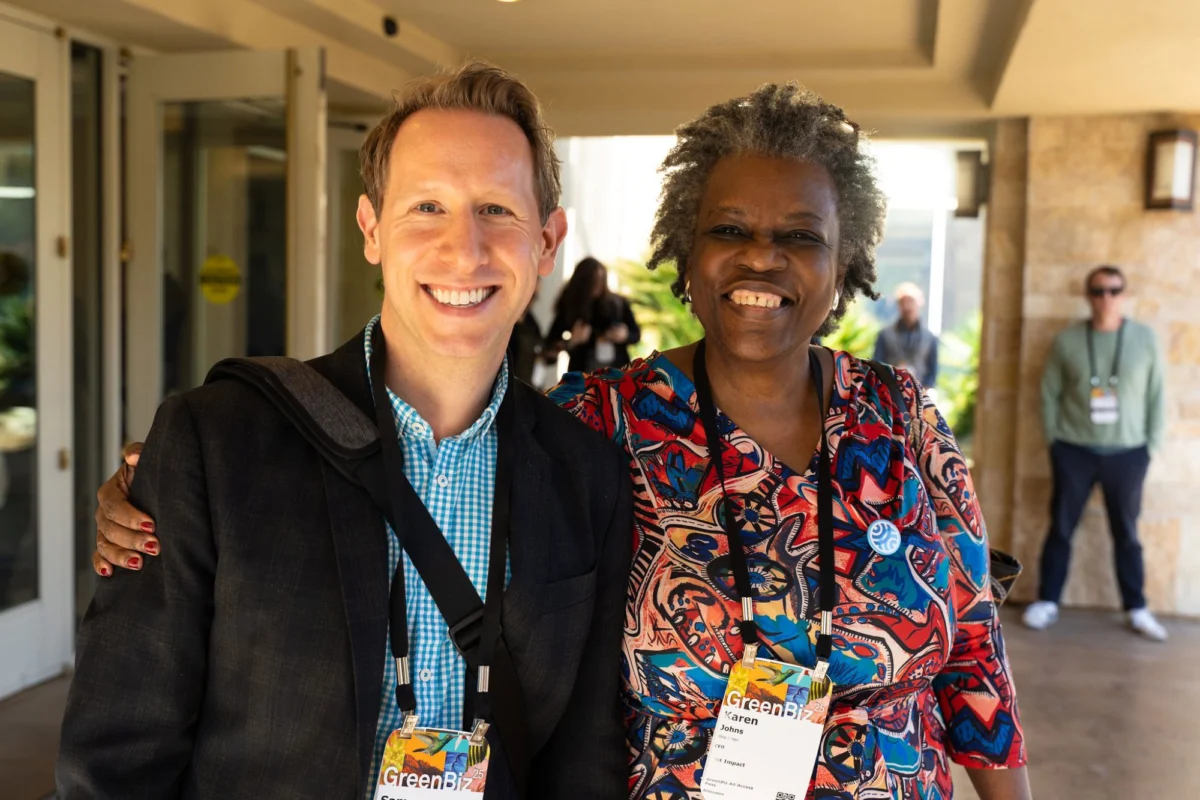
For those who navigate the professional circuit of sustainability—the annual treks to GreenBiz, the marathon weeks of COP, and the bustling climate summits from New York to Singapore—the experience is defined by a jarring duality. On one hand, there is the “soft” appeal: the electric energy of a crowded room, the serendipitous discovery of a like-minded collaborator, and the profound sense of belonging to a global movement. On the other hand, there is the “hard” reality: the mounting costs, the carbon footprint of intercontinental travel, the personal toll of jet lag, and the relentless anxiety of an overflowing inbox left behind at the office.
This friction between what sustainability events promise and the physical and financial price they exact was the focal point of a recent episode of the Two Steps Forward podcast. As the discussion unfolded, a compelling thesis emerged: the intangible elements of these conferences—those moments of connection and community—are not merely "soft add-ons" to the professional agenda. They are, in fact, the entire business case.
The Shift: From Passive Consumption to Peer Connection
For decades, the event industry has been tethered to a model of passive consumption. Programming teams spend the vast majority of their budgets and intellectual energy curating keynote speakers, perfecting slide decks, and managing the logistics of stage-based panels. Yet, evidence suggests that the audience is no longer interested in being lectured to.
A landmark report by Encore and Boldpush, 2026 Experience Design Report: Shaping What Drives Value in Live Corporate Events, provides a stark, data-driven wake-up call to the industry. The findings are unequivocal: peer connection now reigns supreme as the primary driver of event value. Participants are prioritizing horizontal networking—connecting with one another—over vertical content delivery.
In the eyes of the modern attendee, a participatory workshop that forces collaboration is vastly more valuable than a high-production-value panel discussion. The report underscores a fundamental shift in professional development: trust is not built through the polished rhetoric of a talking head on a stage; it is forged through face-to-face vulnerability and shared problem-solving. When attendees are asked why they keep showing up, their answers rarely mention the specific speaker they saw at 2:00 p.m. on a Tuesday. They mention the person they met over coffee who helped them solve a supply-chain hurdle that had been plaguing their organization for months.
Chronology of an Evolving Landscape
The evolution of the sustainability conference circuit has been marked by two distinct trends: consolidation and expansion. Historically, the professional calendar was populated by a dozen or so anchor events—BSR, Ceres, Sustainable Brands, and various media-hosted summits. These events served as the heartbeat of the industry, providing a predictable rhythm to the year.
However, the last five years have fundamentally altered this schedule.
- 2019–2021: The pandemic forced a global pause, leading to an explosion of digital-only formats. While accessible, these formats confirmed the industry’s suspicion: digital events could transfer information, but they struggled to foster the deep, trust-based relationships that drive systemic change.
- 2022–2024: As the world reopened, the schedule compressed into "super-weeks." Events like Climate Week and the annual COP conferences became gargantuan, tentpole gatherings where thousands of professionals congregate at once.
- 2025–Present: We are now witnessing a geographical expansion. Sustainability programming is no longer concentrated in London, New York, or Geneva. There is a surging demand for localized, high-impact summits in India, Southeast Asia, Latin America, and Africa.
This leaves the modern sustainability professional with a paradox: there are more places to be than ever before, but less time to spend in each. The result is a fragmented experience where the "nuggets" of deep connection are harder to mine, and the ROI of attending becomes increasingly difficult to justify on a traditional balance sheet.
The COP Experience: A Case Study in Extreme Logistics
Perhaps no event illustrates this tension better than the United Nations COP conferences. COP31, scheduled for November in Antalya, Turkey, serves as the ultimate test of the “in-person” thesis.
The logistical reality of a COP is, by almost any standard, abysmal. Attendees navigate a labyrinth of checkpoints, endure grueling wait times for basic necessities like food and water, and often face significant safety concerns—a reminder of the instability that plagued previous iterations, including the fire at the COP30 venue. For the professional negotiator, the tangible outputs of these weeks are often incremental and exhausting.
Yet, despite the chaos, thousands of the world’s most influential sustainability experts continue to flock to these venues. Why? Because of the "snaking line" phenomenon. It is in the interstitial spaces—waiting in line for a security check, huddled under an umbrella during a rainstorm, or navigating the corridors between breakout sessions—where the real work happens.
In these moments, a stranger from Côte d’Ivoire might provide the exact legislative context needed for a policy push in the EU. A casual dinner recommendation from a passer-by might lead to a meeting that shifts the trajectory of a company’s decarbonization strategy. These interactions appear on no agenda, yet for many, they are the sole justification for the journey.
Intimacy at Scale: The New Programming Paradigm
Recognizing this, industry leaders—including the team at Trellis—have begun to pivot toward a strategy they call "intimacy at scale." The objective is to stop treating the conference as a theater where attendees watch a show and start treating it as a laboratory where attendees curate their own collisions.
This strategy requires a departure from traditional event planning:
- Curation of Cohorts: Instead of general seating, events are increasingly segmenting attendees into smaller, challenge-oriented cohorts to lower the barrier to entry for networking.
- Space as Strategy: The architecture of the venue is being redesigned to prioritize lounges, roundtables, and "collision spaces" over traditional auditorium seating.
- Facilitated Serendipity: Using AI and better networking apps to match attendees not by industry, but by the specific, vexing challenges they are currently trying to solve.
The goal is to create conditions where, despite the presence of 5,000 people, an individual feels they have found “their people.” This is the secret to retaining attendees in an era where the cost of travel is being scrutinized through the lens of both corporate budgets and carbon emissions.
Implications for the Future of Professional Events
The implications for the industry are profound. If peer-to-peer connection is the primary product, then event organizers must stop acting as content broadcasters and start acting as community architects.
The Financial Disconnect
There is a fundamental mismatch in how companies report the cost of attendance. Expense reports track airfare, hotel, and registration fees—the tangible costs. They fail to track the "intangible gains": the partnership that saved the company $500,000, the mentor who helped a team lead navigate a crisis, or the cross-industry coalition that launched a new circular economy initiative. Until organizations find a way to measure the ROI of these relationships, the sustainability conference will always be an easy target for budget cuts.
The Sustainability Mandate
Furthermore, the industry is entering an era of radical accountability. With the rising focus on Scope 3 emissions, companies are increasingly wary of sending large delegations to conferences unless the impact is clearly defensible. The “conference for the sake of networking” model is dying. In its place, we are seeing a demand for "high-density" events—gatherings that are shorter, more focused, and intentionally designed to produce concrete outcomes rather than just shared experiences.
Conclusion: The Enduring Value of Human Presence
As we move forward, the "soft" benefits of sustainability conferences—connection, community, and shared energy—must be treated with the same rigor as the "hard" business objectives. The paradox of the modern event is that while technology allows us to exchange data instantaneously, it has failed to replicate the trust-building capacity of a shared physical space.
The future belongs to the events that embrace this paradox. By acknowledging that the "soft" stuff is, in fact, the business case, organizers can create experiences that are not only more sustainable but more meaningful. As the global sustainability movement continues to expand into new regions and tackle more complex challenges, the ability to foster genuine, human-to-human connection will remain the most critical infrastructure we have.
Ultimately, the expense report may only capture the flight and the hotel. But the real value of these events is found in the conversations that happen in the hallways, the alliances formed in the coffee queues, and the enduring relationships that persist long after the last keynote speaker has left the stage. That is the tangible ROI of the intangible, and it is a currency that will never lose its value.