In the rapidly evolving landscape of 2026, a new professional archetype has emerged from the crucible of the AI gold rush: the Forward Deployed Engineer (FDE). As artificial intelligence shifts from experimental lab projects to the backbone of mission-critical enterprise infrastructure, the demand for professionals who can bridge the gap between abstract AI capabilities and messy, real-world business requirements has skyrocketed.
For companies like Anthropic and OpenAI, the FDE is no longer just an optional resource—they are the linchpin of product adoption. With industry leaders like DXC Technology recently committing to training tens of thousands of Claude-certified engineers, the FDE has cemented its status as one of the most vital, well-compensated, and intellectually demanding roles in the modern technology sector.
The Anatomy of the FDE: Beyond the Codebase
To understand the FDE, one must first dismantle the traditional definition of a software engineer. A conventional engineer is often presented with a discrete, well-scoped technical task: "Build this service" or "Optimize this database query."
The FDE, by contrast, operates in the realm of ambiguity. They are frequently dispatched to solve open-ended business dilemmas, such as: "This insurance firm has nearly two decades of claims data fragmented across six legacy systems. Their analysts lose four hours per claim to manual review. Can AI reduce this to 20 minutes without compromising data security or introducing hallucinations?"
The FDE is a hybrid professional—a fusion of software engineer, data architect, solutions consultant, and AI specialist. Their lifecycle of work is comprehensive, spanning discovery, technical scoping, system design, implementation, evaluation, and, ultimately, production rollout.
The Economic Reality: Compensation and Demand
As of August 2026, the economic rewards for this versatility are significant. Data from ZipRecruiter indicates an average annual salary of approximately $116,463, with median figures reaching $124,300. However, these figures are often conservative; for roles at top-tier AI labs or high-growth enterprise SaaS firms, compensation packages—including equity and bonuses—frequently push well into the top percentiles of engineering compensation.
This premium is paid for a unique, high-friction skill set. Employers are not looking for theoretical researchers; they are looking for "full-stack" operators who can thrive in the chaotic environment of enterprise IT, where outdated schemas, complex compliance requirements, and non-technical stakeholders are the norm.
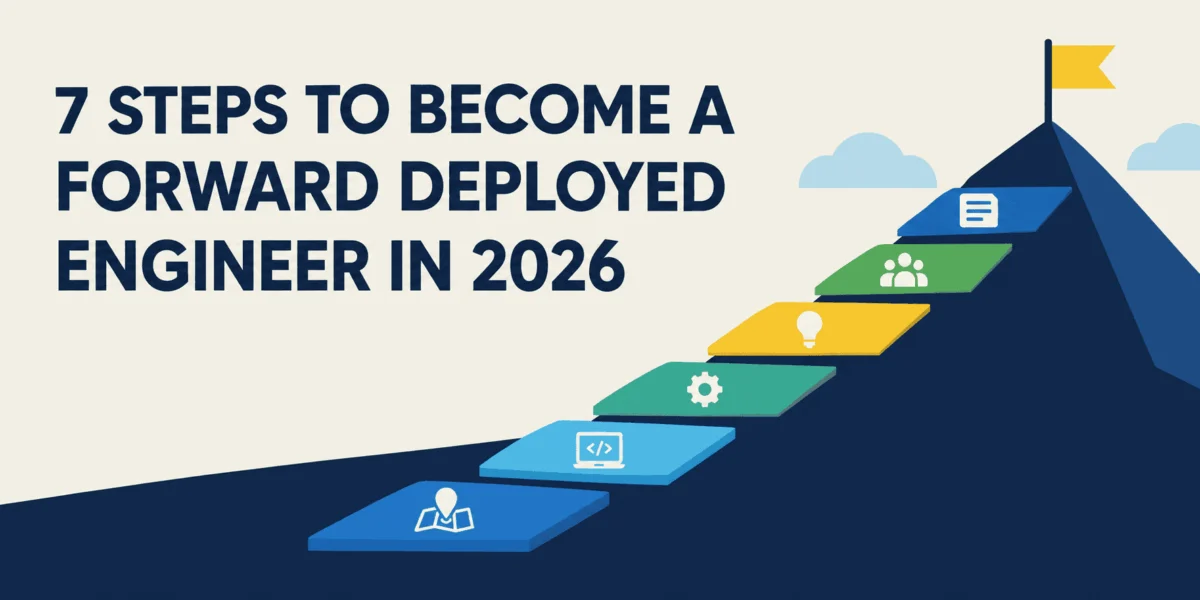
A Seven-Step Roadmap to FDE Excellence
1. Hardening Software Engineering Fundamentals
The foundation of the FDE remains robust software engineering. Python continues to dominate the landscape, appearing in over 40% of analyzed job descriptions for FDE and adjacent roles in 2026. While you do not need to be a competitive programmer, you must be capable of writing clean, maintainable, and scalable production code.
- Focus Areas: Proficiency in Python, understanding of data structures, version control (Git), and an ability to write unit tests that ensure system stability in production.
2. Mastering the Data Ecosystem
Customers rarely provide pristine datasets. An FDE must be comfortable navigating a "spaghetti" environment of PostgreSQL databases, Salesforce CRM instances, Snowflake data warehouses, and legacy REST APIs.
- Skill Acquisition: Learn to ingest data from disparate sources, understand OAuth authentication flows, and manage message queues. The ability to parse and integrate undocumented or poorly documented legacy APIs is a hallmark of a senior-level FDE.
3. Deployment and System Operations
"It works on my machine" is a disqualifying phrase for an FDE. You are expected to own the deployment lifecycle.
- Core Competencies: Proficiency in Docker and container orchestration (Kubernetes), familiarity with cloud providers (AWS, GCP, Azure), and the ability to implement CI/CD pipelines. An FDE must understand how to monitor latency, track costs, and manage system health in real-time.
4. The Shift to Applied AI Engineering
In 2026, the "AI" component of the role is mandatory. However, this does not imply a need for a PhD in machine learning. Instead, it requires the practical ability to implement LLMs, agents, and Retrieval-Augmented Generation (RAG) systems.
- Practical Application: Focus on prompt engineering, vector database management, and understanding the nuances of model evaluation. You are the architect who ensures that when an enterprise uses an AI, the output is reliable, grounded in truth, and compliant with data privacy regulations.
5. Enterprise Security: The Non-Negotiable Pillar
For large corporations, a "move fast and break things" mentality is a liability. FDEs must operate with a "security-first" mindset.
- Key Concepts: Tenant isolation, principle of least privilege, PII (Personally Identifiable Information) masking, and robust audit logging. Understanding how to integrate AI without leaking sensitive data is what differentiates a junior candidate from a hireable expert.
6. The Art of Customer Discovery
This is the "soft" skill that carries the most weight. You must transition from being a passive order-taker to an active problem-solver. When a client requests a "chatbot," an FDE asks: "What business outcome are you trying to achieve? How is this currently measured? Where is the primary bottleneck?"
- The Goal: You are a consultant. Often, the best technical solution is not to build a complex AI feature, but to simplify an existing process or optimize an existing data pipeline.
7. Constructing the "FDE-Style" Portfolio
Avoid the trap of generic "to-do list" applications. Your portfolio should demonstrate your ability to handle complexity.
- Project Recommendations:
- The Enterprise Agent: Build a system that performs RAG on a proprietary dataset, includes human-in-the-loop approval steps, and logs cost/latency metrics.
- The Data Pipeline: Create a system that extracts data from raw PDFs, validates the schema, and routes anomalies to a human-review interface.
- The Domain Expert: Choose a specific industry—such as healthcare or legal—and build a tool that solves a workflow pain point in that sector, demonstrating your ability to learn a domain beyond pure technology.
Official Industry Response: The DXC-Anthropic Alliance
The recent announcement of a multi-year global alliance between DXC Technology and Anthropic serves as a bellwether for the industry. By committing to training tens of thousands of Claude-certified FDEs, these companies are effectively creating a new standard for enterprise readiness. This shift signals that the era of "AI experimentation" is ending, replaced by an era of "AI integration." Enterprises are no longer interested in demos; they are demanding scalable, secure, and professionally managed AI deployments.
Implications for the Future
The emergence of the FDE role suggests that the next decade of software engineering will be defined by "integration and application" rather than pure innovation. As frontier models reach a plateau of capability, the competitive advantage for companies will lie in their ability to deploy these models into the complex, messy realities of global business.
For the aspiring engineer, the path is clear: stop focusing on becoming a specialist in a single language or framework. Instead, cultivate the ability to walk into a room, listen to a complex, ill-defined business problem, and architect a solution that balances technical rigor with organizational reality. In 2026, the Forward Deployed Engineer is not just a role—it is the bridge to the future of the digital enterprise.