
In the world of machine learning, the most catastrophic failures rarely occur because of a poorly tuned neural network or an incorrect loss function. Instead, they happen in the "invisible" space between raw data ingestion and model training. For many data scientists, the transition from prototype to production is marred by "data leakage"—a phenomenon where information from the validation or test set inadvertently leaks into the training process, leading to models that perform exceptionally well in a development environment but fail miserably in the real world.
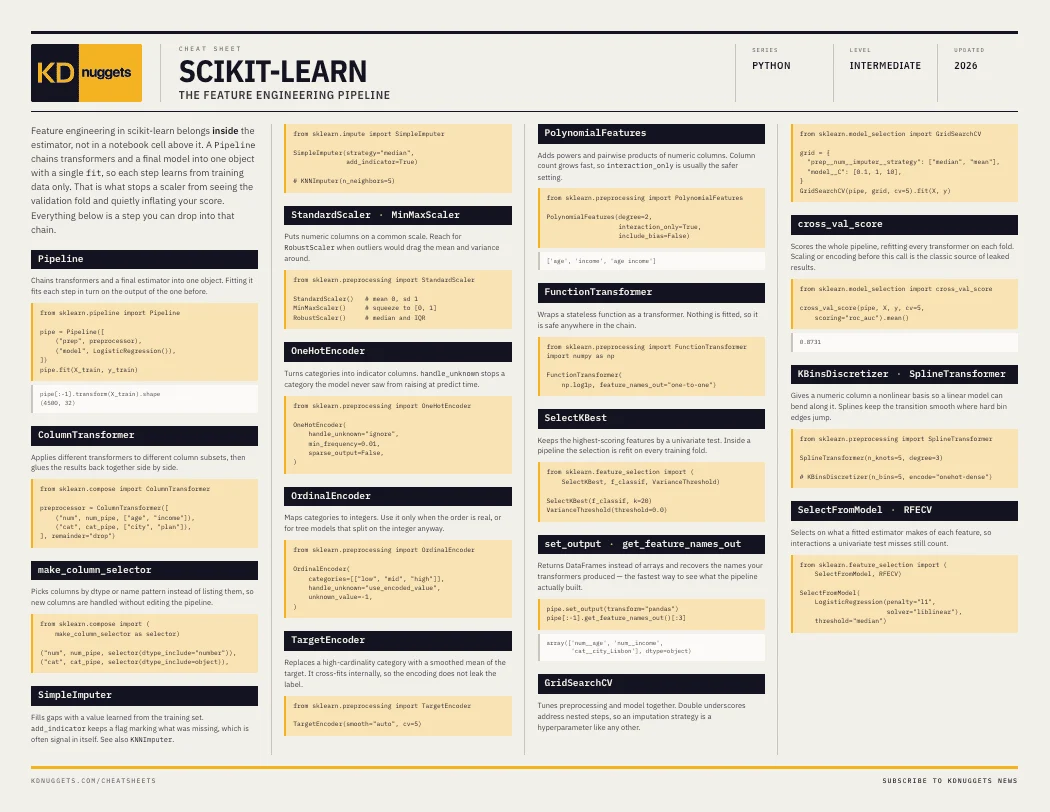
To address this persistent challenge, KDnuggets has released a comprehensive new cheat sheet focused on Feature Engineering in Scikit-Learn. By centralizing the best practices for pipelines, transformers, and automated preprocessing, this resource serves as a roadmap for building robust, reproducible machine learning workflows.
The Anatomy of a Machine Learning Failure
Understanding Data Leakage and Preprocessing Pitfalls
For many practitioners, the early stages of a machine learning project involve a fragmented workflow. A typical "beginner’s mistake" involves scaling columns in one notebook cell, encoding categorical variables in another, and fitting a model much further down the script. While this approach might yield high cross-validation scores, those metrics are often illusions.
When preprocessing steps—such as mean-imputation or feature scaling—are applied to an entire dataset before it is split into training and testing folds, the model is exposed to global statistics. The mean of the entire dataset, for instance, includes information from the validation set, essentially "telling" the model about the data it is supposed to be predicting.
As the KDnuggets resource highlights, the solution is not necessarily to learn more complex algorithms, but to change where preprocessing lives. By encapsulating every step of data transformation within a Scikit-Learn Pipeline, developers ensure that each transformer is fitted strictly on the training data. This architectural shift guarantees that the model is scored on what it has actually learned, rather than what it has "peeked at."
Chronology: The Evolution of the Scikit-Learn Pipeline
The history of Scikit-Learn is defined by a shift from ad-hoc scripting to integrated, object-oriented workflows.
- The Early Days: In the infancy of Scikit-Learn, developers relied heavily on manual data manipulation using NumPy and Pandas. Preprocessing was an external, manual burden.
- The Introduction of Pipelines: The
sklearn.pipeline.Pipelinemodule revolutionized the ecosystem by allowing a sequence of transformers to be wrapped into a single estimator object. This meant that callingfit()orpredict()on the pipeline would automatically trigger the entire chain of transformations. - The Rise of
ColumnTransformer: As datasets became more heterogeneous—mixing numerical, categorical, and text data—the need for column-specific processing became acute. The introduction ofColumnTransformerallowed for the "divide and conquer" approach, enabling different preprocessing logic to run in parallel on specific subsets of features. - Modern Refinements: Today, features like
set_output(transform="pandas")and integrated hyperparameter tuning represent the maturity of the ecosystem. These tools bridge the gap between abstract mathematical transformations and human-readable data frames.
Supporting Data: The Essential Components of a Robust Pipeline
The new cheat sheet focuses on the "boring" but vital components that ensure a pipeline remains maintainable as a project scales. Here are the core building blocks:
1. The Power of ColumnTransformer and make_column_selector
Manually splitting data frames by hand is a recipe for error. ColumnTransformer allows developers to define a list of tuples containing the transformer and the columns it should affect. By pairing this with make_column_selector, data scientists can select features based on their dtype (e.g., selecting all float64 columns). This creates "future-proof" pipelines; if a new numerical column is added to the dataset later, the pipeline automatically detects it and applies the correct transformations without manual intervention.
2. Intelligent Imputation with SimpleImputer
Missing data is a common reality in real-world datasets. The SimpleImputer class is a workhorse, but its true power lies in the add_indicator=True argument. By creating a binary flag indicating where values were missing, the model can learn whether the absence of information is itself a signal—a common pattern in human-generated data.
3. Categorical Encoding: Handling the Unknown
Encoding categorical variables—specifically via OneHotEncoder—can lead to production crashes when a new, unseen category appears in the test data. Setting handle_unknown="ignore" is a critical safety valve that allows the pipeline to proceed by ignoring unknown categories rather than throwing an exception. For high-cardinality features, TargetEncoder serves as a sophisticated alternative, mapping categories to the mean of the target variable, which is often far more efficient than generating hundreds of sparse columns.
4. Transparency with set_output
One of the primary criticisms of Scikit-Learn pipelines in the past was their "black box" nature. When a pipeline transforms data, it often returns a raw NumPy array, making it difficult to trace feature importance. The modern set_output(transform="pandas") method ensures that every step of the pipeline returns a DataFrame with labeled columns, while get_feature_names_out() allows the developer to audit exactly how twelve input columns were expanded into one hundred output features.
Official Perspective: The Philosophical Shift
The philosophy behind the cheat sheet is simple: Everything belongs in the chain.
By treating preprocessing as part of the model’s configuration, the search space for hyperparameter optimization expands significantly. When using GridSearchCV or RandomizedSearchCV, a developer can now treat the imputation strategy (e.g., mean vs. median) or the encoding strategy as a hyperparameter.
This creates a unified search process where the model architecture, regularization parameters, and data preprocessing strategy are tuned simultaneously. This level of automation reduces the "human-in-the-loop" requirement for data cleaning, significantly accelerating the development cycle and ensuring that the final model is as performant as possible given the available data.
Implications: Why This Matters for the Future of Data Science
The release of this cheat sheet underscores a broader trend in the data science industry: the shift toward MLOps-ready code.
Eliminating Technical Debt
By codifying data processing into modular pipelines, organizations reduce the technical debt associated with "spaghetti code" notebooks. When a model is ready to move to production, the pipeline object can be serialized (e.g., using pickle or joblib) and deployed directly to a REST API or a cloud-based inference service. This ensures that the exact same transformations applied during training are applied during inference.
Bridging the Gap Between Research and Production
Data scientists often complain that their work is not implemented because it is too difficult to reproduce in production. Standardized pipelines bridge this gap. When a researcher uses the same ColumnTransformer syntax as the production engineering team, the friction of deployment drops to near zero.
Democratizing Best Practices
Perhaps most importantly, the cheat sheet serves as a guide for newer practitioners who may not yet be aware of the "gotchas" that haunt veteran data scientists. By highlighting the specific arguments—such as handle_unknown="ignore" or the nuance of TargetEncoder—the cheat sheet prevents the repetition of historical mistakes.
Conclusion: A Call to Structure
The machine learning community is moving away from the "wild west" of ad-hoc scripts toward a more disciplined, engineering-focused approach. The KDnuggets cheat sheet on Scikit-Learn feature engineering is more than just a quick reference; it is an invitation to adopt a rigorous, modular, and safe way of thinking about data.
As we look toward the future, the models that will succeed are not necessarily the ones with the most layers or the longest training times. They will be the ones built on solid, transparent, and leakage-free pipelines. By mastering these tools, data scientists can stop fighting their preprocessing and start focusing on what really matters: extracting value and insight from their data.
Resource Link: Download the Feature Engineering in Scikit-Learn Cheat Sheet