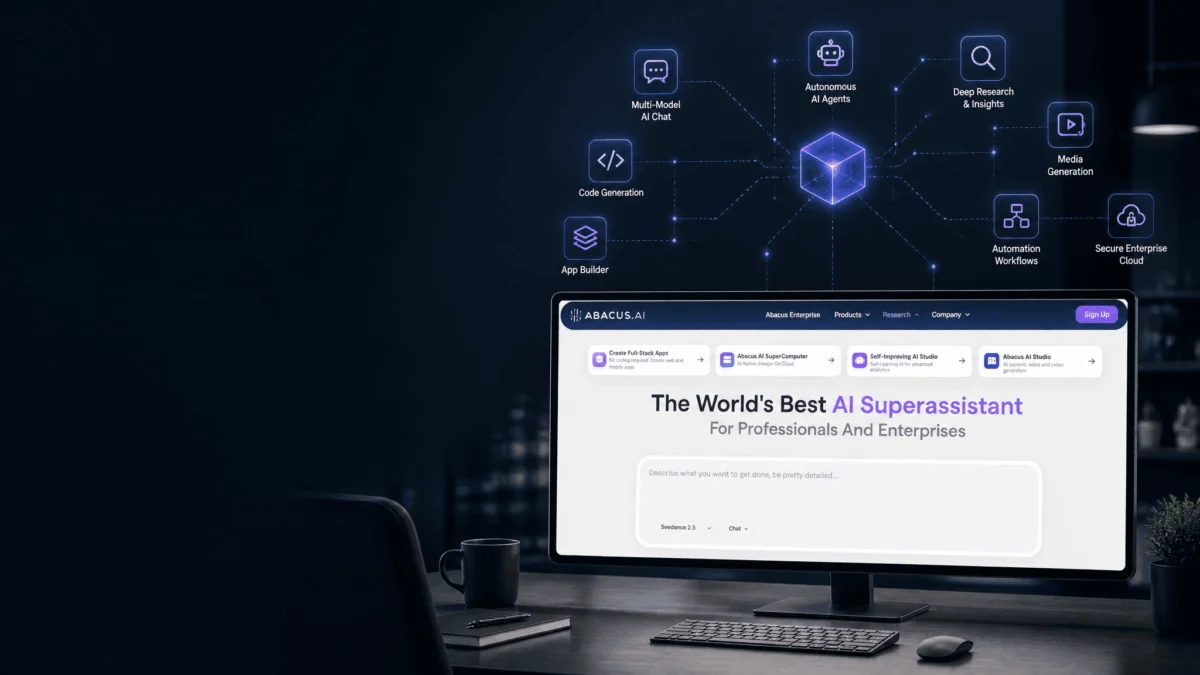
In an era defined by "subscription fatigue," where professional workflows are often fractured across a dozen different AI platforms, Abacus AI has emerged as a disruptive contender. By promising a consolidated "super assistant" that bridges the gap between simple chatbots, autonomous agents, and full-stack development environments, the platform seeks to solve the fragmentation of the modern digital workspace. However, as with any ambitious aggregation tool, the trade-offs—ranging from credit opacity to the complexities of orchestration—demand a closer look.
This article dissects the Abacus AI ecosystem, evaluating whether it truly functions as a unified professional utility or merely adds another layer of complexity to an already crowded tech stack.
The Core Proposition: Consolidation vs. Specialization
The fundamental problem Abacus AI aims to address is "tool sprawl." Currently, a professional might pay for ChatGPT for general reasoning, Claude for nuanced coding, Midjourney for creative assets, and a separate service for automated workflows. Context is lost when files are moved between these silos, and costs stack up quietly.
Abacus AI attempts to solve this by housing over 100 language, image, and video models under one roof. Its ecosystem—comprising ChatLLM, Abacus AI Agent, RouteLLM, Desktop, Studio, and AppLLM—is designed to be a one-stop-shop. By routing prompts to the most appropriate model or allowing manual selection, the platform offers a "hub-and-spoke" model for AI interaction.
Chronology: From Enterprise ML to Consumer Agent
Founded in 2019 by researchers with deep roots at Google Brain and other top-tier institutions, Abacus AI began its life as an enterprise machine-learning platform. For years, it focused on high-stakes organizational use cases: fraud detection, anomaly detection, and predictive forecasting.
The shift toward the current consumer-facing suite began in earnest between 2024 and 2025. As the Generative AI market exploded, Abacus leveraged its existing infrastructure to roll out "ChatLLM." By mid-2025, the platform had evolved rapidly, incorporating "DeepAgent" (now Abacus AI Agent) and building out developer-focused tooling like AppLLM and SuperComputer. This evolution tracks the broader industry trend: moving from static chatbots toward "agentic" workflows that can execute tasks rather than just provide information.
Supporting Data: Understanding the "Credit" Economy
The most significant friction point for new users is the platform’s credit-based billing system. Unlike a standard SaaS subscription that offers "unlimited" usage, Abacus AI ties its pricing to resource consumption.
- The Basic Tier ($7–$10/mo): Intended for individual professionals. It provides access to the core chat interface and basic agent tasks.
- The Pro Tier ($20/mo): Unlocks higher credit limits and removes many of the restrictions on Agent complexity and Desktop integration.
- The Enterprise Tier ($5,000+/mo): Offers dedicated compute, SOC 2 compliance, and in-VPC deployment options.
The Complexity of Consumption: Credits are not a 1:1 measure of tokens. Because the platform facilitates high-compute tasks—such as video generation, persistent cloud runtime via SuperComputer, and multi-step agent reasoning—the depletion rate is highly variable. An hour of text chat might cost pennies in credit terms, while a single complex video generation or a looping agent process can significantly drain a monthly allocation. This variability is the primary source of user friction, as it creates an "unpredictable utility bill" dynamic rather than a flat-rate subscription.
Official Stance and Security Commitments
For professionals handling proprietary data, the security architecture is the most vital component of the platform. Abacus AI officially documents the following:
- Encryption: AES-256 for data at rest and TLS 1.2+ for data in transit.
- Compliance: The platform aligns with SOC 2 Type II, ISO/IEC 27001:2022, HIPAA, GDPR, and CCPA.
- Data Sovereignty: The company explicitly states that customer data is not used to train generalized or proprietary models, a critical differentiator from some free-tier consumer chatbots.
However, these certifications apply primarily to the platform’s infrastructure. Users must recognize that the application of these tools—such as granting a desktop agent permission to read sensitive local files or connecting an agent to a private email server—introduces human-managed risk. The vendor’s documentation emphasizes that while the "pipes" are secure, the "flow" of data remains a user-managed responsibility.
The Performance Gap: Promises vs. Reality
Independent research and user feedback suggest a divergence between marketing claims and the "in-the-wild" experience.
1. Agentic Reliability
Abacus AI Agent is designed to handle multi-step tasks, such as market research or code review. While some users report high success rates, others highlight "hallucination loops," where an agent gets stuck in a repetitive cycle, consuming credits without producing a finished result. This is a common hurdle for current-generation autonomous agents, not limited to Abacus, but it necessitates a "human-in-the-loop" strategy.
2. The "Router" Accuracy
RouteLLM allows developers to use one endpoint that intelligently selects a model. While the concept is elegant, independent benchmarks from early 2026 indicate that even the best routers still struggle to match the performance of an ideal, human-curated model selector. Developers should view the router as a tool for efficiency, not as a replacement for manual model optimization in high-stakes environments.
3. Interface Overhead
While "all-in-one" is a powerful value proposition, it creates cognitive load. The interface must balance dozens of tools, which can feel overwhelming compared to the streamlined, minimalist UIs of competitors like Claude or ChatGPT. For simple tasks, the "everything" approach can actually be slower than using a single-purpose application.
Implications for the Professional Workflow
The implications for a user considering a switch are profound:
- Financial Efficiency: For those currently paying for three or more separate AI subscriptions, Abacus AI is mathematically likely to reduce costs. If you are already paying for OpenAI, Anthropic, and a creative tool, the $20 Pro plan is a significant bargain.
- Operational Risk: If your workflow relies on 99.99% reliability, the "agentic" nature of the platform requires a staged rollout. You should not move your most critical business processes to an autonomous agent without a testing phase.
- Development Velocity: For technical founders, the ability to build, host, and deploy an application using AppLLM while having access to a local coding assistant (Desktop) creates a unique competitive advantage in speed-to-market.
Final Assessment: Is It Worth the Subscription?
Abacus AI is currently an 8/10 proposition. It succeeds because it recognizes that the future of AI is not just "chatting" but "doing." It is the most robust toolkit for a professional who needs to bridge the gap between creative, analytical, and technical AI requirements.
You should choose Abacus AI if:
- You are a power user or developer who frequently toggles between different model families.
- You need a unified environment for coding, app deployment, and complex research.
- You are tired of managing multiple subscriptions and want a centralized billing and usage dashboard.
You should look elsewhere if:
- Your AI needs are limited to simple, high-frequency text interaction.
- You require a "set-and-forget" tool and have zero tolerance for managing credit budgets or troubleshooting agent loops.
- You prefer the polished, minimalist UX of first-party products like Claude or Gemini.
The most sensible strategy remains the "trial-by-workload." Use the introductory pricing to run three of your most common, yet distinct, tasks (e.g., a coding query, a research summary, and a creative generation). If the platform reduces your friction and keeps costs within your projected monthly budget, it is a superior alternative to the current fragmented landscape of AI services. If not, the simplicity of a first-party subscription likely outweighs the versatility of an all-in-one platform.