
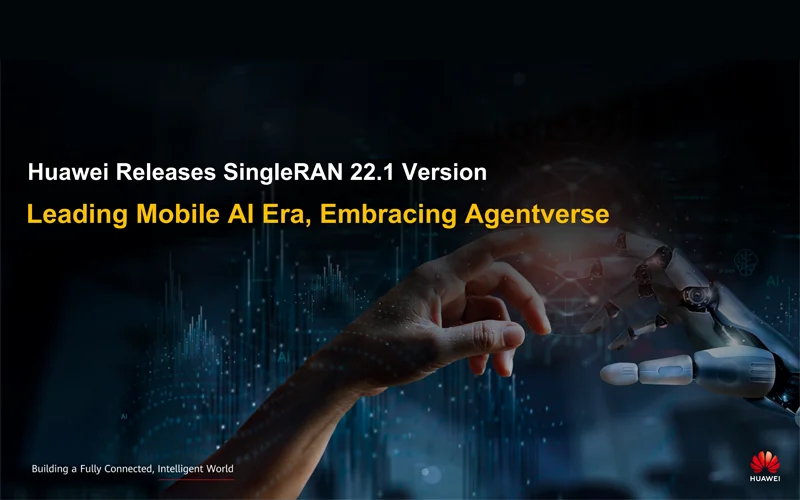
The telecommunications landscape is undergoing a transformation of seismic proportions. As Artificial Intelligence (AI) evolves from simple chatbot interfaces into autonomous, task-oriented entities, the underlying infrastructure powering these interactions is reaching a critical breaking point. With industry experts projecting billions of active AI agents by the end of the decade, the global mobile network is shifting its focus from a human-centric "best-effort" connectivity model to a machine-centric, deterministic, and highly responsive ecosystem. At the forefront of this transition, Huawei has introduced its SingleRAN 22.1 software, a platform designed to serve as the structural backbone for the impending "Agentverse."
The Rise of the Agentverse: A New Era for Wireless Networks
The term "Agentverse" describes an interconnected, global ecosystem of autonomous AI agents capable of performing complex, multi-step tasks with minimal human intervention. While the mainstream public is familiar with generative AI interfaces, the industrial and commercial application of these agents is where the true revolution lies.
According to projections from IDC, the number of actively deployed AI agents is expected to exceed 1 billion by 2029, ballooning to 2.2 billion by 2030. Other industry analysts, such as those behind Huawei’s Intelligent World 2035 report, provide an even more aggressive forecast: a staggering 900 billion active agents, with 90% operating within mobile scenarios. This sentiment is echoed by industry titans, most notably NVIDIA CEO Jensen Huang, who has publicly envisioned a future workforce where each human employee is supported by over 100 dedicated AI agents.
This proliferation presents a unique challenge to mobile network operators (MNOs). Legacy networks were designed for downlink-heavy consumption—streaming video, browsing the web, and downloading files. AI agents, by contrast, require continuous, multimodal data transmission, real-time interaction, and constant collaboration between multiple agents. This shift necessitates a fundamental redesign of mobile network capacity, demanding massive uplink throughput, deterministic low latency, and guaranteed service-level agreements (SLAs) that traditional "best-effort" networks simply cannot provide.
Huawei’s Strategic Response: SingleRAN 22.1
Recognizing that traditional infrastructure would soon become obsolete, Huawei unveiled its SingleRAN 22.1 software earlier this year in Shanghai. This release is more than a mere firmware update; it is a fundamental reconstruction of network capabilities, designed specifically to accommodate the unique traffic patterns and resource requirements of the Agentic era.
SingleRAN 22.1 introduces a suite of technical advancements intended to optimize the interplay between cloud-based intelligence and edge-based execution. By focusing on dynamic resource orchestration and capability allocation, the software allows operators to transition away from static network management toward an intelligent, predictive model that can allocate bandwidth based on the specific "intent" of the AI agent traffic.
The Technical Pillars of SingleRAN 22.1
The software update centers on six core technical innovations, each addressing a specific bottleneck in modern mobile communication:
- Massive Uplink Optimization: AI agents require constant feedback loops. SingleRAN 22.1 prioritizes uplink capacity, ensuring that the heavy data streams generated by agents in the field are transmitted with minimal congestion.
- Deterministic Latency Control: For real-time autonomous systems, packet delay variation (jitter) is fatal. The update introduces new scheduling algorithms that guarantee deterministic response times, crucial for agents performing real-time analytics or robotic control.
- Dynamic Resource Orchestration: Unlike human traffic, which follows predictable daily patterns, agentic traffic is bursty and unpredictable. The software uses advanced AI-driven algorithms to dynamically reallocate spectrum and processing resources in real-time.
- Multi-Dimensional Capability Allocation: The network can now distinguish between different classes of agent traffic, providing different tiers of service based on the mission-critical nature of the tasks being performed.
- Integration with UBBPi Hardware: SingleRAN 22.1 is the first software to support Huawei’s next-generation UBBPi series baseband boards. This hardware-software synergy allows for unprecedented processing density, enabling base stations to handle significantly more concurrent agent connections than previous generations.
- Energy Efficiency for the AI Era: As network traffic density increases, power consumption remains a primary concern. The software incorporates "Green AI" features that modulate hardware power usage based on real-time traffic demand, ensuring that the network remains sustainable despite the increased computational load.
Chronology: From Concept to Global Deployment
The development of SingleRAN 22.1 did not happen in a vacuum. It is the culmination of years of R&D following the initial rollout of 5G infrastructure.
- 2022–2023: Huawei begins internal stress-testing of network architectures designed for "Machine-to-Machine" (M2M) communication, anticipating the shift toward generative AI and agentic workflows.
- Early 2024: Huawei officially announces the development of the "Mobile AI" network architecture, identifying the "Agentverse" as the primary driver for future wireless demand.
- Mid-2024: The official launch of SingleRAN 22.1 in Shanghai. The company demonstrates the software’s capability to handle multi-agent collaboration in simulated high-density environments.
- Q3 2024: Commercial deployment commences. The software is installed at 35 operator sites across 23 countries, focusing on urban centers with high demand for smart industrial applications.
- Current Status: Global rollout is accelerating, with over 100 operators committed to deployment by the end of the year.
Official Perspectives and Industry Implications
The implications of this shift are profound. For operators, the transition to an agent-ready network is not just a defensive measure against obsolescence; it is an offensive strategy to capture value in the emerging "Token economy."
He Yunru, Vice President of Huawei Wireless Network Solutions, emphasized this paradigm shift during the launch. "Mobile AI is not a service upgrade—it is a paradigm shift for the industry," Yunru stated. "As the first commercial version for the Mobile AI era, SingleRAN 22.1 comprehensively reconstructs network capabilities, empowering operators to seize new opportunities in the Token economy, making intelligence omnipotent, omnipresent, and perpetual."
The "Token economy" referenced by Yunru refers to the monetization of AI agent services. By providing a reliable, low-latency, and high-capacity network, operators can transition from being "dumb pipes" to becoming essential service providers for the AI industry, potentially charging premium rates for guaranteed service levels that support autonomous vehicles, remote medical diagnostics, and industrial automation.
Implications for the Future of Connectivity
The deployment of SingleRAN 22.1 signals the beginning of the end for the "human-centric" era of mobile connectivity. As AI agents become the primary users of the network, the requirements for data integrity and speed will only intensify.
The Path Toward 6G
Industry analysts view these updates as a crucial bridge toward 6G. While 5G was largely about high-speed data for humans, the next generation of mobile technology will be defined by its ability to support billions of intelligent machines. The integration of advanced baseband processing and AI-optimized software in SingleRAN 22.1 effectively sets the "rules of engagement" for how machines will interact with the physical world through wireless spectrum.
Challenges Ahead
Despite the optimism, significant challenges remain. Global network operators face high capital expenditures (CAPEX) to upgrade hardware to support the UBBPi boards. Furthermore, the regulatory landscape regarding AI agent traffic—specifically concerning privacy, security, and data sovereignty—remains in flux. Operators will need to work closely with both equipment manufacturers like Huawei and government regulators to ensure that the "Agentverse" remains secure as it scales.
Conclusion
The introduction of SingleRAN 22.1 marks a pivotal moment in the history of telecommunications. By systematically addressing the limitations of downlink-centric, legacy networks, Huawei has provided a blueprint for how global infrastructure must evolve to support the upcoming era of autonomous intelligence. As the world moves toward a future where 900 billion AI agents operate across our mobile networks, the ability to orchestrate, allocate, and guarantee network performance will define the winners and losers of the next decade of technology.
For operators, the choice is clear: adapt to the demands of the Agentverse or risk being left behind in a digital landscape that is rapidly becoming, quite literally, autonomous. With its initial global rollout already underway, the transition to the Mobile AI network is no longer a theoretical exercise—it is a current, commercial reality.