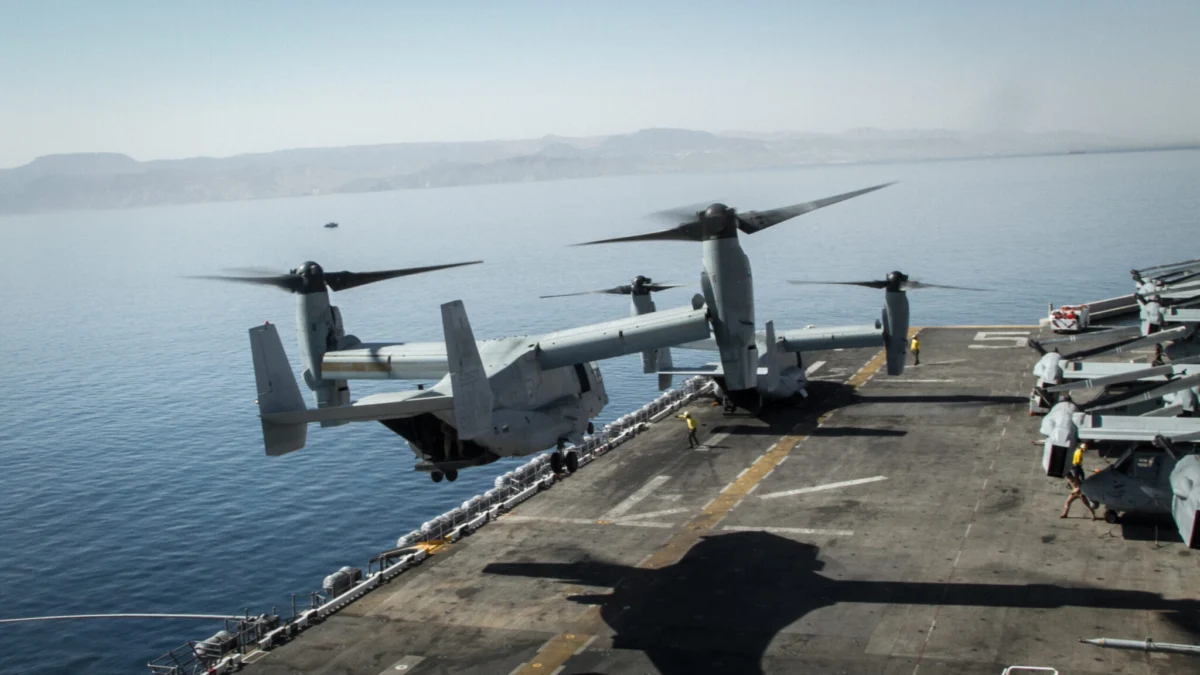
WASHINGTON — The United States Marine Corps has officially reached a historic milestone in modern aviation history, taking delivery of its 359th and final MV-22 Osprey. This delivery marks the completion of the program of record for the tiltrotor aircraft, an asset that has fundamentally redefined expeditionary warfare since it first achieved initial operating capability (IOC) in 2007.
As the Marine Corps closes the book on acquisition, it is simultaneously opening a critical new chapter focused on modernization, safety, and operational sustainability. With a mandate to keep the platform viable through 2055, the service is now pivoting its resources toward structural upgrades and systems refinement to ensure the Osprey remains a cornerstone of the Marine Air-Ground Task Force (MAGTF).
The Osprey’s Evolution: A Chronology of Capability
The journey of the V-22 Osprey has been one of the most controversial and transformative sagas in Department of Defense history. Born from the need to combine the vertical lift capabilities of a helicopter with the speed, range, and fuel efficiency of a fixed-wing turboprop aircraft, the Osprey began its life under intense scrutiny.
Early Development and IOC (1980s–2007)
The V-22 program emerged from the lessons of the failed 1980 Iranian hostage rescue mission, which highlighted the need for long-range, high-speed vertical lift. Despite decades of developmental hurdles and budget debates, the aircraft finally achieved IOC in 2007. Its entry into service provided commanders with an unprecedented tactical advantage: the ability to move personnel and equipment over vast distances at speeds that made traditional helicopters obsolete.
Operational Maturity (2007–2020)
Over the last 17 years, the Osprey has become the backbone of Marine Corps logistics and transport. The fleet has logged more than 686,500 flight hours across 114 operational deployments. From humanitarian assistance missions in the Pacific to combat sorties in the Middle East, the MV-22B proved it could bridge the gap between ship-to-shore movement and land-based expeditionary maneuver.
The Crucible of Safety (2020–Present)
The last four years have been the most challenging in the program’s history. A series of high-profile, fatal mishaps—including the June 2022 crash that claimed five Marines and the November 2023 Air Force tragedy that killed eight airmen off the coast of Japan—placed the fleet under the intense gaze of Congress and the public. These events triggered a nationwide grounding of the entire V-22 force in late 2023, forcing a deep dive into the mechanical reliability of the platform.
Supporting Data: Fleet Statistics and Maintenance Metrics
The scale of the Marine Corps’ Osprey fleet is vast, and the data collected over nearly two decades of service provides a roadmap for the future.
- Program Completion: 359 aircraft delivered.
- Operational Footprint: 686,500+ flight hours.
- Service Life Extension: The current roadmap aims to keep the airframes operational through 2055.
- Maintenance Focus: Current initiatives prioritize the replacement of the Input Quill Assembly (IQA) and the upgrading of nacelle wiring systems to reduce the "mean time between maintenance" (MTBM) events.
The shift from acquisition to sustainment is not merely a change in administrative focus; it is a technical necessity. As the airframes age, the wear and tear on the complex drive systems—the heart of the tiltrotor mechanism—requires a more aggressive preventative maintenance posture.
Official Responses: Defining the Osprey’s Legacy
Lt. Gen. William Swan, the Marine Corps’ deputy commandant for aviation, emphasized that the completion of the delivery schedule is not an end, but a transition to a more refined capability.
"The MV-22B didn’t just join our fleet; it fundamentally changed the way the Marine Air-Ground Task Force generates combat power," Lt. Gen. Swan said in an official statement. "It provides commanders with decision space that only speed and reach can provide, connecting ships, bases, and distributed forces in ways previous generations could only imagine. Today, Marine commanders build operations around the assumption that the MV-22B will be there."
Addressing the challenges of recent years, Swan was pragmatic about the road ahead. "We cannot assume that because the MV-22B transformed Marine aviation once, its evolution is complete. It is our responsibility to carry this legacy forward and ensure this aircraft remains ready, relevant, safe, and lethal for the fight ahead."

The Path Forward: Modernization and Risk Mitigation
With the final airframe now in the hangar, the Marine Corps is channeling its efforts into three primary areas: hardware redesign, software-driven diagnostics, and structural standardization.
1. The Hard Clutch Engagement (HCE) Solution
The "Hard Clutch Engagement"—an event where the clutch slips and then suddenly reengages—was identified as a primary factor in the 2022 mishap. To solve this, the Marine Corps, in conjunction with the V-22 Joint Program Office and NAVAIR, is fast-tracking a redesigned input quill assembly (IQA).
Capt. Jacob Sugg, a Marine Corps spokesperson, noted that while the final design is being perfected, interim flight-hour restrictions on the IQA have been highly effective. "In the meantime, the present flight-hour restriction on the IQA implemented in February 2023 has resulted in no further Hard Clutch Engagements," Sugg confirmed.
2. Nacelle Wiring and Standardization
One of the most persistent issues identified in recent maintenance reviews is the complexity of the wiring within the nacelles—the housings that rotate to allow for vertical or horizontal flight. The Marines are undertaking a systemic update to these wiring harnesses, which is expected to drastically reduce maintenance hours and improve the overall reliability of the flight control systems.
3. Gearbox Integrity
Following the 2023 Air Force investigation, which cited a gearbox failure as the root cause of the fatal crash in Japan, NAVAIR implemented strict inspection protocols. As of late 2024, the fleet remains under a "predetermined flight threshold" policy. This requires rigorous inspections before every flight. While the command has declined to release the specific flight-hour thresholds for security reasons, the directive remains a core component of the current operational tempo.
Implications: The Osprey in the Future Fight
The completion of the fleet delivery marks a strategic inflection point for the U.S. military. As the Department of Defense shifts its focus toward potential high-end conflicts in the Indo-Pacific, the V-22’s role in "distributed maritime operations" becomes even more critical.
Logistics in a Contested Environment
In a potential conflict involving island chains and distributed naval assets, the Osprey is the only platform capable of moving critical supplies, medical personnel, and rapid-reaction forces at the speed required to stay ahead of an adversary’s "kill chain." By keeping the fleet relevant through 2055, the Marines are ensuring they have the mobility to support the "Force Design" concept—a strategy that relies on small, dispersed units moving rapidly across a vast theater of operations.
The Cost of Modernization
However, the path to 2055 will not be cheap. The transition from building new aircraft to maintaining and retrofitting existing ones requires a different budgetary approach. The focus will likely shift toward "digital twins" and advanced sensors that can predict component failures before they occur—a necessity if the Marines are to avoid the high-maintenance burdens that have historically plagued the Osprey.
A Legacy of Resilience
Despite the tragic loss of life and the mechanical scrutiny that has followed, the Osprey remains the premier vertical lift platform for the U.S. military. Its ability to perform missions that were once deemed impossible—long-range, high-speed assault and logistics—continues to be a vital component of the nation’s defense strategy.
As the Marine Corps moves forward, the success of the Osprey will no longer be measured by how many aircraft are produced, but by the safety and reliability of the fleet currently in the sky. The final delivery of the 359th Osprey is a milestone for the acquisition community, but for the Marines in the field, the real work of ensuring the platform’s longevity is only just beginning.
Through rigorous testing, a commitment to engineering excellence, and a transparent approach to addressing mechanical failures, the Marine Corps aims to transform the V-22 from a controversial pioneer into a mature, indispensable workhorse of the 21st century. The legacy of the Osprey is still being written, and for the next three decades, the focus will remain steadfast on one goal: keeping the aircraft, and the Marines who fly them, safe and effective in the face of any threat.