San Jose, CA – August 24, 2026 – The global semiconductor industry stands on the precipice of a monumental expansion, poised to nearly double its revenue to an astonishing $1.6 trillion by 2026. This dramatic surge, detailed in a comprehensive report by leading technology research firm Gartner, is primarily fueled by an unprecedented wave of investment in Artificial Intelligence (AI) infrastructure and a significant upswing in memory chip prices. The seismic shifts underway are not merely cyclical; they represent a fundamental reshaping of the chip landscape, driven by the insatiable demand for computing power and data processing.
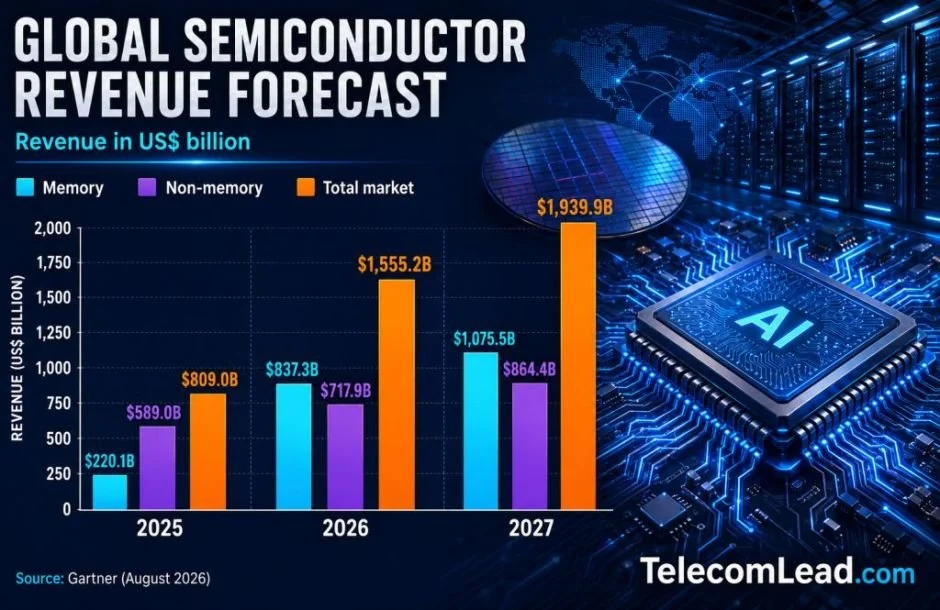
According to Gartner’s latest projections, worldwide semiconductor revenue is set to skyrocket from an estimated $809 billion in 2025 to a staggering $1.555 trillion in 2026. This represents a remarkable year-over-year growth of 92 percent. The upward trajectory is expected to continue, with the market projected to further expand to $1.940 trillion in 2027, signaling a new era of sustained growth for an industry historically characterized by its cyclical nature.
This new growth phase is underpinned by two critical pillars: sustained, robust investment in AI data centers and a memory pricing cycle that has proven stronger and more enduring than many anticipated. The proliferation of AI technologies is not only increasing the demand for chips but is also fundamentally altering the industry’s application mix. This broadening demand now spans an entire spectrum of semiconductor technologies, including memory, processors, networking components, power management solutions, and optical technologies, indicating a more pervasive integration of chips across the entire digital ecosystem.
The Memory Surge: A Trillion-Dollar Revolution
The most significant driver of this explosive growth lies within the memory segment. Gartner forecasts that global memory revenue will experience a meteoric rise, soaring from an estimated $220.1 billion in 2025 to an eye-watering $837.3 billion in 2026. This trajectory is expected to culminate in memory alone surpassing the trillion-dollar mark in 2027, reaching an estimated $1.076 trillion.
This dramatic influx into memory revenue signifies a profound shift in market dynamics. In 2025, memory constituted approximately 27 percent of total semiconductor revenue. By 2026, this share is projected to balloon to a dominant 54 percent, underscoring its pivotal role in the current market boom.
The surge in memory revenue is attributed to a confluence of factors, chief among them being higher memory prices, a direct consequence of robust demand and constrained supply. Furthermore, the escalating memory content within AI servers is a critical element. As AI models become more complex and the scale of AI computations increases, the need for high-bandwidth memory (HBM) and other advanced memory solutions has become paramount. AI infrastructure deployments are consuming significantly more memory as computing clusters grow larger and more powerful, creating a feedback loop of demand.
Delving deeper into the memory segment, Gartner’s analysis reveals particularly explosive growth projections for specific memory types. DRAM (Dynamic Random-Access Memory) revenue is expected to surge by an astonishing 246.6 percent in 2026. Simultaneously, NAND flash memory revenue is forecast to experience an equally impressive leap of 371.9 percent in the same year. These figures highlight the immense demand for both volatile and non-volatile memory solutions, essential for the operations of AI models and the storage of vast datasets.
While additional manufacturing capacity is anticipated to enter the market during 2027, Gartner predicts that supply-demand conditions will remain tight. This sustained tightness is driven by the relentless pace of AI infrastructure deployment, which will continue to drive up memory consumption. The combination of higher memory content per AI server and the sustained, strong demand for HBM is expected to prop up memory revenue growth well into 2027 and beyond, solidifying its position as the bedrock of the AI revolution.
AI Data Centers: The New Epicenter of Chip Demand
The transformative impact of AI is perhaps most vividly illustrated by the burgeoning role of AI data centers. Gartner forecasts that the AI data center ecosystem will account for a substantial 36.5 percent of global semiconductor revenue in 2026. This share is projected to grow exponentially, exceeding a commanding 53 percent by 2030.
This projected shift signifies a fundamental structural change in how and where semiconductor value is being created. The traditional dominance of consumer electronics and PC markets is gradually ceding ground to the insatiable demands of AI servers, specialized accelerators, high-speed data center networking, advanced memory systems, robust power infrastructure, and sophisticated optical connectivity solutions.
The evolution of AI clusters is characterized by their increasing size, speed, and power consumption. The deployment of these advanced computing environments necessitates significant investments across a broad range of semiconductor categories. This includes not only the central processing units (CPUs) but also specialized networking silicon for high-speed data transfer, advanced power-management chips to ensure efficient energy usage, and critical analogue devices that interface with the physical world. Moreover, high-speed optical interconnect technologies are becoming indispensable for enabling the rapid flow of data within and between these massive computational systems.
Consequently, AI is not merely benefiting a single segment of the semiconductor industry; it is expanding the market opportunity across the entire data center infrastructure stack. This holistic impact ensures that a wide array of chip manufacturers and technology providers are poised to capitalize on the AI revolution.
Non-Memory Segment Shows Robust, Sustained Growth
While the memory segment is undoubtedly the star of the current semiconductor boom, the non-memory semiconductor market is also experiencing a period of strong, albeit more moderate, growth. Non-memory revenue is forecast to increase from an estimated $589 billion in 2025 to approximately $717.9 billion in 2026, representing a solid growth rate of 21.9 percent.
Looking ahead, Gartner anticipates that non-memory semiconductor revenue will continue its upward trajectory, reaching an estimated $864.4 billion in 2027. This sustained expansion in the non-memory segment is largely driven by the ongoing demand for crucial components that power AI data centers. This includes high-performance CPUs, sophisticated networking silicon essential for interconnectivity, advanced analogue semiconductors that manage and process signals, optical interconnects for high-speed data transmission, and power-management components that ensure the efficiency and stability of these complex systems.
The combined growth in both memory and non-memory segments paints a clear picture of a semiconductor market that is undergoing a profound and long-term transformation. The traditional cyclical expansion patterns are being augmented and potentially superseded by the persistent demand generated by AI infrastructure. The confluence of tight memory supply, coupled with the increasing semiconductor content within servers, is creating a powerful momentum that is pushing annual industry revenue towards the $2 trillion mark by 2027. This represents a significant departure from historical market trends and heralds a new era of sustained, high-value growth for the global semiconductor industry.
Implications and Future Outlook
The implications of Gartner’s forecast are far-reaching, extending beyond the financial figures to signal a fundamental shift in the technological landscape. The semiconductor industry’s pivot towards AI infrastructure suggests a future where intelligence is not just an application but a foundational element of computing. This will likely accelerate innovation in areas such as specialized AI chips (ASICs and TPUs), advanced packaging technologies to increase chip density and performance, and novel materials science to overcome current limitations.
The increased reliance on memory, particularly HBM, also highlights potential supply chain vulnerabilities and the strategic importance of memory manufacturing capacity. Nations and corporations will likely redouble efforts to secure domestic semiconductor production capabilities, especially for critical memory components, to mitigate geopolitical risks and ensure supply chain resilience.
Furthermore, the growing demand for power-management and optical interconnect technologies underscores the increasing complexity and energy demands of AI workloads. This will spur innovation in energy-efficient chip design and advanced cooling solutions for data centers, potentially driving new market opportunities for specialized manufacturers.
The projected dominance of AI data centers in chip revenue by 2030 suggests a future where the majority of semiconductor innovation and demand originates from the cloud and enterprise sectors, rather than traditional consumer devices. This shift will likely influence research and development priorities, with a greater focus on enterprise-grade solutions, reliability, and security.
While the short-term outlook is exceptionally bright, the long-term sustainability of this growth will depend on continued innovation in AI algorithms, the development of new AI applications, and the ability of the industry to manage supply chain complexities and geopolitical challenges. However, based on current trends and Gartner’s robust analysis, the semiconductor industry is embarking on a transformative journey, with AI serving as the primary catalyst for unprecedented growth and innovation. The coming years promise to be a defining period for the chip industry, solidifying its role as the indispensable engine of the digital age.