STOCKHOLM — In a landmark move signaling a strategic pivot toward heightened maritime power, Sweden has officially inked a multi-billion-euro deal with France’s Naval Group for the acquisition of four FDI (Frégate de Défense et d’Intervention) frigates. While the immediate focus remains on the seamless integration of Swedish domestic systems, top military and civilian leaders have signaled an “open-minded” approach toward potentially equipping these vessels with French-made long-range naval cruise missiles.
The deal, valued at approximately €4.3 billion, marks a significant deepening of the defense and industrial partnership between Stockholm and Paris. However, as the ink dries on the contract, the conversation is already shifting toward the next horizon: the pursuit of a potent, deep-strike maritime capability.
The Core of the Agreement: Enhancing Sweden’s Naval Architecture
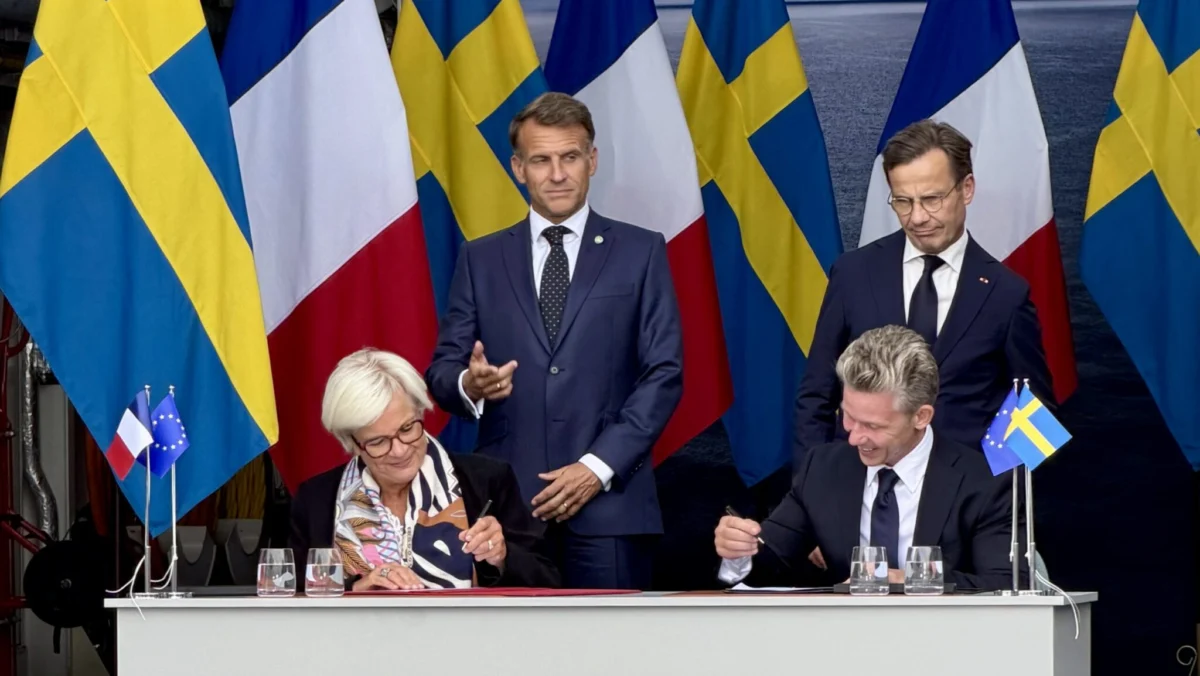
The agreement, formalized on the deck of the French flagship Amiral Ronarc’h, represents one of the most significant defense procurements in Swedish history. Prime Minister Ulf Kristersson and President Emmanuel Macron presided over the signing, underscoring the political weight of the collaboration.
The FDI frigates, set for initial delivery in 2030, are designed to serve as the backbone of the Swedish Navy’s future surface fleet. A cornerstone of the contract is the integration of advanced Swedish-built technology, ensuring that these French-designed hulls are optimized for the unique, challenging operational environment of the Baltic Sea.
Key Integrated Systems
The Swedish configuration of the FDI frigate will be a hybrid of international innovation and domestic expertise:
- Anti-Air Warfare: The ships will feature the Aster 30 air-defense missile, providing critical protection against ballistic missile threats—a requirement that has moved to the forefront of Swedish strategic planning following the escalation of the war in Ukraine.
- Surface-to-Surface Strike: The vessels will carry the battle-proven Saab RBS 15 anti-ship missile.
- Versatile Defense Suite: The ships are expected to be equipped with Saab’s Giraffe 1X radar systems, Trackfire remote weapon stations, and BAE Systems Bofors 57 mm and 40 mm naval guns.
- Anti-Submarine Warfare (ASW): The configuration includes 47 lightweight torpedoes, reinforcing Sweden’s focus on the littoral ASW mission.
Chronology of the Strategic Pivot
The path to the current procurement has been marked by a series of rapid strategic shifts necessitated by the evolving European security landscape:
- 2022–2023: Following the Russian invasion of Ukraine, Sweden accelerated its defense modernization, prioritizing inter-operability with NATO allies and long-range precision capabilities.
- 2024: Sweden joined the European Long-Range Strike Approach (ELSA) initiative, a collaborative framework involving France, Germany, Italy, Poland, and the UK, aimed at closing the continent’s long-range precision strike gap.
- Mid-2026: Sweden officially selects the FDI frigate platform after a rigorous competitive process, finalizing the €4.3 billion contract.
- Late 2026 (August): Formal signing ceremony between Prime Minister Kristersson and President Macron, accompanied by the announcement of a broader framework agreement on industrial development.
- Future Outlook (2030): Anticipated delivery of the first FDI unit, with ongoing evaluations for the inclusion of deep-strike cruise missile systems.
Evaluating the “Deep Strike” Capability: The MdCN Question
While the current contract provides the foundation for air defense and anti-submarine warfare, the prospect of adding a naval cruise missile has emerged as the most debated element of the deal.
French President Emmanuel Macron, during his address in Stockholm, explicitly teased the possibility. “By equipping the Swedish frigates with the Aster missile and possibly with a naval cruise missile, France is not only delivering ships; it is also providing a capability to protect the territories of our allies,” Macron noted.
Though Macron did not name the specific weapon, industry analysts and media reports indicate that Paris is positioning MBDA’s MdCN (Missile de Croisière Naval) as the primary candidate. The MdCN, which provides a deep-strike capability against land-based targets, is currently utilized by the French Navy on its FREMM frigates and Suffren-class attack submarines.
The Technical Hurdle
Integrating the MdCN is not a "plug-and-play" operation. The current contract includes the Sylver A50 vertical launch system (VLS). To accommodate the MdCN, the Swedish Ministry of Defence noted that these would likely need to be swapped for A70 launchers—a modification that would represent a significant secondary investment and technical re-evaluation.
Official Responses and Strategic Rationale
Swedish Commander-in-Chief Gen. Michael Claesson has adopted a pragmatic, phased approach to the acquisition. While acknowledging the intrigue of the MdCN, he remains laser-focused on the immediate delivery goals.
“The most important thing for me right now is that we move forward in integrating the Swedish weapon systems and sensor systems that we have included in the contract,” Gen. Claesson told Breaking Defense. “But of course, we will evaluate and discuss the French offer as well.”
Defense Minister Pål Jonson echoed this sentiment, framing the potential acquisition as a natural evolution of Sweden’s lessons from the war in Ukraine. “The lessons learned from the war in Ukraine are that it is very important to have this kind of long-range precision-strike capability as well,” Jonson stated. “The platform we are working on right now is of course predominantly an air-defense and ASW platform, but we also have an open mind.”
Implications for Regional Security
The potential addition of a naval deep-strike capability would represent a paradigm shift for the Swedish Armed Forces.
1. Complementing Air-Launched Capabilities
Just weeks before the signing ceremony, the Swedish Air Force successfully tested a Taurus KEPD 350 air-launched cruise missile from a JAS 39 Gripen at the Vidsel Test Range. This success provided Sweden with its first true deep-strike capability. By potentially adding a naval-launched equivalent, Stockholm would be creating a redundant, multi-domain strike architecture that complicates the defensive calculations of any potential adversary in the Baltic region.
2. Deepening the European Defense Industrial Base
The framework agreement signed by French Minister of Armed Forces Catherine Vautrin and Pål Jonson signals more than just a purchase; it indicates a shift toward a long-term, integrated industrial partnership. By participating in the ELSA initiative and engaging with French naval systems, Sweden is effectively weaving itself into the fabric of European strategic autonomy.
3. Deterrence in the Baltic Sea
For the Swedish Navy, the FDI frigates offer a massive leap in capability. By shifting from smaller, localized corvettes to multi-mission frigates capable of long-range air defense and potential land-attack missions, Sweden is signaling that its maritime domain awareness—and its power-projection capability—now extends far beyond its immediate coastal waters.
Conclusion: A Measured Expansion
As the Swedish military moves toward the 2030 delivery date, the focus will remain on the complex task of integrating domestic systems into the FDI platform. The inclusion of the Aster 30 missile already provides a formidable air-defense umbrella.
However, the "open mind" expressed by Minister Jonson and the explicit encouragement from President Macron suggest that the debate over deep-strike naval capability is only just beginning. Whether or not Sweden chooses to upgrade to A70 launchers and adopt the MdCN will depend on the evolving threat environment in the North Atlantic and Baltic, as well as the continued development of the ELSA framework.
For now, Stockholm has secured a powerful new maritime asset—one that creates a robust platform for future expansion, ensuring that the Swedish Navy remains a cornerstone of security in Northern Europe for decades to come.