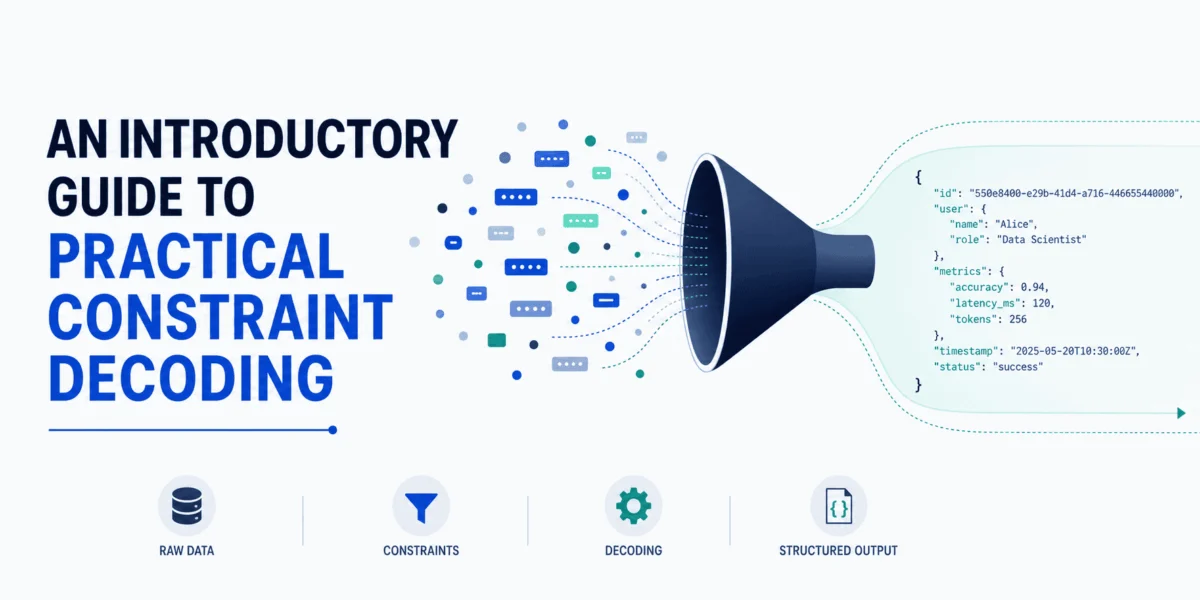
In the rapidly evolving landscape of Generative AI, Large Language Models (LLMs) have demonstrated an uncanny ability to mimic human prose, code, and reasoning. However, for enterprise developers and data scientists, this creative fluidity often presents a significant liability. When an LLM is tasked with populating a database, triggering a software function, or adhering to a strict data schema, the "probabilistic" nature of its output becomes a hurdle.
Enter Practical Constraint Decoding—a technical framework designed to transform LLMs from unpredictable creative engines into deterministic, schema-compliant processors. By intervening at the moment of token selection, developers can now force models to "speak" in the precise syntax required by downstream applications.
Main Facts: The End of "Prompt Engineering" Uncertainty
For years, the standard approach to getting structured data from an LLM involved "prompt engineering"—the art of begging, cajoling, and providing few-shot examples to encourage a model to output JSON instead of markdown-wrapped conversational filler. This approach is inherently brittle; even the most sophisticated models can occasionally "hallucinate" an extra bracket or fail to close a string.
Practical constraint decoding, often referred to as structured generation or guided decoding, fundamentally changes this paradigm. It shifts the burden of structural integrity from the model’s "intent" to a mathematical guarantee. By controlling the model’s output at the logit level, engineers can ensure that the model generates only what is permitted by a predefined grammar or schema. In short, it makes it mathematically impossible for the model to output a malformed result.
The Chronology of Structured Generation
The evolution of structured generation can be mapped through three distinct eras:
- The Era of Parsers (Pre-2023): Developers relied on post-generation parsing. The model would generate text, and a script would attempt to scrape the relevant JSON from the output. If the model failed, the code would throw an exception, often leading to a retry loop that increased latency and cost.
- The Era of Prompt Crafting (Early 2023): With the rise of GPT-4, developers focused on "System Prompts" that mandated specific output formats. While more effective, this remained a "soft" constraint—the model could still ignore instructions under high temperature or complex queries.
- The Era of Guided Decoding (Late 2023–Present): With the introduction of libraries like Outlines, Guidance, and LMQL, the industry shifted toward "hard" constraints. By integrating Finite State Machines (FSMs) into the inference loop, developers can now force models to adhere to rigid grammars in real-time.
Supporting Data: How Logic Masks the Probabilities
To understand why this method is so powerful, one must look at the "black box" of LLM inference. When an LLM generates text, it does not output words; it outputs a probability distribution across its entire vocabulary—a vector of "logits" representing thousands of possible next tokens.
The Mechanism of Masking
Normally, the model samples from this distribution based on parameters like Temperature or Top-P. Practical constraint decoding inserts a middleman into this process:
- Pre-Compilation: Before the prompt is even processed, a library compiles your target constraint (e.g., a Pydantic schema or a regex) into a Finite State Machine.
- The Masking Step: At every single token generation step, the FSM checks the current state. It identifies which tokens are valid to reach the next state in the schema.
- The Logit Override: Any token not permitted by the FSM is assigned a logit value of
-inf(negative infinity). When the softmax function is applied, these tokens have a zero-percent probability of being selected. - Sampling: The model is left to sample only from the "white-listed" tokens, ensuring the output remains perfectly compliant with the underlying schema without sacrificing the model’s inherent reasoning capabilities.
Contrary to concerns regarding performance, this process introduces negligible latency. Because the vocabulary is static, the FSM transitions are pre-computed, allowing for rapid lookups that do not bottleneck the inference engine.
Official Perspectives and Industry Standards
Industry experts, including AI researcher and consultant Iván Palomares Carrascosa, highlight that this technology is a prerequisite for the "productionization" of LLMs.
"When we look at the transition from AI prototypes to enterprise-grade agents, reliability is the primary bottleneck," Carrascosa notes. "By implementing constraint decoding, we stop treating LLMs like unpredictable chatbots and start treating them like specialized software components."
The current gold standard, the outlines library, has gained widespread traction because it abstracts this complexity. By allowing developers to define schemas using standard Python objects like Pydantic models, it removes the need for manual regex writing, making structured generation accessible to the broader engineering community.
Implications: The Future of LLM Integration
The implications of practical constraint decoding extend far beyond simple JSON formatting.
1. Agentic Workflow Reliability
Modern AI agents rely on "tool use," where the model calls an external API. If the model outputs a malformed function call, the agentic loop breaks. Constraint decoding ensures that the tool-call syntax is always perfect, enabling autonomous agents to operate for longer durations without human intervention.
2. Enhanced Data Extraction
In sectors like finance and legal tech, extracting structured data from unstructured documents is critical. Constraint decoding ensures that extracted information, such as invoice dates or contract clauses, is formatted exactly as required for database ingestion, eliminating the need for complex regex post-processing.
3. Latency and Cost Efficiency
By eliminating the need for "retry logic" and excessive prompt engineering, companies can reduce their token usage. Fewer failed attempts and shorter, more direct prompts lead to a leaner, more cost-effective inference pipeline.
4. Security and Input Sanitization
By enforcing strict schemas, developers can effectively "sanitize" model output before it reaches the end user or a database, providing a layer of protection against prompt injection or malformed data that could trigger downstream errors.
Strengths and Limitations: A Balanced View
While the benefits are transformative, practitioners must remain aware of the trade-offs:
Strengths:
- Deterministic Output: Eliminates syntax errors in generated code or data.
- Seamless Integration: Works with existing Python ecosystems like Pydantic.
- Efficiency: Minimal impact on inference latency due to pre-compiled state machines.
- Developer Experience: Reduces the "prompt engineering" burden, allowing developers to focus on logic rather than formatting.
Limitations:
- Creative Constraint: Forcing a model into a rigid schema can occasionally interfere with the model’s ability to "think" if the schema is overly restrictive or poorly defined.
- Library Dependency: It requires the use of specific inference engines (like those supported by Outlines or vLLM), which may not be compatible with all proprietary, closed-source API endpoints.
- Complexity of Grammars: While Pydantic makes JSON simple, enforcing highly complex, custom grammars still requires an understanding of formal language theory and FSMs.
Conclusion: Toward a More Reliable AI
Practical constraint decoding represents a maturation of the Large Language Model field. As we move away from the "wild west" of early prompt engineering, we are entering a phase where LLMs are being integrated into the deterministic foundations of software engineering. By masking the probabilistic chaos of model inference with the rigid logic of state machines, we are finally building AI systems that are not just clever, but consistently correct.
Whether you are building an automated customer support agent or a high-frequency financial data extractor, the ability to "lock down" your model’s output is no longer a luxury—it is an essential tool for the modern AI engineer.