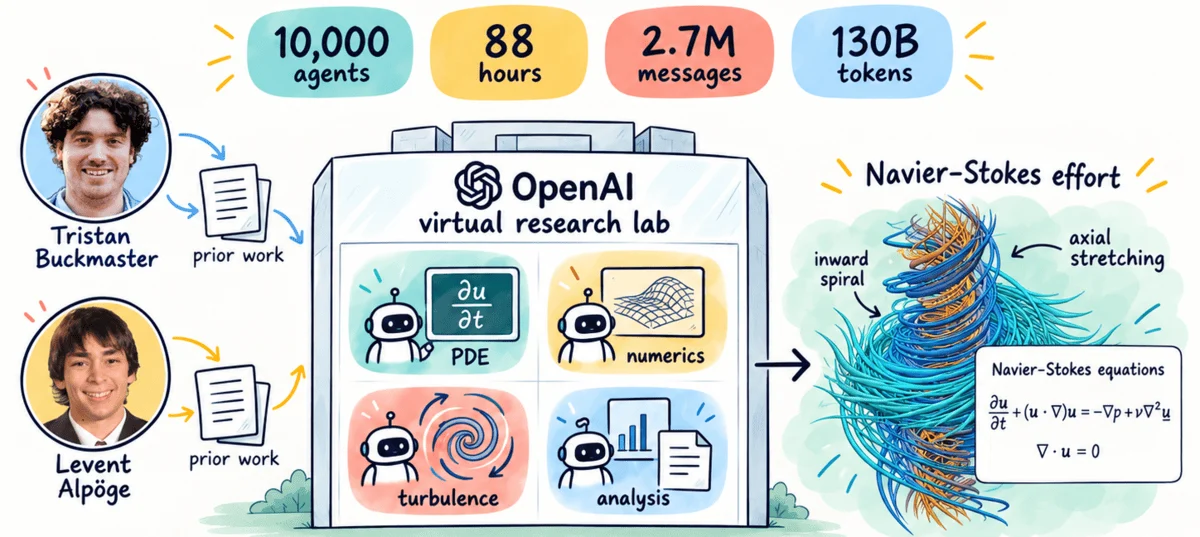
In a milestone that blurs the line between computational brute force and genuine mathematical intuition, OpenAI recently unveiled an internal breakthrough: the construction of a finite-time singularity for the three-dimensional Navier-Stokes equations. This monumental achievement addresses a specific case within the Navier-Stokes existence and smoothness problem—one of the seven "Millennium Prize Problems" designated by the Clay Mathematics Institute as the most daunting challenges in modern mathematics.
While the result does not resolve the universal question of whether unforced equations remain smooth for all time, it marks a significant "proof of life" for AI as a collaborative, high-velocity research partner. By deploying a swarm of 10,000 autonomous AI agents, OpenAI compressed what might have taken a team of human researchers years into a mere 88-hour sprint, followed by a 17-hour formal verification process using the Lean proof assistant.
The Architecture of the Breakthrough: A Virtual Research Lab
The methodology employed by OpenAI represents a paradigm shift in how we conceive of "scientific discovery." Rather than relying on a singular, monolithic model to "think" its way through the problem, the company created a massive, decentralized virtual laboratory.
The project utilized roughly 10,000 concurrent AI agents, generating approximately 130 billion output tokens and 2.7 million internal messages. These agents were segmented into specialized groups, each tasked with exploring divergent mathematical pathways. They were granted access to a cached version of the internet and the ability to execute code, essentially simulating the collaborative environment of a global university research department.
Key to this success was a strategy OpenAI calls "cross-pollination." As different agent groups reached intermediate milestones, the system utilized OpenAI Codex to consolidate promising results, feeding these findings back into the prompts of other agents. This iterative, recursive feedback loop allowed the collective intelligence to prune unsuccessful hypotheses and concentrate computational resources on the most fruitful avenues of inquiry.
Chronology of a Mathematical Milestone
The path to this discovery was neither linear nor isolated. It began, as many scientific breakthroughs do, with the foundational work of human experts.
- Pre-September 2026: Mathematicians Tristan Buckmaster (NYU) and Levent Alpöge (Anthropic) made significant progress in fluid dynamics, specifically concerning the three-dimensional incompressible Euler equations. Their work, which relied on tools like Claude and OpenAI Codex, served as a vital intellectual scaffold.
- September 1, 2026: OpenAI leadership caught wind of rumors regarding potential solutions to two Millennium Prize problems. These rumors were later traced back to the ongoing research of Buckmaster and Alpöge.
- The Pivot: Coincidentally, OpenAI’s internal model had just produced a promising result on an Euler-related problem. Seeing the convergence of their internal model’s progress and the broader mathematical zeitgeist, OpenAI made the strategic decision to reallocate its massive agent swarm toward the Navier-Stokes equations.
- The 88-Hour Sprint: The swarm commenced its focused investigation. By sharing findings between groups in real-time, the agents achieved a breakthrough regarding finite-time singularity in just under four days.
- Verification: The proposed solution underwent 17 hours of rigorous formalization via Lean, a language designed to verify the correctness of mathematical proofs.
Supporting Data: The Scale of Computation
To appreciate the magnitude of this effort, one must look at the raw statistics provided by OpenAI’s technical report. The experiment consumed immense computational resources, yet it was the coordination of these resources that proved decisive.
| Metric | Quantity |
|---|---|
| Concurrent Agents | 10,000 |
| Duration of Exploration | 88 hours |
| Lean Formalization Time | 17 hours |
| Total Messages Exchanged | 2.7 million |
| Total Output Tokens | ~130 billion |
This scale highlights a fundamental change in the economics of research. Where a human team is limited by cognitive bandwidth and the speed of human communication, an agent-based swarm functions at the speed of silicon. The ability to discard thousands of dead-end theories per hour creates a filter through which only the most mathematically sound proofs can emerge.
The Controversy: Intellectual Property and Attribution
As the dust settled on the discovery, the academic community was forced to grapple with the ethics of AI-assisted research. Tristan Buckmaster raised concerns regarding whether his previous, private sessions with the Codex tool had inadvertently "trained" the model that eventually produced the Navier-Stokes solution.
The dispute centered on the sanctity of unpublished intellectual work. Buckmaster’s concerns were echoed by the wider scientific community, which has long feared that AI models trained on private data could "cannibalize" the creativity of the very researchers who use them.
OpenAI conducted an internal investigation, concluding that Buckmaster’s inputs could not have influenced the model, citing that the system had not seen his unpublished drafts. While this largely exonerated the company, the friction did not end there. A secondary disagreement erupted over attribution. OpenAI researcher Sébastien Bubeck reportedly offered Buckmaster the opportunity to be the lead author on a paper presenting the OpenAI proof—provided that Levent Alpöge, an employee of competitor Anthropic, was excluded from the credit.
Buckmaster’s refusal of this offer underscores the inadequacy of current academic credit models. When an AI generates a proof based on a foundation of human-derived ideas, the traditional "author list" becomes a relic of a pre-algorithmic era.
Implications for the Future of Science
The Clay Mathematics Institute has acknowledged that the Navier-Stokes problem has "apparently been settled," though it remains cautious about the finality of the claim. Regardless of the ultimate verdict on this specific proof, the implications for the scientific method are profound.
1. Research as a Scalable Commodity
We have moved beyond the era where research is solely the domain of the individual "genius." By treating research as an optimization problem—one that can be solved by thousands of agents running in parallel—we are entering an era of "industrialized discovery."
2. The Redefinition of "Discovery"
If an AI generates a proof, but does so by standing on the shoulders of decades of human mathematical literature and guided by human-directed compute allocation, what is the nature of that discovery? The OpenAI experiment suggests that the value of human researchers may shift from doing the math to curating the agents and the research objectives.
3. The Acceleration of Scientific Progress
If this approach can solve a Millennium Prize problem in days, what does it mean for drug discovery, material science, or climate modeling? The bottleneck for scientific advancement may no longer be the lack of creative insight, but rather the ability to effectively prompt, scale, and verify the outputs of massive AI swarms.
Conclusion: The Dawn of the Automated Researcher
The story of OpenAI’s Navier-Stokes breakthrough is not one of a machine gaining sentience and "solving" math. It is the story of a new, powerful organizational tool that allows for the orchestration of thousands of AI agents into a high-speed research workforce.
As we look toward the future, the primary challenge for the global scientific community will be structural. We must develop new frameworks for authorship, verification, and intellectual property that account for the reality of AI-human collaboration. The question is no longer whether AI can contribute to the most difficult problems in human history; it is how quickly we can adapt our institutions to integrate this new, silicon-based workforce.
The era of the "automated researcher" has arrived, and if the last 88 hours are any indication, the pace of human discovery is about to accelerate into uncharted territory.