New Delhi, India – July 25, 2026 – India’s once-booming smartphone market experienced a sharp contraction in the second quarter of 2026, with shipments plummeting by a significant 13 percent year-on-year. According to a comprehensive report by leading technology research firm Omdia, the market shipped just 33.9 million units during the April-June period, signaling a concerning trend for the industry. This downturn is attributed to a confluence of factors, including rising component costs, subdued consumer sentiment, and cautious inventory management by vendors.
The decline marks a stark departure from the rapid growth previously characterizing the Indian smartphone landscape, which has long been a crucial battleground for global manufacturers. The data from Omdia paints a picture of a market grappling with economic headwinds and shifting consumer priorities, prompting a re-evaluation of growth strategies by key players.
Economic Headwinds and Affordability Crisis Drive Downshipments
The primary catalyst behind the significant slowdown, as identified by Omdia’s Principal Analyst Sanyam Chaurasia, is the escalating cost of smartphone components, particularly memory. This surge in manufacturing expenses has inevitably translated into higher retail prices for handsets, directly impacting affordability within the crucial mass-market segment. For a large swathe of Indian consumers, the dream of owning the latest smartphone has become increasingly out of reach.
"Rising memory costs pushed handset prices higher, reducing affordability in the mass-market segment of the Indian smartphone market," stated Chaurasia. "Delayed consumer upgrades ahead of festive offers, depreciation in the rupee, inflation, and weak summer retail demand also contributed to the decline, while smartphone vendors remained cautious about channel inventory amid slower sell-out."
The impact of these economic pressures is amplified by several other contributing factors. The typical pre-festive season upgrade cycle, usually a significant driver of sales in the latter half of the year, appears to have been postponed by consumers delaying their purchases in anticipation of potential deals. Furthermore, the continued depreciation of the Indian rupee against major global currencies has made imported components, and consequently, the finished smartphones, more expensive. Persistent inflation has also eroded consumer purchasing power, making discretionary spending on electronics a lower priority for many households. The summer months, typically a period of moderate retail activity, also failed to provide the anticipated boost to sales.
Compounding these demand-side challenges, smartphone vendors have adopted a more conservative approach to inventory management. Faced with slower sell-out rates and an uncertain market outlook, manufacturers are hesitant to build up large stocks, leading to a more cautious approach in their shipment strategies. This proactive measure, while prudent for individual companies, contributes to the overall decline in reported shipment figures.
Brand Performance: A Shifting Landscape Amidst the Downturn
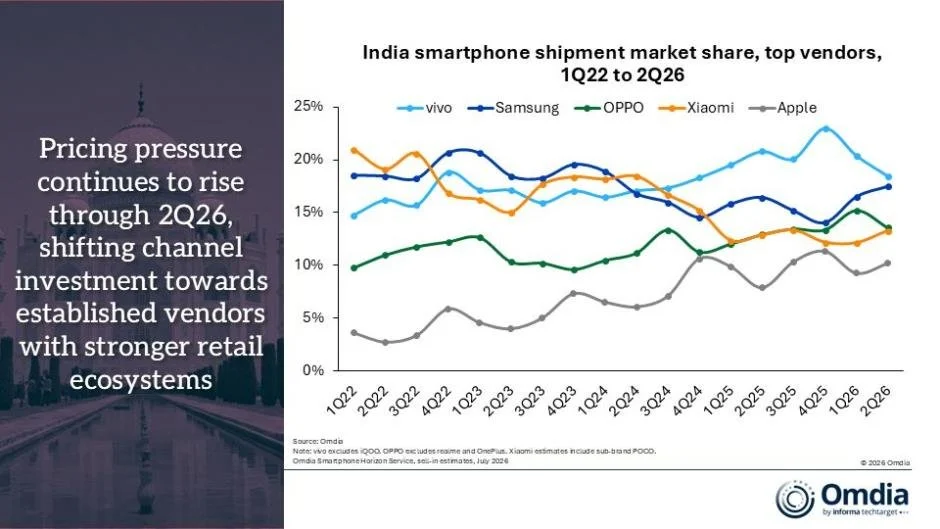
Despite the overall market contraction, key players have managed to navigate the challenging environment with varying degrees of success. Omdia’s data reveals the market share distribution for Q2 2026, with Vivo retaining its top position, followed closely by Samsung, Oppo, Xiaomi, and Apple.
Vivo: Despite a double-digit decline in its own shipments, Vivo managed to hold onto its crown as India’s largest smartphone vendor. The company shipped an estimated 6.3 million units during the quarter. Vivo’s strategy for defending its leadership involved a meticulous streamlining of its entry-level portfolio, focusing on popular models like the Y11 5G and Y21 5G. Simultaneously, the company bolstered its mid-range offerings with the introduction of the V70 FE, demonstrating a dual approach to cater to different consumer segments and maintain its market presence.
Samsung: Securing the second spot, Samsung shipped approximately 5.9 million smartphones. Notably, Samsung exhibited the strongest performance among the leading brands during the quarter, suggesting its strategies are resonating with consumers despite the prevailing economic conditions. The demand for its Galaxy A07 and Galaxy A17 models provided a solid volume base. Furthermore, Samsung’s aggressive promotional strategies, including the "Galaxy Forever" program, attractive exchange offers, buyback schemes, and robust distributor financing, played a crucial role in driving sales of its flagship Galaxy S26 series and instilling confidence within the channel.
Oppo: Oppo secured the third position with 4.6 million units shipped. The company, while experiencing a volume impact due to multiple price increases across its product range, continued to solidify its presence in the mid-range and premium segments. The introduction of the F33 series, an expanded Reno 15 lineup, and the high-end Find X9 family were key initiatives that underscored Oppo’s commitment to these more lucrative market tiers.
Xiaomi: Ranking fourth, Xiaomi shipped 4.5 million smartphones. The company’s performance was bolstered by its popular Xiaomi 15A and Xiaomi 15C models. In the entry-level segment, Xiaomi continued to serve budget-conscious consumers with the Redmi A7 4G and Redmi A7 Pro 4G. The revival of its premium T-series, backed by Leica’s imaging expertise, also aimed at strengthening its portfolio in the higher-priced segment.
Apple: Completing the top five, Apple shipped 3.5 million iPhones. The Cupertino giant benefited from strategic channel inventory build-up for the base iPhone 17 models, particularly in anticipation of potential price hikes and the absence of a new base model launch in the immediate future. Apple’s premium segment appeal was further amplified by attractive financing schemes, exchange offers, and cashback programs, which continue to be effective in driving sales of its high-end devices.
Strategic Shifts: Streamlining Portfolios and Embracing Value
In response to the challenging market dynamics, Sanyam Chaurasia highlighted a significant strategic shift among smartphone brands: a deliberate simplification of their product portfolios. This move is aimed at improving profitability, creating clearer product differentiation, and enhancing overall channel efficiency.
"Smartphone brands increasingly simplified their product portfolios during the quarter to improve profitability, differentiate products, and enhance channel efficiency," Chaurasia explained. "Entry-level portfolios were streamlined around hero models, product lifecycles were extended, and premium portfolios were redesigned to offer clearer upgrade paths."
This strategic recalibration is evident across the board. Brands are focusing on a select few "hero" models in their entry-level segments, aiming to maximize sales volume and simplify marketing efforts. Product lifecycles are being extended, allowing for more sustained sales of existing models before introducing new ones, thereby reducing the financial burden of rapid product refreshes. In the premium segment, portfolios are being redesigned to offer more discernible upgrade paths for consumers, encouraging them to move up the product ladder within the same brand.
Furthermore, Chaurasia noted that brands like Samsung and Apple are particularly well-positioned in this evolving market. Retailers are increasingly gravitating towards brands that can demonstrate stronger demand in the premium segment, offer robust financing support to ease consumer affordability concerns, and minimize inventory risk. This trend favors established players with strong brand equity and established financial and logistical capabilities.
Future Outlook: A Prolonged Slump and the Path Forward
The implications of the Q2 2026 downturn extend beyond the immediate quarter, with Omdia forecasting a continued challenging environment for India’s smartphone market. The research firm anticipates a double-digit decline for the full year 2026, with demand expected to remain under pressure throughout the year.
"Omdia expects India’s smartphone market to record a double-digit decline in 2026, with demand continuing to face pressure from inflation, rupee depreciation, higher living costs, and elevated smartphone prices caused by persistent memory cost increases," stated the report.
The persistent increase in memory costs, a key driver of higher device prices, is unlikely to abate significantly in the near term. This suggests that meaningful price normalization for smartphones is not anticipated before the first half of 2027. This extended period of elevated prices will continue to test consumer patience and purchasing power.
In light of these projections, Omdia offers crucial recommendations for smartphone vendors to navigate this protracted downturn. The research firm emphasizes the importance of maintaining pricing discipline, acknowledging the sensitivity of the Indian market to price fluctuations. Simultaneously, vendors are advised to bolster affordability through a multi-pronged approach, including:
- Enhanced Financing Options: Offering more accessible and flexible financing plans to spread the cost of smartphone purchases over manageable installments.
- Compelling Exchange Programs: Providing attractive trade-in values for older devices to incentivize upgrades.
- Lucrative Cashback Offers: Implementing targeted cashback schemes to reduce the immediate out-of-pocket expense for consumers.
- Value-Added Service Bundles: Integrating useful services and subscriptions with smartphone purchases to enhance perceived value.
- Disciplined Inventory Planning: Continuing to manage inventory levels meticulously to avoid the pitfalls of overstocking and subsequent price markdowns.
- Stronger Channel Partnerships: Cultivating robust relationships with both large-format retail chains and the extensive general trade network across India, ensuring wider product availability and efficient last-mile delivery.
The Indian smartphone market is at a critical juncture. The rapid expansion of previous years has given way to a period of consolidation and recalibration. As economic headwinds persist and component costs remain elevated, the ability of smartphone vendors to innovate not only in product features but also in pricing, financing, and distribution strategies will be paramount to their success in the coming quarters. The market’s recovery will hinge on a delicate balance between navigating macroeconomic challenges and effectively addressing the evolving affordability and value expectations of the Indian consumer.