The boundary between genuine technological innovation and performative market signaling has become increasingly porous. In the current financial landscape, artificial intelligence has transitioned from a specialized tool for software engineers to a mandatory "must-mention" in the prospectuses of companies that, by any objective metric, have nothing to do with deep learning, large language models, or neural networks.
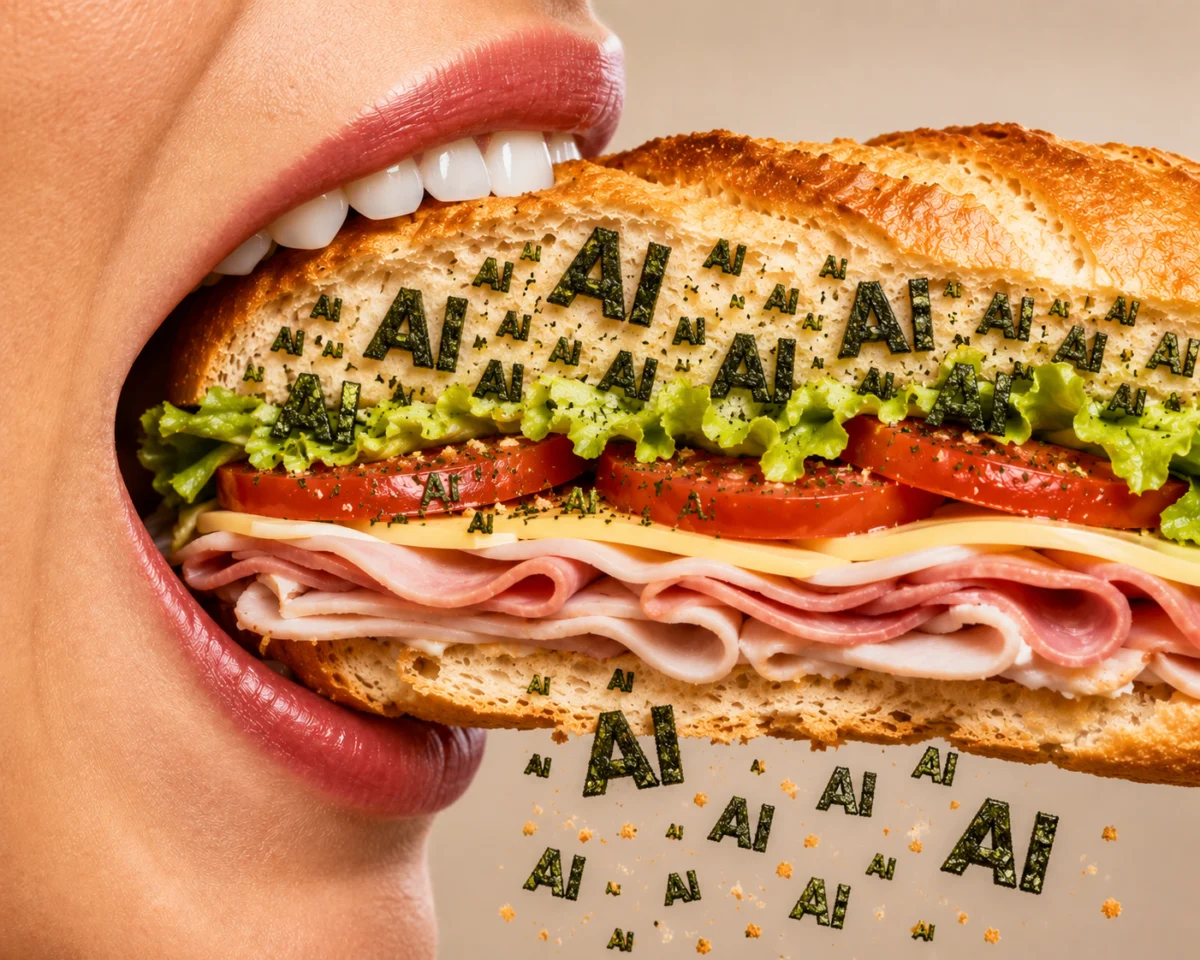
Perhaps no recent development better illustrates this trend than the S-1 filing for Jersey Mike’s Subs. As the sandwich chain prepares for its initial public offering (IPO), the presence of AI-related terminology within its core financial disclosures highlights a systemic compulsion among companies to sprinkle "AI dust" over their pitches, regardless of whether their business model involves code or cold cuts.
The Main Facts: 22 Mentions of the Future
When a company prepares to go public, its S-1 filing is meant to be a sober, transparent assessment of its business operations, competitive landscape, and inherent risks. It is a document designed for institutional investors, not for PR buzz. Yet, in the case of Jersey Mike’s—a brand synonymous with sliced-to-order meats and bread—the document reads as if it were trying to audition for a spot in a tech-heavy index.
The term "artificial intelligence" and its acronym, "AI," appear 22 times in the company’s IPO paperwork. To be clear, Jersey Mike’s is not an AI software developer; it is a franchisor of sandwich shops that counts actor Danny DeVito as its public face. In a landscape where investor appetite for AI-driven growth is insatiable, the chain has clearly decided that a total lack of mention might be perceived as a competitive disadvantage.
Chronology: The Evolution of the IPO Pitch
The trend of "AI-washing" in non-tech sectors did not happen overnight. It is the culmination of a multi-year shift in market sentiment.
- 2023: Generative AI hits the mainstream following the release of ChatGPT. Venture capital firms begin prioritizing AI-native startups almost exclusively.
- Early 2024: Startups in unrelated fields—from logistics to real estate—begin rebranding their basic automation tools as "AI-powered" to secure funding.
- Mid-2025: High-profile public debuts, such as that of Bending Spoons, demonstrate that even companies in the business of acquiring and rehabilitating legacy, "non-AI" tech are leaning heavily into the AI narrative to bolster their valuation.
- July 2026: Jersey Mike’s files its S-1. By this point, the inclusion of AI as a risk factor is considered "boilerplate" necessity, even for brick-and-mortar retail and food service entities.
The trajectory is clear: what started as a legitimate technological paradigm shift has metastasized into a marketing requirement for any entity seeking to capture the attention of public market investors.
Supporting Data: By the Numbers
To understand the extent to which Jersey Mike’s is leaning into the lexicon of the tech sector, one must look at the frequency of specific terminology within their S-1:
- "Artificial Intelligence / AI": 22 mentions.
- "Software": 52 mentions.
- "Data": 112 mentions.
- "Weather": 5 mentions.
- "Lightning": 0 mentions.
The disparity is telling. While "software" and "data" are legitimately essential to the operations of a modern, multi-state franchise business, the pivot to AI represents a departure from traditional operational disclosure. The company notes that it is "beginning to use AI technologies in our business," but offers no granular detail on what these technologies are, how they are integrated into the sandwich-making process, or what tangible efficiency gains they provide.
Official Responses and the "Risk Factor" Paradox
The most peculiar aspect of this trend is the inclusion of AI under "Risk Factors." Public companies are required to disclose any condition that could harm their financial performance. By including AI in this section, Jersey Mike’s is essentially telling investors: "We are using AI, and it might go wrong."
This is not a hypothetical concern. The retail and food service industry has already seen the consequences of "half-baked" AI implementation. Most notably, Starbucks recently retired a high-profile AI inventory tool after it failed to accurately count stock and actively impeded the workflows of baristas, ultimately slowing down service—the exact opposite of the tool’s intended purpose.
When asked for comment or clarification, companies often defer to the "boilerplate" defense: the assertion that these disclosures are standard legal practice. However, legal experts suggest that the boilerplate is growing exponentially. By classifying AI as a business risk, the company protects itself from litigation should their AI experiments fail, but it simultaneously obscures the reality that for a sandwich shop, the risk of an "AI disaster" is statistically negligible compared to traditional business risks like supply chain disruptions or food safety issues.
The Implications: Why It Matters
The implications of this behavior are twofold: it signals a dangerous level of market desperation, and it threatens to dilute the meaning of technological progress.
The Dilution of Innovation
When a sandwich shop is forced to use the same vocabulary as a machine-learning research lab, the value of the term "AI" becomes diluted. Investors, who are already weary of the current hype cycle, may eventually find it difficult to distinguish between companies that are genuinely building the future and those that are simply using buzzwords to distract from stagnating core businesses.
The "Lightning" Test
There is a profound irony in the Jersey Mike’s S-1. A sandwich shop in Texas was actually struck by lightning in 2021—a literal, physical event that caused damage to the business. Yet, while "weather" is mentioned five times, "lightning" is mentioned zero times. The probability of an AI-induced catastrophe for a sandwich shop is arguably lower than the probability of another location being struck by lightning, yet AI receives nearly five times as much attention in the document.
The Investor’s Dilemma
For the retail investor, this trend is a cautionary tale. If a company feels compelled to lean on the "AI" crutch to make their IPO more palatable, it raises questions about the strength of their actual product. Are investors buying into the quality of the sandwiches, or are they buying into a narrative that has been artificially inflated by the prevailing tech zeitgeist?
Conclusion: Reality vs. Rhetoric
As the market moves forward, the "AI-washing" of IPO documents will likely continue until the hype bubble fully deflates. While it is understandable that companies want to appear modern and technologically savvy, there is a point at which the inclusion of such terminology becomes more damaging than helpful.
Investors are increasingly looking for substance over syntax. A business that focuses on the quality of its ingredients, the efficiency of its supply chain, and the loyalty of its customer base will always be more resilient than one that relies on the buzzwords of the day to mask a lack of clear strategy.
In the case of Jersey Mike’s, the sandwiches will likely continue to sell based on their taste and brand recognition—not because of any "AI dust" sprinkled on their financial filings. If the company wants to build long-term trust, it might be better served by focusing on what it does best: crafting a high-quality product, and leaving the artificial intelligence to the software engineers.
The market has a way of correcting for hype. Eventually, the companies that succeed will be the ones that deliver value in the real world, not just the ones that can write the most compelling "AI" copy in their regulatory filings. For now, the "aww-come-on" factor remains high, and investors should remain vigilant in separating the technological wheat from the marketing chaff.