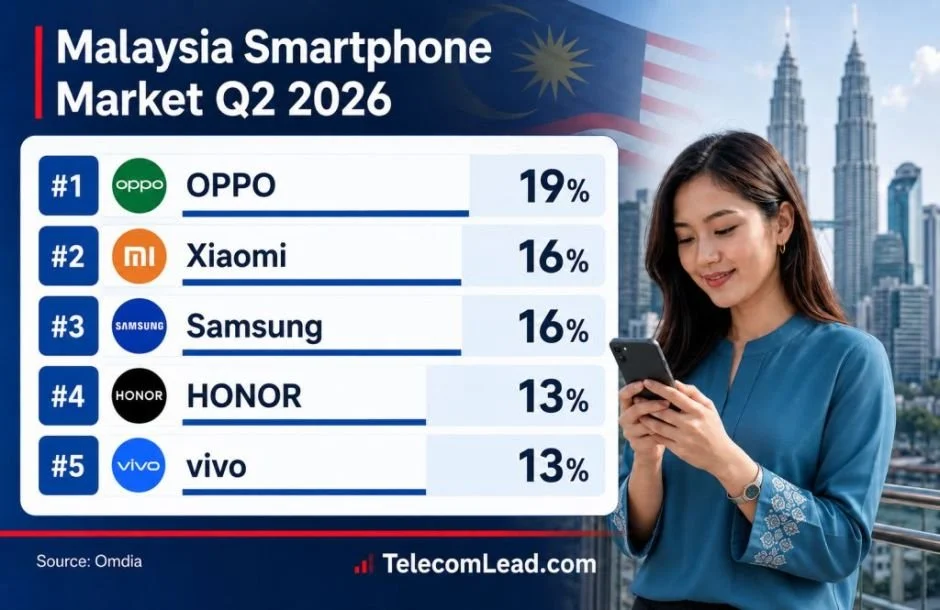
Kuala Lumpur, Malaysia – August 15, 2026 – Malaysia’s smartphone market has officially cemented its status as Southeast Asia’s most intensely contested battleground. In the second quarter of 2026, a razor-thin six-percentage-point margin separated the top five leading vendors, painting a vivid picture of a market where every shipment and every sale counts. OPPO has emerged at the forefront, securing a 19 percent market share, narrowly edging out a tightly packed duo of Samsung and Xiaomi, who both claimed 16 percent. Hot on their heels, HONOR and vivo each commanded a respectable 13 percent share, collectively demonstrating the fierce competition that defines the Malaysian mobile landscape.
This dramatic showdown, detailed in the latest Omdia Southeast Asia smartphone market report, underscores a dynamic shift in consumer preferences and vendor strategies. The collective dominance of these five powerhouses is undeniable, accounting for a substantial 77 percent of all Malaysian smartphone shipments. This leaves the remaining 23 percent to be divided among global giants like Apple, emerging players such as Transsion, and other established brands like realme. The slim three-percentage-point lead that OPPO holds over its closest rivals—Samsung and Xiaomi—serves as a stark reminder that the market’s hierarchy remains fluid, susceptible to rapid alterations driven by aggressive promotional campaigns, astute retail execution, and the timely introduction of compelling new products.
The Q2 2026 Malaysian Smartphone Market Snapshot: A Tight Race
| Vendor | Shipment Share (Q2 2026) |
|---|---|
| OPPO | 19% |
| Samsung | 16% |
| Xiaomi | 16% |
| HONOR | 13% |
| vivo | 13% |
Source: Omdia Southeast Asia Smartphone Market Report, Q2 2026
The data from Omdia’s comprehensive report paints a compelling narrative of a market in flux, where technological innovation, strategic pricing, and sophisticated marketing are all critical levers for success. As consumers navigate an increasingly complex array of choices, vendors are forced to innovate relentlessly to capture and retain market share.
OPPO’s Ascendancy: A Calculated Climb to the Top
OPPO has successfully navigated the treacherous waters of the Malaysian smartphone market to claim the coveted top spot in Q2 2026, boasting a 19 percent shipment share. This achievement is a testament to the company’s robust and diverse product portfolio, which effectively caters to a wide spectrum of consumer needs and price points. From the budget-friendly A-series, designed to attract a broad base of first-time smartphone buyers and those seeking value, to the stylish and feature-rich Reno smartphones that occupy the lucrative mid-range segment, and the cutting-edge Find models that push the boundaries of premium innovation, OPPO has strategically positioned itself to appeal to virtually every segment of the Malaysian market.
However, this national triumph stands in notable contrast to OPPO’s broader regional performance. In the preceding quarter, Q1 2026, OPPO experienced a 17 percent decline in its Southeast Asian shipments, totaling 4.2 million units. This dip was attributed to a period of operational adjustments following the strategic integration of realme into its broader ecosystem. Despite this regional recalibration, OPPO managed to retain its second-place standing across Southeast Asia, trailing only behind Samsung, highlighting its enduring appeal and market penetration in the region.
In response to a softening demand in the entry-level segment, a trend observed across many markets, OPPO has proactively shifted its strategic focus. The company is increasingly emphasizing smartphones that offer enhanced camera capabilities, advanced Artificial Intelligence (AI) features, larger battery capacities for extended usage, and higher memory configurations to support more demanding applications and multitasking. This strategic pivot is vividly demonstrated by the recent launch of the Reno16 family, which includes the high-end Reno16 Pro 5G, the capable Reno16 5G, and the versatile Reno16 F 5G. These models represent a deliberate move into higher-value price segments, aiming to capture consumers who are willing to invest more for superior performance and advanced features.
Beyond product innovation, OPPO is employing sophisticated financial strategies to enhance affordability and drive sales. The company is actively leveraging zero-interest installment plans, offering consumers the flexibility to spread the cost of their purchases over extended periods of up to 24 months. This is complemented by robust loyalty point programs that reward repeat customers and strategically timed online sales events. These initiatives are designed to mitigate the immediate financial burden on Malaysian consumers without resorting to permanent, across-the-board price reductions, thereby preserving the perceived value of their devices while simultaneously stimulating demand.
Samsung and Xiaomi: A Stalemate at 16 Percent
The Malaysian market’s intense competition is further underscored by the tie between Samsung and Xiaomi for the second position, each securing a significant 16 percent of the smartphone shipment share. This places them just three percentage points adrift of market leader OPPO, a gap that is certainly bridgeable in the dynamic and fast-paced mobile industry.
Samsung, a perennial powerhouse in the global and regional smartphone arena, demonstrates a robust performance that provides a strong foundation for its Malaysian operations. In Q1 2026, Samsung led the entire Southeast Asian market with impressive shipments of 4.6 million units, capturing a 21 percent market share and registering a healthy 4 percent year-on-year growth. This regional strength translated into global success as well; according to Counterpoint Research, Samsung commanded a substantial 23 percent of the global smartphone market in Q2 2026, with shipments rising by a notable 9 percent.
The company’s strategic advantage lies in its exceptionally diversified product portfolio, which acts as a formidable shield against volatility in any single market segment. The popular Galaxy A-series continues to be a volume driver, attracting a vast consumer base with its blend of affordability and reliable performance. Simultaneously, the premium Galaxy S26 series provides a critical revenue stream and reinforces Samsung’s brand prestige at the high end of the market. In Malaysia, Samsung has strategically priced key models to attract consumers. The Galaxy A57 5G, for instance, was launched with a compelling offer: the 12GB+512GB variant was initially priced at RM2,699, but a promotional rebate of RM300 brought its launch price down to RM2,399, making it an attractive proposition for mid-range buyers.
For its flagship offerings, Samsung maintains premium pricing for the Galaxy S26 series, which starts at RM4,399. To enhance accessibility, the company actively promotes substantial trade-in savings, potentially reaching up to RM3,510, and offers flexible installment programs. These initiatives allow consumers to acquire high-end devices without the immediate financial strain, ensuring Samsung’s continued dominance in the premium segment while maintaining its profitability.
Xiaomi, while also a major player, faces a more pronounced exposure to price-sensitive consumers, a factor that has impacted its regional performance. In Q1 2026, Xiaomi’s Southeast Asian shipments saw a decline of 12 percent, amounting to 3.7 million units. Globally, Xiaomi experienced one of the steepest declines among the top five vendors in Q2 2026, with shipments plummeting by 26 percent. This downturn was largely attributed to rising memory prices, which significantly affected demand for its entry-level and mid-range devices, the core of its market strategy.
The pressure of rising costs is evident in Xiaomi’s Malaysian pricing strategies. The Redmi Note 15 4G model entered the market at RM799, a notable increase of approximately 14 percent from its predecessor, which was priced at RM699. Similarly, the Redmi Note 15 Pro+ (12GB+512GB) was launched at RM1,899, a significant RM300, or nearly 19 percent, increase compared to the comparable previous generation model. To mitigate the impact of these price hikes and maintain demand, Xiaomi is strategically employing launch bundles for its higher-end devices. The Xiaomi 17T, priced at RM2,399 for the 12GB+256GB configuration, was offered at an introductory price of RM2,099. The Xiaomi 17T Pro, meanwhile, launched with a starting price of RM2,899. These bundles aim to provide added value and incentivize early adoption in a challenging market environment.
HONOR’s Momentum: A 13 Percent Share and Foldable Dominance
HONOR has carved out a significant presence in the Malaysian smartphone market, securing a 13 percent share in Q2 2026, a position it shares with vivo. While its overall market share remains six percentage points behind the leader, OPPO, HONOR’s growth trajectory is demonstrably stronger than many of its larger competitors.
The first quarter of 2026 proved to be a period of substantial expansion for HONOR in Southeast Asia. Shipments increased by an impressive 28 percent, reaching 1.2 million units. This growth was not confined to a single market but was observed across six of the region’s eight major markets, indicating a broad-based strengthening of its presence. Over the first half of 2026, HONOR’s shipments in Southeast Asia grew by 15 percent, positioning the company as one of the fastest-growing leading vendors in key markets like Malaysia and the Philippines.
A particularly noteworthy achievement for HONOR in Malaysia is its commanding lead in the burgeoning foldable smartphone segment. In Q2 2026, HONOR captured a dominant 53 percent of Malaysia’s foldable smartphone shipments. For comparative context, Samsung, a pioneer in the foldable space, held 26 percent, while OPPO secured a modest 8 percent. This substantial 27-percentage-point lead over Samsung in this premium category highlights HONOR’s ambitious strategy to not only compete in the mainstream market but also to establish itself as a leader in the high-end, innovative foldable segment.
HONOR’s mainstream strategy is characterized by a commitment to offering competitive devices at accessible price points. The HONOR 600, for instance, is currently available at RM2,399 after a RM200 price reduction, making it an appealing option for consumers seeking quality and performance without breaking the bank. The company actively employs a combination of attractive installment plans, discount vouchers, and bundled accessories to enhance its competitive edge against OPPO and Xiaomi in Malaysia’s highly saturated upper-mid-range segment. This multi-pronged approach ensures that HONOR remains a compelling choice for a wide range of Malaysian consumers.
vivo’s Strategic Shift: 13 Percent Share and a Focus on Higher Value
vivo has also secured a 13 percent share of the Malaysian smartphone market, mirroring HONOR’s performance and placing it three percentage points behind the joint second-place holders, Samsung and Xiaomi. While its market share is solid, vivo’s regional shipment performance in Q1 2026 presented a more challenging picture, with a year-on-year decline of 27 percent, shipping 2.1 million smartphones in Southeast Asia.
Despite this volume contraction, vivo has demonstrated remarkable strategic acumen by significantly increasing its Average Selling Price (ASP). The company’s ASP saw a substantial 28 percent increase in the region, marking the strongest growth among the major vendors in Southeast Asia. This suggests a deliberate and strategic decision by vivo to reduce its reliance on lower-margin, affordable devices and to aggressively pursue higher-value market segments. This strategy is clearly aimed at improving overall profitability and brand perception.
This focus on higher-value devices is evident in vivo’s Malaysian offerings. The V70 5G, a key model in its portfolio, is priced starting at RM2,199 for the 8GB+256GB configuration, with options extending to RM2,499 for 12GB+256GB and RM2,999 for the top-tier 12GB+512GB variant. These devices are equipped with premium features designed to appeal to discerning consumers, including ZEISS-branded cameras, a substantial 6,500mAh battery for extended usage, and rapid 90W charging capabilities.
vivo continues to utilize strategic discounting as a vital component of its competitive strategy. The V70 FE 5G has seen its price adjusted downwards to RM1,899 from its previous listing of RM1,999. More significantly, the V60 5G has been offered at a promotional price of RM1,795, a considerable reduction from its original price of RM2,399, representing a substantial saving of RM604, or approximately 25 percent. These aggressive pricing tactics, coupled with its focus on premium features, aim to attract consumers seeking high-quality devices at more attainable price points.
Rising Smartphone Prices Reshape Competition in Malaysia and Beyond
The Malaysian smartphone market, like many in Southeast Asia, has been grappling with a broader trend of rising smartphone prices, a phenomenon that is fundamentally reshaping the competitive landscape. Omdia data reveals that in Q1 2026, the Malaysian smartphone market experienced a significant 19 percent decline, with shipments of devices priced below $200 falling by more than 30 percent. This contraction is a direct reflection of a growing affordability challenge, particularly concerning the sub-$200 segment, which traditionally accounts for over 60 percent of smartphone shipments across Southeast Asia.
The regional downturn intensified in the second quarter of 2026. Southeast Asian smartphone shipments plummeted by 23 percent to 19.3 million units, marking the lowest quarterly result since 2014. Paradoxically, despite the drop in unit volumes, the market value reached $6.6 billion, driven by a substantial 31 percent increase in the average selling price (ASP), which climbed to $342. This indicates a market shift towards higher-priced devices, even as overall demand contracts.
Compared to the 21.6 million units shipped in Q1 2026, the Q2 2026 total represents a sequential decline of approximately 10.6 percent. While the regional ASP saw a slight moderation from the record $349 recorded in Q1 2026, it remains significantly higher year-on-year, underscoring the persistent trend of increasing device costs.
Looking ahead, Omdia forecasts a continued contraction for the Southeast Asian smartphone market, projecting a 25 percent decline in shipments for 2026, bringing the total to an estimated 75.3 million units. This forecast implies a market size of approximately 100.4 million units in 2025, indicating a significant year-on-year decrease.
The competitive strategies observed among the leading vendors in Malaysia’s Q2 2026 rankings highlight distinct approaches to navigate this evolving market. OPPO is pursuing a dual strategy of broad retail reach combined with a premiumization push led by its Reno series. Samsung is balancing the volume generation of its Galaxy A-series with the premium appeal and revenue contribution of its S-series. Xiaomi, despite its significant exposure to price-sensitive segments, is leveraging aggressive specifications and promotional bundles to maintain its market presence. HONOR is steadily gaining momentum, fueled by its strong performance in the foldable segment and ongoing channel expansion. Meanwhile, vivo appears to be strategically accepting lower shipment volumes in its pursuit of higher-value sales and improved profitability.
With OPPO, Samsung, Xiaomi, HONOR, and vivo all clustered within a narrow six-percentage-point band, the Malaysian smartphone market is poised to remain one of the most dynamic and fiercely competitive arenas in Southeast Asia throughout the remainder of 2026. Consumers can anticipate a continuous cycle of innovation, aggressive promotions, and strategic pricing as these major players vie for dominance.
By Fasnaabeer