The operational reality of space domain management is undergoing a fundamental transformation. As orbit grows increasingly congested, contested, and technologically complex, the traditional methods of satellite mission management—characterized by centralized ground stations, periodic downlink passes, and manual command queuing—are proving insufficient for modern national security demands.
To maintain space domain awareness and tactical superiority, defense agencies and commercial aerospace leaders are pivoting toward edge computing, autonomous mission orchestration, and cloud-native software architectures deployed directly onboard spacecraft.
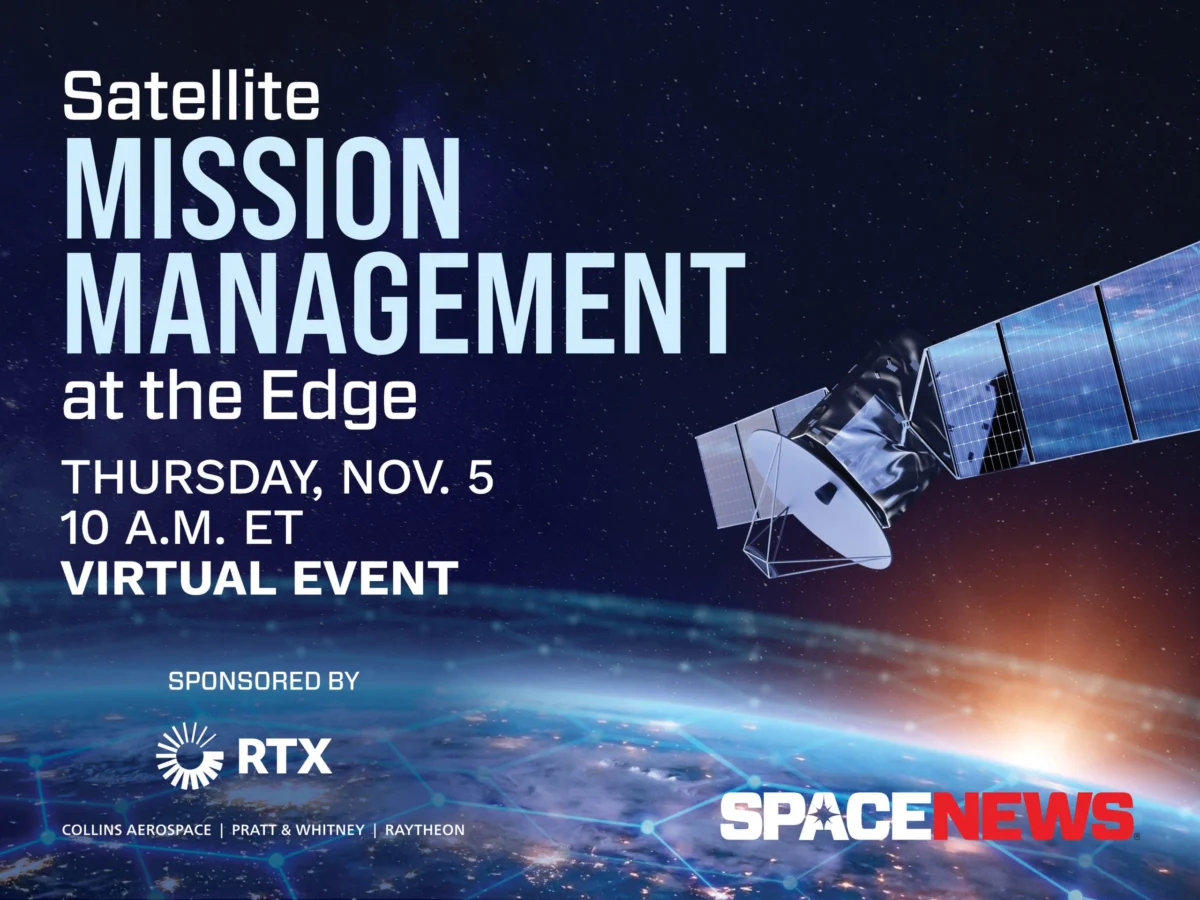
To address these shifting operational dynamics, SpaceNews and global defense technology giant RTX will host an upcoming industry symposium, "Satellite Mission Management at the Edge," on Thursday, Nov. 5, from 10:00 to 10:45 a.m. ET. The virtual event brings together technical experts and program leaders to examine how emerging edge capabilities, modular software frameworks, and commercial innovation are reshaping the national security space architecture.
Main Facts: Modernizing National Security Space Operations
At the core of the modern national security space debate is the imperative to shift decision-making timelines from hours to milliseconds. Historically, space missions relied heavily on "bent-pipe" architectures or ground-dependent pipelines: raw payload data was captured on orbit, stored onboard, downlinked during pre-scheduled passes over ground stations, processed in centralized ground facilities, and converted into actionable intelligence long after the event occurred.
Today’s threat environment demands a radical alternative. Operators face a combination of anti-satellite (ASAT) capabilities, dynamic orbital jamming, laser counter-measures, and rapidly growing swarms of commercial and adversary satellites. To counter these vulnerabilities, the U.S. Department of Defense and allied nations are prioritizing three foundational operational capabilities:
Edge Processing On Orbit: Deploying radiation-hardened, high-performance computing clusters directly onto satellites. This enables onboard artificial intelligence and machine learning (AI/ML) algorithms to process raw synthetic aperture radar (SAR), optical imagery, or signals intelligence (SIGINT) directly at the payload level.
Autonomous Mission Management: Empowering spacecraft to dynamically adjust their trajectories, tasking agendas, and payload configurations without waiting for explicit ground-station commands.
Cloud-Native, Open-Architecture Software: Utilizing containerized software environments (such as Kubernetes and microservices architectures) that allow satellite operators to push secure software patches, threat libraries, and operational applications to orbit via remote software updates.
The joint SpaceNews and RTX virtual event will examine how these capabilities can be integrated into next-generation constellations while maintaining strict cybersecurity, operational control, and mission assurance. As legacy ground control systems reach their operational limits, military and intelligence customers are seeking modular, commercial-off-the-shelf (COTS) technologies that offer lower cost-per-bit processing and rapid scalability.
Chronology: The Evolution of Orbital Command and Control
To understand the urgency driving edge-based mission management, it is necessary to examine how satellite operation paradigms have evolved over the past six decades.
+-----------------------------------------------------------------------------------+
|                            EVOLUTION OF SATELLITE COMMAND                         |
+-----------------------------------------------------------------------------------+
|  1960s – 2000s: Traditional Monolithic Era                                        |
|  • Custom, single-mission ground networks                                         |
|  • Centralized ground processing; multi-hour/day latency                         |
|  • Fixed onboard hardware with static operational software                        |
+-----------------------------------------------------------------------------------+
                                         |
                                         v
+-----------------------------------------------------------------------------------+
|  2010s: Proliferated Low Earth Orbit (pLEO) & Commercial Surge                   |
|  • Shift toward large constellations of smaller, standardized satellites          |
|  • Exponential increase in telemetry, tracking, and command (TT&C) load           |
|  • Ground downlink bottlenecks emerge as data volumes explode                     |
+-----------------------------------------------------------------------------------+
                                         |
                                         v
+-----------------------------------------------------------------------------------+
|  2020s & Beyond: Autonomous Edge & Cloud-Native Architectures                     |
|  • Radiation-hardened edge processors running onboard AI/ML                       |
|  • In-space mesh networking via Optical Inter-Satellite Links (OISLs)            |
|  • Dynamic tasking, local data reduction, and software-defined payloads           |
+-----------------------------------------------------------------------------------+
The Monolithic Ground-Centric Era (1960s–2000s)
During the Cold War and the early post-Cold War era, satellite operations were built around large, highly complex, and extremely expensive monolithic spacecraft residing primarily in Geostationary Earth Orbit (GEO) or specialized High Earth Orbits (HEO).
Ground stations operated on bespoke operational software. Downlink bandwidth was modest, and command chains were heavily manual. Satellites were essentially passive collectors; intelligence was extracted only after ground processing centers decrypted and formatted the downlinked streams.
The Proliferation and Data Explosion Era (2010s–Early 2020s)
The rise of small-satellite technology and lower-cost launch vehicles triggered a transition toward Proliferated Low Earth Orbit (pLEO) architectures. Organizations began deploying hundreds—and eventually thousands—of satellites to build resilient, distributed constellations.
However, this proliferation created a massive data bottleneck. Ground infrastructure could no longer keep up with the continuous stream of raw sensor data generated by hundreds of sensors overhead. Downlink pass availability, atmospheric attenuation, and restricted radio-frequency (RF) spectrum allocations created severe operational choke points.
The Autonomous Edge Era (Current Day)
To overcome the downlink bottleneck, industry and government entities are turning to on-orbit edge computing. By shifting processing capabilities up into the space domain, satellites no longer need to downlink gigabytes of unrefined imagery. Instead, onboard AI processes the data locally, detects relevant features (such as vehicle movements, missile plumes, or vessel deployments), and downlinks only small, encrypted tactical alerts—reducing bandwidth requirements by orders of magnitude and slashing response times from hours to seconds.
Supporting Data: Architecture, Bandwidth Bottlenecks, and Scale
The technical drive toward edge computing is highlighted by stark operational metrics across data bandwidth, constellation density, and latency requirements.
The Data vs. Downlink Mismatch
Modern high-resolution imaging payloads, such as hyperspectral sensors and Synthetic Aperture Radar (SAR), generate immense volumes of raw data. A single modern hyperspectral satellite payload can generate up to several terabytes of raw data per day.
Traditional Downlink Capacity: Typical X-band or S-band ground downlinks deliver throughput rates between tens to hundreds of megabits per second (Mbps), heavily constrained by orbital pass duration (often only 5 to 15 minutes per ground station pass).
The Optical Mesh Alternative: Laser communication terminals—or Optical Inter-Satellite Links (OISLs)—provide inter-satellite transport rates exceeding 10 to 100 Gigabits per second (Gbps).
The Edge Compression Factor: Onboard processing reduces payload transmission size significantly. By filtering out background noise, cloud cover, and non-target data directly at the sensor level, edge algorithms reduce the bandwidth footprint of actionable intelligence by 90% to 99%.
+-----------------------------------------------------------------------------+
|                     DATA REDUCTION AT THE ORBITAL EDGE                      |
+-----------------------------------------------------------------------------+
| Raw Payload Collection (e.g., Hyperspectral/SAR):  100% Data Volume         |
|                                                                             |
| [ Onboard Edge AI / Processing Filter ]                                     |
|   ├── Removes cloud cover & empty terrain                                   |
|   └── Identifies targets of interest / anomalies                             |
|                                                                             |
| Actionable Tactical Alert / Metadata Downlink:     < 1% to 10% Data Volume    |
+-----------------------------------------------------------------------------+
Scale of Enterprise Support
The hardware and software integration required for this shift requires significant scale and resources. RTX, which is co-sponsoring the upcoming panel, represents one of the largest aerospace and defense software-engineering footprints globally:
Global Workforce: Over 180,000 employees globally across aerospace, defense systems, and intelligence technologies.
Corporate Headcount & Base: Headquartered in Arlington, Virginia.
Financial Scale: Net sales exceeding $88 billion in 2025.
Core Technology Focus: Advanced sensor hardware, radiation-tolerant processing systems, cloud-native command and control software, and secure defense network integration.
Official Responses and Industry Perspectives
Defense acquisition officials and defense industry executives increasingly emphasize that operational software, rather than physical satellite buses, will determine future space dominance.
Speaking on the shift toward edge-based operations, military space planners highlight that modern space capabilities must mirror commercial cloud architectures, adapting dynamically as operational demands change.
"In a contested space domain, relying on continuous, unbroken communications links back to ground command stations is an operational risk," noted defense software architects in recent space domain analysis. "Space platforms must possess sufficient onboard autonomy to perform threat assessment, real-time orbit determination, dynamic payload reallocation, and edge target recognition even when communications links are actively jammed or degraded."
Industry developers from companies like RTX emphasize that implementing cloud-native software on space platforms requires balancing rapid innovation with mission assurance:
"Modernizing satellite mission management is not just about mounting faster microprocessors on a spacecraft," experts observe. "It requires building an open, modular software ecosystem that allows operators to deploy containerized software updates safely without risking spacecraft bus stability, telemetry loops, or operational safety."
Bridging legacy mission control hardware with modern software architectures remains a priority for commercial primes. The goal is to establish interoperable standards that allow new software payloads to run seamlessly across heterogeneous satellite buses manufactured by different vendors.
Implications for National Security and Commercial Space
The move toward edge-computing architectures in orbital mission management carries major implications for the future of military strategy, space commerce, and defense procurement.
+----------------------------------------------------------------------------+
|                        KEY OPERATIONAL IMPLICATIONS                        |
+----------------------------------------------------------------------------+
| ⚡ Sensor-to-Shooter Acceleration                                           |
|    Dramatically cuts tactical data loops from hours to real-time seconds.  |
|                                                                            |
| 🛡️ Operational Resilience & Jamming Defense                                |
|    Enables autonomous satellite survival actions during link degradation.  |
|                                                                            |
| 🔄 Software-Defined Satellite Longevity                                    |
|    Extends mission life by pushing software upgrades directly to orbit.    |
|                                                                            |
| 🤝 Commercial-Military Standard Alignment                                  |
|    Unifies military specifications with commercial ground and cloud APIs.  |
+----------------------------------------------------------------------------+
1. Accelerating the Sensor-to-Shooter Loop
By combining onboard AI target recognition with direct-to-tactical-warfighter data links (such as Link 16 or specialized UHF/VHF links), national security space assets can alert tactical forces on the ground, at sea, or in the air to emerging threats in near-real-time. This cuts minutes or hours out of kill-web execution loops.
2. Space Domain Resiliency and Survivability
Edge-computing systems paired with autonomous command algorithms allow satellites to detect approaching orbital hazards or directional RF jamming and initiate defensive maneuvers or counter-adjustments instantly. Spacecraft no longer need to complete an orbit cycle to down-link telemetry and receive emergency escape parameters from ground controllers.
3. Software-Defined Payload Economics
Historically, a satellite launched with a static set of capabilities; if a target signature changed or a mission requirement shifted, the hardware could not adapt. Modern edge-centric architectures utilize software-defined payloads. Operators can reconfigure satellite tasking on the fly—turning an optical imagery satellite into an automated anomaly detection node overnight purely via software updates.
4. Integration of Commercial and Military Standards
The adoption of containerized workloads (e.g., Docker, Kubernetes adapted for embedded space systems) bridges the gap between commercial software tech stacks and defense acquisition programs. This open architecture approach allows small software startups and non-traditional defense contractors to write apps for military space platforms, accelerating innovation cycles across the defense industrial base.
Event Details and Registration
The upcoming symposium will serve as a platform for defense and aerospace stakeholders to unpack these emerging technologies, discuss open standards, and outline strategies for updating ground and orbital software architectures.
Event Satellite Mission Management at the Edge
Date: Thursday, Nov. 5
Time: 10:00 a.m. – 10:45 a.m. ET
Format: Virtual Event (Hosted via Zoom)
Co-Hosts:SpaceNews & RTX
Participants will gain technical perspective into how modular design, cloud computing, and onboard automation can drive down mission lifecycle costs while boosting operational resilience across next-generation space constellations.