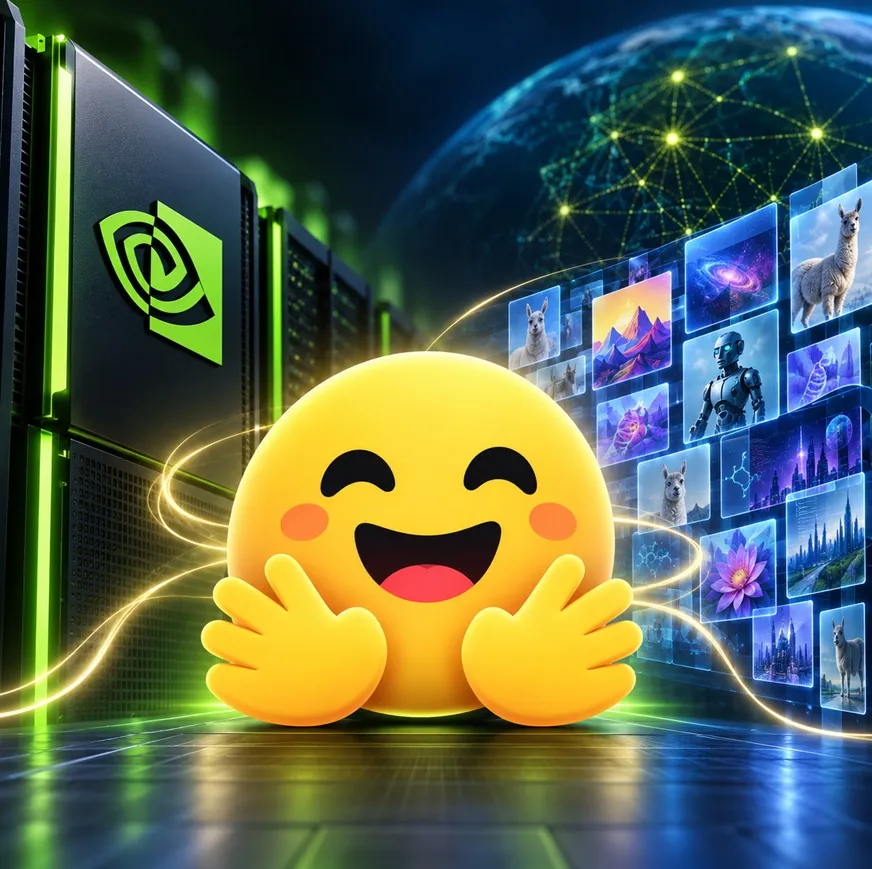
In a move that promises to reshape the trajectory of artificial intelligence development, Nvidia has officially announced the acquisition of HuggingFace, the industry-leading platform for open-source AI models, datasets, and software libraries, for a staggering $12.9 billion. The acquisition represents a landmark consolidation between the world’s most dominant hardware provider and the primary repository for the global open-source AI community.
For many in the technology sector, the acquisition of the startup—famously named after the "hugging face" emoji—is seen as the most significant deal in the recent history of machine learning. Founded in 2016 by three French entrepreneurs, HuggingFace has evolved from a niche project into the "GitHub of AI," serving as the foundational infrastructure for millions of developers. As the tech industry pivots toward more robust, domain-specific AI applications, this merger signals a strategic shift in how AI models will be distributed, optimized, and integrated across the global cloud and hardware ecosystem.
A Chronology of Growth: From Emoji to Industry Pillar
To understand the scale of this acquisition, one must look at the meteoric rise of HuggingFace over the last decade. Founded in 2016, the company initially focused on chatbots before pivoting toward an open-source model repository. This pivot proved to be a masterstroke, aligning the company with the explosive growth of generative AI.

- 2016: HuggingFace is founded by French entrepreneurs Clem Delangue, Julien Chaumond, and Thomas Wolf.
- 2018–2020: The platform gains massive traction by simplifying the deployment of Transformers, the architecture that powers modern Large Language Models (LLMs).
- 2021–2023: The "HuggingFace Hub" becomes the industry standard, hosting hundreds of thousands of models and datasets, attracting support from major tech giants and venture capital firms.
- 2024–2025: The platform reaches a critical mass of 18 million users, cementing its status as the heartbeat of the open-source AI movement.
- 2026: Nvidia announces the acquisition of the platform for $12.9 billion, marking a new chapter for the company’s independence and long-term scaling goals.
The Strategic Logic: Nvidia’s Dominance and Neutrality
Nvidia, already the undisputed leader in AI hardware, has long been HuggingFace’s largest contributor. By bringing the platform in-house, Nvidia aims to ensure that the open-source ecosystem thrives in a way that is compatible with its proprietary hardware, while simultaneously maintaining a veneer of platform neutrality.
During a high-stakes press conference, Nvidia VP of AI Software, Justin Boitano, addressed the primary concern of the developer community: whether HuggingFace would remain an "open" platform. Boitano was unequivocal in his defense of the platform’s neutrality.
"We’re committed to helping build this community, stewarding, and fostering this community," Boitano stated. "We want to continue to work with all AI developers globally to make sure that they’ve got an open and neutral platform that interoperates with every cloud provider, every hardware company in the world."

The strategic imperative for Nvidia is clear. By owning the repository, they gain visibility into the cutting edge of model development. However, to keep that edge sharp, they must avoid "locking" the platform. Boitano noted that Nvidia’s specific software runtimes will continue to coexist with open-source alternatives like vLLM and SGLang. This "co-existence" strategy is designed to ensure that the HuggingFace repository remains the default choice for developers, regardless of the underlying hardware they choose to deploy on.
Official Responses: Reassuring the Ecosystem
The acquisition has naturally sparked intense debate regarding the future of open-source software. HuggingFace CEO Clem Delangue, appearing alongside Nvidia leadership, sought to calm fears regarding the potential stifling of innovation.
"The vast majority of what we do is open source—open models, open datasets that are by definition neutral," Delangue said. "Everyone can take them, everyone can optimize them, everyone can fork our open source if they’re not happy about it."

Delangue emphasized that the acquisition provides the one thing the startup lacked: long-term stability and deep-pocketed resources. He noted that the company is aiming for 100 million users, a goal he believes is now firmly within reach thanks to Nvidia’s support. Furthermore, he explicitly addressed the "French-founder-exiting-to-the-US" narrative, reframing it as a win for the European ecosystem.
"All three co-founders are French, but I was already in the U.S. when we started the company, so quite naturally, we built it with American investors," Delangue explained. "We hope that after this acquisition, the team will be able to reinvest quite a lot in the European tech ecosystem," pointing toward a future where they support more European labs, such as France’s Mistral and Germany’s Black Forest Labs.
Implications for the Global AI Landscape
The $12.9 billion price tag is not just a payment for code or a user base; it is an investment in the future of "Physical AI" and domain-specific intelligence. As companies move away from monolithic, general-purpose models toward smaller, highly specialized models, the importance of a centralized repository for data and architecture cannot be overstated.

The Developer Experience
For the 18 million developers currently using HuggingFace, the immediate impact will likely be an increase in resources. Improved infrastructure, faster model loading, and better integration with Nvidia’s H100 and Blackwell-class hardware are expected to be the immediate priorities.
The Competition
Competitors in the cloud space—such as AWS, Google Cloud, and Microsoft Azure—will be watching closely. While Nvidia has pledged that HuggingFace will remain "hardware and cloud-neutral," the reality of a hardware giant owning the software distribution hub will create a complex dynamic. Will Nvidia eventually prioritize its own cloud infrastructure within the HuggingFace UI? That remains the "billion-dollar question" that will define the regulatory scrutiny this deal will likely face.
The "Open vs. Closed" Debate
The acquisition highlights a fundamental tension in the AI market. While OpenAI and other firms move toward closed, proprietary models, Nvidia is betting that an open ecosystem is necessary for the long-term health of the industry. By supporting open models, Nvidia ensures that companies can build their own "domain-specific intelligence," which keeps the demand for high-end GPUs consistent and growing.

Conclusion: A New Inflection Point
The acquisition of HuggingFace by Nvidia is a defining moment for the artificial intelligence industry. It marks the transition of open-source AI from a grassroots movement into a foundational pillar of global enterprise technology.
As Clem Delangue noted, the company is at an "inflection point." By aligning with the financial and technological might of Nvidia, HuggingFace is poised to scale at a pace that would have been impossible as a standalone entity. However, the true test of this deal will be in the execution. If Nvidia can successfully balance its role as a hardware hegemon with the role of an open-source steward, this deal could indeed usher in a golden age of AI democratization. If, however, the "neutrality" pledge proves to be merely a transitionary period toward closer integration with Nvidia’s own ecosystem, the backlash from the developer community could be swift and severe.
For now, the AI community watches with bated breath, waiting to see if the "hugging face" of the future remains as open as the one that captured the industry’s imagination in 2016. With 100 million users as the target, the stakes for the future of AI have never been higher.