WASHINGTON — In a move highlighting the rapid expansion of U.S. military orbital infrastructure, the U.S. Space Force has more than tripled the budget ceiling of its primary commercial-focused launch procurement program.
According to a federal contracting notice released on July 17, 2026, the military branch has raised the maximum cumulative value of its National Security Space Launch (NSSL) Phase 3 Lane 1 contract vehicle from $5.6 billion to $17 billion.
This multi-billion-dollar adjustment reflects an unprecedented surge in demand for defense-related satellite deployments. It substantially expands the funding runway for launch task orders competed among a pool of seven pre-selected aerospace companies through fiscal year 2029.
The decision underscores a broader strategic pivot by the Department of Defense (DoD). The military is moving away from a small number of massive, expensive satellites toward highly resilient, proliferated constellations in Low Earth Orbit (LEO).
Main Facts: Inside the NSSL Phase 3 Lane 1 Program
The NSSL Phase 3 procurement strategy is divided into two distinct pathways: Lane 1 and Lane 2. This structure is designed to balance rapid commercial innovation with the rigorous mission-assurance requirements of the military’s most sensitive payloads.
The Mechanics of Lane 1
Lane 1 serves as the Space Force’s commercial-style procurement lane. It targets missions that do not require the exhaustive, multi-year certification processes or custom engineering reserved for the military’s heaviest and most sensitive payloads.
By utilizing a multiple-award, indefinite-delivery, indefinite-quantity (IDIQ) contract structure, the Space Force can quickly onboard commercial providers and solicit competitive bids for individual launch task orders.
- Expanded Ceiling: Increased from $5.6 billion to $17 billion.
- Contract Duration: Active through Fiscal Year 2029.
- The Vendor Pool: Seven companies are currently eligible to compete for these task orders:
- Space Exploration Technologies Corp. (SpaceX)
- United Launch Alliance (ULA)
- Blue Origin
- Rocket Lab
- Stoke Space
- Impulse Space
- Relativity Space
Distinguishing Lane 1 from Lane 2
While Lane 1 offers a flexible, risk-tolerant framework for smaller or redundant satellites, Lane 2 is reserved for the nation’s highest-priority national security missions. These include heavy-lift spy satellites, secure nuclear command-and-control communications platforms, and highly classified payloads.
Lane 2 providers must meet stringent, government-mandated launch vehicle certification standards. This ensures near-zero tolerance for failure, but also results in significantly higher launch costs and longer lead times.
Chronology: The Road to a $17 Billion Launch Pipeline
The dramatic tripling of the Lane 1 ceiling is the result of several years of shifting defense acquisition strategies and a sudden spike in projected satellite deployment rates.
[2024] NSSL Phase 3 Strategy Established (Lane 1 Ceiling set at $5.6B)
   │
   ▼
[April 2026] Space Systems Command identifies 25 additional high-priority Lane 2 missions
   │
   ▼
[July 16, 2026] SpaceX Falcon 9 launches 21 SDA Tranche 1 satellites from Vandenberg SFB
   │
   ▼
[July 17, 2026] Space Force officially raises Lane 1 contract ceiling to $17 billion
1. Establishing the Phase 3 Framework (2024)
The Space Force finalized its Phase 3 acquisition strategy to replace the highly consolidated Phase 2 program, which relied almost exclusively on SpaceX and ULA. Recognizing the rapid maturation of the commercial space sector, the military established Lane 1 with an initial $5.6 billion ceiling. This move aimed to foster a broader domestic launch industrial base.
2. The Heavy-Lift Demand Spike (April 2026)
Signs of an accelerating launch schedule emerged in early 2026. Space Systems Command (SSC), the Space Force’s primary acquisition arm, announced it had identified 25 additional heavy-lift missions for Phase 3 Lane 2, raising the projected five-year total from 54 to 79 launches. This unexpected increase signaled that the military’s overall orbital traffic was expanding far faster than anticipated.

3. Operational Execution (July 16, 2026)
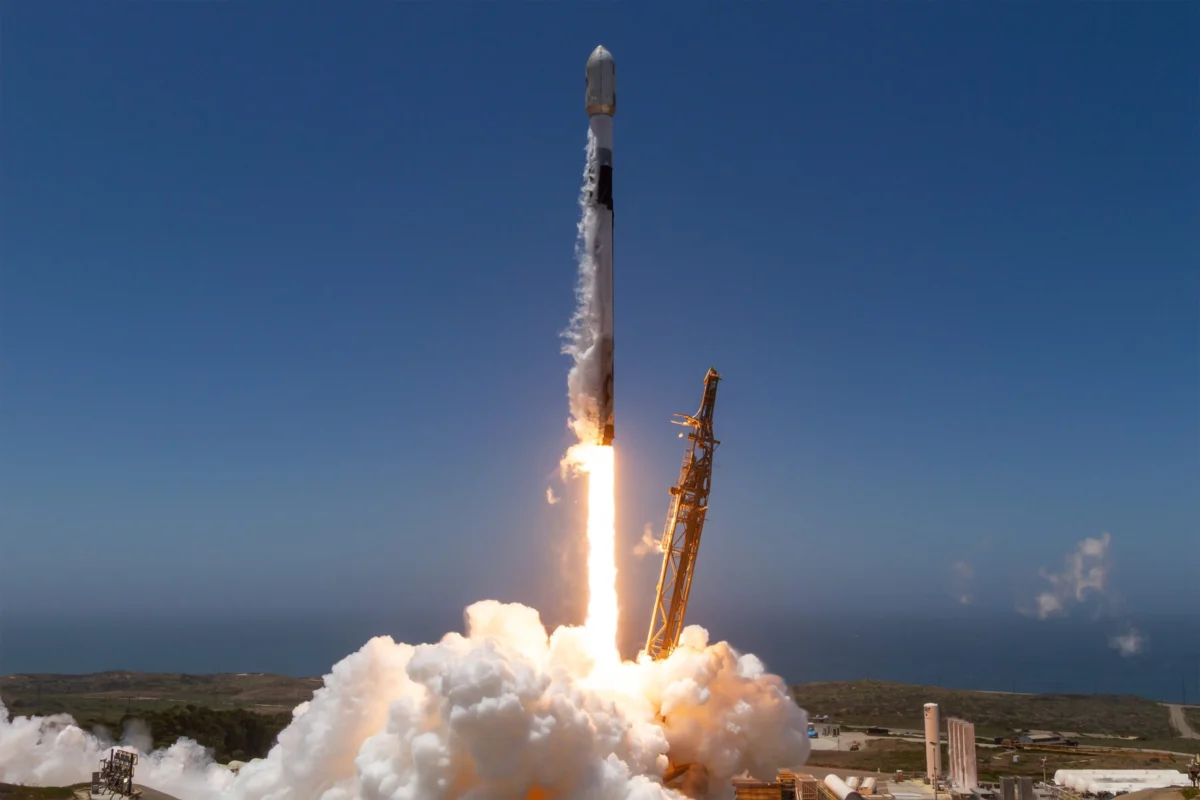
Demonstrating the high-tempo operational environment driving these budget increases, a SpaceX Falcon 9 rocket lifted off from Space Launch Complex 4 East (SLC-4E) at Vandenberg Space Force Base in California.
The mission successfully delivered 21 Space Development Agency (SDA) Tranche 1 Transport Layer satellites to orbit. These spacecraft form the backbone of the Pentagon’s new low-latency data communication network.
4. The Budget Expansion (July 17, 2026)
Just one day after the successful Vandenberg launch, the Space Force formally published the contracting notice tripling the Lane 1 ceiling to $17 billion. This administrative action aligned the program’s legal spending limits with the actual volume of satellites scheduled for production and launch through 2029.
Supporting Data: Fleet Profiles and Constellation Architecture
The expansion of the Lane 1 ceiling is directly tied to the technical diversification of the seven selected launch providers and the shifting architecture of defense payloads.
The Lane 1 Launch Provider Matrix
The seven vendors represent a mix of established legacy operators, dominant commercial market leaders, and emerging startups developing next-generation reusable systems.
| Provider | Primary Target Vehicles | Operational Status (as of 2026) | Primary Launch Sites |
|---|---|---|---|
| SpaceX | Falcon 9, Falcon Heavy | Fully Operational | Cape Canaveral, Vandenberg |
| ULA | Vulcan Centaur | Operational / Ramping Up | Cape Canaveral, Vandenberg |
| Blue Origin | New Glenn | Entering Service | Cape Canaveral |
| Rocket Lab | Neutron, Electron | Electron Operational / Neutron in Development | Wallops Island, New Zealand |
| Relativity Space | Terran R | In Development | Cape Canaveral |
| Stoke Space | Nova | In Development | Vandenberg, Cape Canaveral |
| Impulse Space | Helios / In-Space Transfer Stages | Operational (In-Space Transport) | Orbit-to-Orbit |
The Proliferated LEO Shift
The primary operational driver behind this budget expansion is the Space Development Agency’s Proliferated Warfighter Space Architecture (PWSA). Instead of relying on a single, school-bus-sized communication satellite in Geostationary Orbit (GEO), the SDA is deploying hundreds of smaller, interconnected satellites in LEO.
- Redundancy: If an adversary disables one satellite, the network automatically reroutes data through the remaining nodes.
- Launch Frequency: Deploying thousands of satellites requires a continuous schedule of launches, making the flexible bidding process of Lane 1 essential.
- Cost Efficiency: By utilizing commercial-style rockets, the military can deploy dozens of satellites per launch at a fraction of the historical cost per kilogram.
Official Responses: Strategic Alignment and Market Stability
Military leadership and industry analysts view the contract adjustment as a win-win for national security and the commercial space economy.
Space Systems Command Perspective
While Space Systems Command did not issue a formal press release alongside the July 17 contracting notice, officials have previously emphasized the strategic necessity of Lane 1.
Acquisition leaders at SSC have consistently noted that the Lane 1 structure acts as an "on-ramp" for innovative commercial launch companies. This approach allows the military to leverage private-sector capital and rapid development cycles.
By raising the contract ceiling, the Space Force is signaling to the commercial market that it has the financial authority to purchase launches at scale. This provides critical revenue predictability for companies scaling up production.
Industry and Investor Confidence
For the newer entrants in the Lane 1 pool—such as Stoke Space, Impulse Space, and Relativity Space—the $17 billion ceiling represents a major market opportunity.
Securing a spot on a multi-billion-dollar government vehicle is a key milestone for venture-backed space companies. It provides a clear path to high-margin defense contracts once their launch systems achieve operational readiness.

Implications: Geopolitics, Market Dynamics, and the Launch Bottleneck
The decision to triple the Lane 1 ceiling carries profound implications for the global launch industry and the broader geopolitical landscape.
1. Fostering a Resilient Domestic Supply Chain
By distributing task orders among seven different companies, the Space Force is actively working to prevent a monopoly in the national security launch market.
While SpaceX currently commands the lion’s share of commercial and military launches, the expanded funding pool provides a financial lifeline for competitors like Rocket Lab, Blue Origin, and ULA to scale their medium- and heavy-lift vehicles.
A diverse market ensures that if one launch vehicle is grounded due to a technical failure, the military can quickly reassign payloads to a competitor, preserving access to space.
2. Countering Near-Peer Adversaries
The rapid deployment of military satellites is a core component of the United States’ strategy to counter the space capabilities of near-peer adversaries, specifically China and Russia.
Both nations have developed sophisticated anti-satellite (ASAT) weapons and electronic jamming systems designed to neutralize U.S. space assets during a conflict.
The high-volume launch capability enabled by the $17 billion Lane 1 program ensures the U.S. can rapidly replenish lost orbital assets, neutralizing the strategic advantage of offensive counter-space weapons.
3. Navigating the Launch Infrastructure Bottleneck
While the Space Force has secured the funding authority to purchase more launches, the physical infrastructure of the nation’s spaceports remains a key constraint.
Both the Eastern Range (Cape Canaveral Space Force Station and Kennedy Space Center in Florida) and the Western Range (Vandenberg Space Force Base in California) are experiencing unprecedented congestion.
To fully utilize the expanded $17 billion contract vehicle, the Space Force, the Federal Aviation Administration (FAA), and commercial range operators must invest heavily in upgrading launch pads, propellant storage, and automated flight safety systems to support daily launch cadences.