Major telecommunications companies worldwide are significantly shifting their Artificial Intelligence (AI) strategies, moving beyond internal automation to actively monetize AI capabilities and infrastructure. A comprehensive report by GSMA Intelligence reveals a growing trend of operators investing in "AI factories," sovereign cloud infrastructure, agentic AI, and AI-enabled networks, signalling a new era of AI-driven revenue generation.
The landscape of AI adoption within the telecommunications sector is undergoing a profound transformation. Traditionally, AI initiatives within telcos have been primarily focused on optimizing internal operations, enhancing customer service, and improving network efficiency. However, recent analyses by GSMA Intelligence, a leading authority on mobile technology and strategy, indicate a decisive pivot towards leveraging AI as a direct source of revenue. This strategic evolution sees operators not merely as consumers of AI but as active participants in its deployment and monetization, building sophisticated AI infrastructure and offering AI-powered services to enterprise and public sector clients.
This paradigm shift is underscored by a notable increase in telco AI deployments with explicit revenue objectives. GSMA Intelligence data highlights that a significant portion of new AI initiatives are now geared towards generating income, moving beyond the traditional cost-saving and efficiency gains. This is particularly evident in the burgeoning development of "AI factories" – dedicated infrastructure and platforms designed to accelerate AI development, deployment, and operation, with the potential to unlock substantial revenue streams.
The AI Revolution: A Paradigm Shift for Telecoms
The traditional role of telecommunications operators has been to provide connectivity and communication services. However, the advent of advanced AI technologies presents a unique opportunity for these companies to redefine their value proposition and tap into new, lucrative markets. GSMA Intelligence’s latest report, "AI Investment by Telecom Operators," meticulously details this evolving trend, showcasing how leading operators across the globe are strategically investing in AI infrastructure and services.
The report identifies a robust list of pioneering operators actively engaged in these transformative AI initiatives. This includes industry giants like Orange, Deutsche Telekom, Iliad, Bell Canada, Telus, e&, China Telecom, Grameenphone, Robi Axiata, and Batelco, among many others. Their collective efforts paint a clear picture of a sector that is not only embracing AI but is actively shaping its future deployment and commercialization.
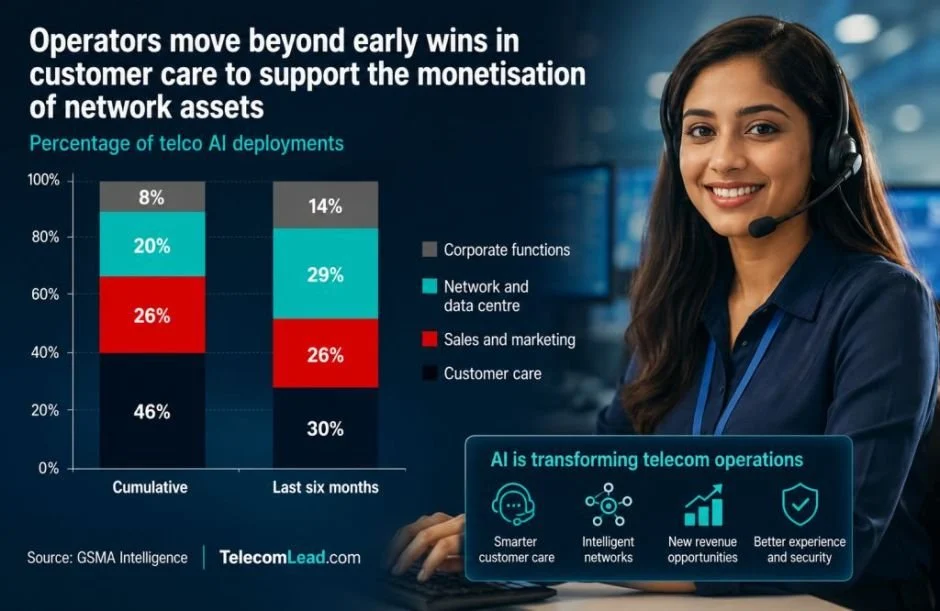
A critical indicator of this strategic reorientation is the growing proportion of new telco AI deployments that have a direct revenue objective. According to GSMA Intelligence, a substantial 35 percent of these new deployments are now explicitly designed to generate income. This contrasts with previous trends where the primary focus was on internal automation and cost reduction. Furthermore, the report highlights the significant expansion of network and data-centre solutions related to AI, which now constitute 29 percent of all announced deployments in the last six months. This expansion in infrastructure capabilities is directly supporting the drive towards AI monetization, enabling operators to offer more sophisticated and valuable AI services.
The potential financial impact of these investments is considerable. GSMA Intelligence estimates that the strategic deployment of AI factories alone could lead to an increase in operator revenues exceeding 5 percent. This projected growth underscores the immense commercial opportunity that AI represents for the telecommunications industry.
Vendor Landscape: A Competitive Ecosystem for AI Infrastructure
The burgeoning AI ecosystem within the telecom sector is characterized by intense competition and strategic partnerships among technology vendors. GSMA Intelligence’s analysis identifies key players across different segments of the AI infrastructure supply chain, revealing a dynamic landscape where collaboration and innovation are paramount.
In the realm of Graphics Processing Units (GPUs), essential for accelerating AI workloads, Nvidia has emerged as the dominant force among the world’s top 250 operators. Its comprehensive portfolio of AI-optimized GPUs positions it as a preferred partner for telcos building advanced AI capabilities. Following closely behind Nvidia are AMD and Intel, also providing critical GPU solutions to the market.
The cloud infrastructure segment is equally competitive, with Google leading among hyperscalers in terms of partnerships with top telcos. This indicates a strong preference for Google’s cloud offerings and AI services. Microsoft and AWS (Amazon Web Services) are also significant players, vying for market share and actively engaging with telecommunications companies to integrate their cloud solutions.
In the foundational AI models category, which underpins many advanced AI applications, Perplexity has taken the lead. This suggests a growing interest among telcos in utilizing Perplexity’s advanced language models and AI research capabilities. OpenAI, the creator of ChatGPT, and DeepSeek, another prominent AI research organization, follow closely, highlighting the critical role of advanced AI models in the telcos’ monetization strategies.
The competitive dynamics extend to smaller and medium-sized operators as well, though with some shifts in vendor dominance. Nvidia continues to hold the top spot in GPUs for this segment, demonstrating its broad appeal across the industry. Intel and AMD also maintain strong positions. In the hyperscaler category, AWS leads among smaller operators, followed by Microsoft and Google. This suggests that different cloud providers may cater to the specific needs and scales of various operator segments. Notably, Perplexity also leads among foundation model partners for smaller operators, indicating its growing influence in providing accessible and powerful AI models. Snowflake, a cloud-based data warehousing company, also features prominently in this category, highlighting the importance of data management for AI deployments.
This vendor hierarchy underscores the strategic importance of partnerships for telecommunications operators. By collaborating with leading technology providers, telcos can accelerate their AI development, leverage cutting-edge hardware and software, and ultimately bring new AI-powered products and services to market more effectively.
Sovereign AI: A New Frontier for Telcos
A significant and increasingly important trend within the AI monetization drive is the development of "sovereign AI" infrastructure. This refers to AI capabilities and data processing that are locally controlled, reside within national borders, and adhere to specific data residency and privacy regulations. Several prominent European operators are at the forefront of this movement, recognizing the growing demand for trusted, domestically managed AI solutions.
Deutsche Telekom is a prime example of an operator actively investing in sovereign AI infrastructure. The company is reportedly planning an "AI Gigafactory" in collaboration with the Schwarz Group in Germany. This initiative is explicitly designed to provide sovereign AI compute infrastructure, catering to the stringent requirements of European nations for locally controlled data processing and trusted digital environments. This strategic move aligns with the broader European Union’s efforts to foster digital sovereignty and reduce reliance on non-European cloud providers.
Across Europe, the motivation for AI investment is multifaceted. While 61 percent of cumulative telco AI deployments have historically focused on cost savings and efficiency, a notable shift is occurring. For new deployments in the six months leading up to June 2026, the revenue objective has increased, with 39 percent of deployments now targeting revenue generation, while 78 percent still focus on internal efficiencies. This indicates a growing commercial ambition alongside the ongoing pursuit of operational improvements.
Orange is another operator making significant strides in establishing a multi-market sovereign AI strategy, extending its reach across Europe and Africa. In France, Orange is leveraging Google Distributed Cloud and OpenAI deployments on sovereign infrastructure to enable in-country AI processing. This allows for data to be processed and analyzed within France, adhering to local data protection laws and enhancing national digital autonomy.
In West Africa, Orange is actively promoting its local cloud platform, "Door," as a compelling alternative to foreign cloud providers. This strategy aims to empower local enterprises with AI and cybersecurity solutions, fostering regional digital growth and ensuring data sovereignty. In Côte d’Ivoire, Orange is specifically targeting local businesses with tailored AI and cybersecurity offerings, further solidifying its position as a provider of sovereign digital services.
The commercial importance of sovereignty is increasingly being recognized by operators. A significant 34 percent of operators identify demand from regulated industries such as finance, healthcare, and defense as the primary driver for sovereign AI. These sectors often have strict data handling and privacy requirements. Furthermore, 30 percent of operators cite national regulations and data residency mandates as key motivators, while an additional 17 percent acknowledge the contribution of enterprise demand for data sovereignty.
Iliad is pursuing a more infrastructure-intensive approach to sovereign AI. The company has partnered with Nvidia to host an Nvidia DGX SuperPOD within its own French data centers. This combination of locally controlled data center capacity and powerful Nvidia computing infrastructure provides a robust platform for AI development and deployment, ensuring data remains within France. This partnership exemplifies the wider vendor hierarchy emerging in telecom AI, where operators are integrating leading-edge technology within their own controlled environments.
In North America, Bell Canada and Telus are also actively pursuing Canadian sovereign AI initiatives. Bell Canada has formed a partnership with Cohere, an AI company, with the specific goal of ensuring Canadian data remains under Canadian jurisdiction. Telus is concurrently developing its own sovereign AI factory and Canadian sovereign data centers, demonstrating a strong commitment to national data control and AI development. North America stands out as a region particularly advanced in this area, with approximately 40 percent of operators in the US and Canada having commercially launched sovereign AI products, a figure that surpasses other regions by a significant margin.
North American operators are also exhibiting a more commercially oriented approach to their broader AI strategies. A substantial 47 percent of cumulative AI deployments in this region target revenue generation, compared to 53 percent focused on cost savings. This trend is projected to continue, with new deployments in the six months to June 2026 showing an even split of 50 percent revenue and 50 percent internal efficiency, indicating a balanced yet commercially driven approach.
In the MENA region, e& is demonstrating a model that combines Nvidia GPUs with operator data centers. In Egypt, e& has deployed Nvidia H100 GPUs within an Oracle Cloud Infrastructure region hosted in its own data centers. This approach highlights a powerful partnership model where operators provide the foundational local infrastructure, connectivity, and sovereign positioning, while technology companies supply cloud platforms, GPUs, and advanced AI capabilities. Across MENA, 43 percent of new AI deployments in the six months to June 2026 are targeting external product revenue, while 57 percent are focused on cost efficiencies, indicating a strong commercial outlook.
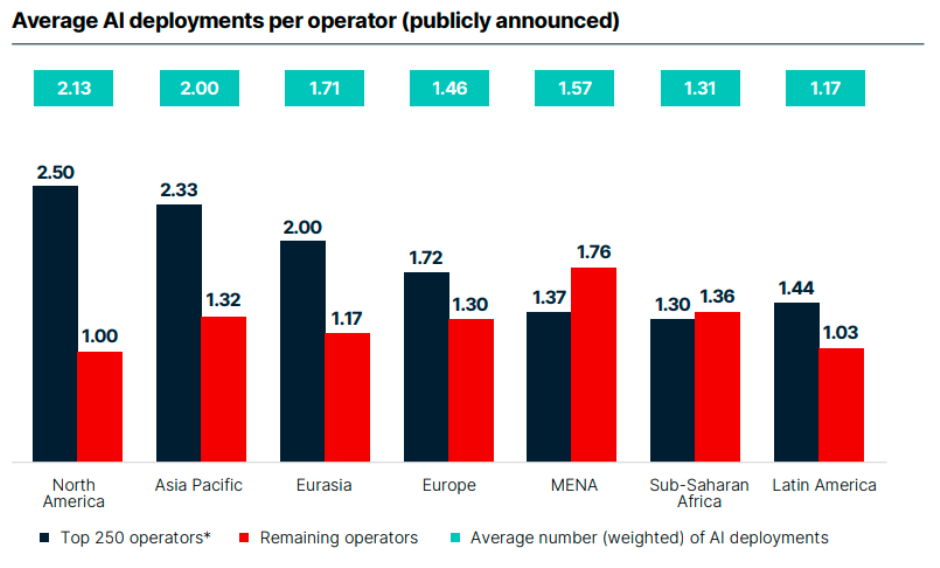
The Asia-Pacific region also showcases a robust commercial orientation in AI. Grameenphone and Robi Axiata in Bangladesh are building local AI infrastructure to cater to regional demands. Grameenphone is establishing a national AI factory utilizing Nvidia GPUs, while Robi Axiata operates a locally hosted Tier-4 cloud designed to support AI and machine learning workloads while adhering to sovereignty requirements. In Asia-Pacific, 43 percent of cumulative AI deployments are targeting revenues, with 57 percent focusing on cost savings and efficiencies. Among new deployments, the revenue proportion stands at 42 percent, demonstrating a sustained focus on commercial opportunities. Asia-Pacific also exhibits a high AI deployment intensity, with large operators averaging 2.3 deployments per operator.
Batelco in Bahrain is pushing AI to the network edge, leveraging its existing edge infrastructure. The company has developed an AI-ready edge data center that offers sovereign, low-latency infrastructure. This approach capitalizes on the inherent advantage telcos possess in distributed network sites and connectivity, differentiating them from centralized cloud providers. GSMA Intelligence advocates for operators to prioritize investments in connectivity, data centers, edge infrastructure, and sovereign AI rather than attempting to replicate the hyperscaler model.
Agentic AI: Automating and Enhancing Operations
Beyond infrastructure and sovereign solutions, a significant area of AI investment for telecom operators is the deployment of "agentic AI" into their operational processes. Agentic AI refers to AI systems that can act autonomously to perform complex tasks, make decisions, and adapt to changing environments. This represents a move towards truly autonomous operations, promising unprecedented levels of efficiency and new service capabilities.
Several operators are actively integrating agentic AI into their core functions. Telkom has introduced "Agentic AI by BigBox," designed to support industrial transformation and drive operational efficiencies. O2 Telefónica is utilizing an "AI-powered network operations agent" to enhance the management and performance of its network. The PLDT Group has implemented agentic AI for enterprise risk management, demonstrating its application in critical business functions. Furthermore, a collaboration between Grameenphone and ZTE aims to develop autonomous networks through agentic AI, signaling a future where network management is largely automated.
Beyond these core operational applications, agentic AI is also finding its way into customer-facing and service enhancement roles. KDDI has launched its "au Support AI Advisor," a digital human capable of interacting with customers and providing assistance. Optus and Ericsson have conducted trials of AI to improve 5G downlink performance, showcasing the potential for AI to optimize network services. In Pakistan, Zong and ZTE have achieved an AI-based FDD Massive MIMO commercial deployment, further illustrating the advancement of AI in network infrastructure.
These diverse applications of agentic AI reinforce a broader industry transition. The focus is shifting from rudimentary chatbots towards more sophisticated network intelligence, truly autonomous operations, and the development of revenue-generating infrastructure. This evolution signifies a maturing AI landscape within telecommunications, where AI is becoming an integral component of both operational efficiency and commercial strategy.
The Capex Challenge: Navigating the Hyperscaler Divide
While the opportunities presented by AI are vast, telecommunications operators face a significant challenge in terms of capital expenditure (capex) when compared to hyperscale cloud providers. GSMA Intelligence’s report highlights a stark disparity in investment figures. In 2025, Amazon is projected to spend $92.3 billion on capex, followed by Google at $54.4 billion, Microsoft at $53.1 billion, and Meta at $48.2 billion. In contrast, the collective capex of US telecom operators was $29.9 billion, Chinese telcos $19.6 billion, and European operators in Germany, the UK, and France significantly less. The capex of hyperscalers experienced a remarkable 50 percent increase in 2025, further widening this gap.
This substantial difference in investment capacity suggests that telecommunications operators are unlikely to compete directly with hyperscalers on sheer compute power or infrastructure build-out. Instead, their strategic advantage lies in a different approach. The report emphasizes that operators should leverage their unique assets: their extensive 5G connectivity networks, their existing data center infrastructure, their deep-rooted local customer relationships, and their ability to offer data sovereignty solutions. By combining these strengths with the cutting-edge AI technologies supplied by vendors like Nvidia, hyperscalers, and specialized AI model companies, telcos can carve out a distinct and profitable niche.
This strategic alignment with their core competencies directly connects with the economic projections outlined by GSMA Intelligence. The report suggests that by capturing even a modest portion of the addressable cloud revenue opportunity, operators can achieve significant growth in their mobile service revenue. For instance, converting 5 percent of the addressable cloud revenue could add 1.4 percentage points to mobile service revenue growth. This uplift increases to 2.9 points for 10 percent, 4.3 points for 15 percent, and a substantial 5.7-point uplift for capturing 20 percent of this market. This economic model underscores the viability of the operator-led AI monetization strategy, highlighting that success does not hinge on matching hyperscaler capex but on intelligently leveraging existing strengths and forging strategic partnerships. The era of telcos as mere connectivity providers is rapidly evolving into a future where they are key enablers and beneficiaries of the AI revolution.