In a watershed moment for the world’s most valuable automaker, Tesla has officially committed to achieving net-zero emissions by 2040. This announcement, unveiled within the company’s 2025 Impact Report, marks a profound shift in corporate strategy for a firm that has long prioritized its product-level environmental impact over traditional, company-wide greenhouse gas (GHG) reporting.
For years, Tesla stood as an outlier in the corporate world, often dismissing the standard environmental, social, and governance (ESG) frameworks that govern modern industry. Under the leadership of Elon Musk—who has famously labeled corporate ESG as "the Devil Incarnate"—Tesla’s narrative has consistently focused on the "avoided emissions" generated by its fleet of electric vehicles (EVs), solar panels, and battery storage systems, rather than the carbon footprint generated by its own manufacturing operations and supply chain.
By setting a concrete, time-bound deadline, Tesla is attempting to bridge the gap between its disruptive roots and the growing demands of global investors, regulators, and climate advocates who insist that every industrial giant must account for its total carbon ledger.
The Chronology of a Shift: From Avoided Emissions to Operational Accountability
To understand the significance of this pledge, one must look at Tesla’s historical resistance to standard climate reporting. For much of its existence, the company’s internal philosophy was simple: if the product is green, the company is inherently sustainable.
The "Avoided Emissions" Era
Tesla’s early climate rhetoric centered on the "substitution effect." By replacing internal combustion engines with electric drivetrains, Tesla argued that its contribution to the planet was greater than that of all other manufacturers combined. In their 2025 Impact Report, the company reinforced this legacy, estimating that each of its vehicles avoids an average of 32 metric tons of carbon dioxide equivalent (tCO2e) over its lifetime. Collectively, the company claims its products helped avoid nearly 37 million tCO2e in 2025 alone—a figure representing more than half of its total calculated emissions for that year.
The Turning Point
The pivot toward formal disclosure began in earnest around 2022, when Tesla began reporting its Scope 3 emissions—the indirect emissions that occur in a company’s value chain, such as those from the mining of raw materials for batteries. Despite this, the company remained a holdout against standardized reporting platforms like the CDP (formerly the Carbon Disclosure Project), arguing that these frameworks favor legacy "polluter" companies that have the administrative infrastructure to track and "game" the metrics.
The 2040 Commitment
The 2040 pledge is the culmination of this slow but steady evolution. It complements two existing, albeit less rigid, objectives:
- The Renewable Electricity Goal: Tesla has pledged to power its operations with 100% renewable electricity "well before" the 2040 net-zero deadline.
- Supercharger Network Alignment: The company continues its effort to match the total energy load of its global Supercharger network with renewable energy generation.
By setting the 2040 date, Tesla has finally moved from an "avoided emissions" narrative to a "lifecycle accountability" model.
Supporting Data: The Rising Tide of Operational Emissions
While the headline goal of 2040 is ambitious, the underlying data reveals the significant challenge Tesla faces. As the company scales its manufacturing volume to meet global demand, its absolute emissions have trended upward, complicating the path to net zero.
According to the most recent figures, Tesla’s operational footprint is expanding alongside its production capacity:
- Scope 1 Emissions (Direct Operations): These have surged 43% since 2023. As Tesla opens new "Gigafactories" and increases assembly line activity, the energy intensity of its direct operations is rising.
- Scope 2 Emissions (Purchased Electricity): These have increased by 80%. While Tesla aims to source this power from renewables, the immediate impact on its carbon accounting remains a challenge.
- Scope 3 Emissions (Supply Chain): At 56 million tCO2e, this remains the company’s largest hurdle. These emissions, which include the extraction and refining of lithium, cobalt, nickel, and steel, are up 14% year-over-year.
The Sector Context
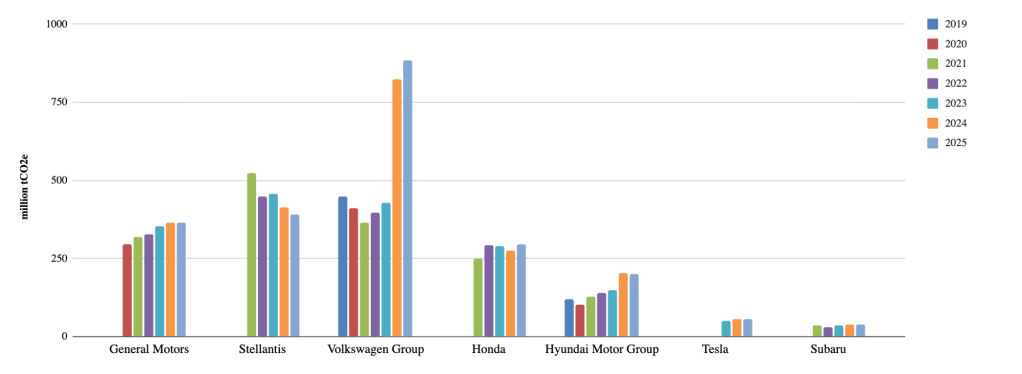
Data provided by DitchCarbon, a specialist platform for Scope 3 emissions tracking, suggests that Tesla is not unique in this trend. Across the automotive sector, the transition to electrification is paradoxically driving up upstream emissions as manufacturers race to secure battery minerals and build out massive supply chains. However, Tesla continues to outperform its peers in many sustainability rankings. The 2025 report from the International Council on Clean Transportation (ICCT) ranked Tesla at the top of its automaker ratings, citing the company’s product efficiency and its leadership in the EV market.
Official Responses and Expert Perspectives
The reception to Tesla’s announcement has been mixed, reflecting a broader debate about how "net-zero" should be measured for a high-growth technology company.
Frederic Hans, a senior climate policy advisor at the NewClimate Institute, provided a nuanced critique of the announcement. "We agree that traditional target-setting frameworks centered on absolute emission reduction can disadvantage innovators entering a market while favoring incumbents," Hans noted. He acknowledges that Tesla’s unique position as a market disruptor makes standard reporting templates feel restrictive.
However, Hans cautioned that absolute targets are only half the battle. "A focus on vehicle sales alone is insufficient," he argued. The NewClimate Institute advocates for "transition targets"—specific, verifiable milestones for the procurement of low-carbon materials like green steel, recycled aluminum, and sustainable battery chemistries.
In a 2025 study examining five major automotive manufacturers, the NewClimate Institute found a significant gap in industry standards: while companies like Ford and General Motors have begun setting targets for steel and aluminum procurement, no major manufacturer, including Tesla, has yet established robust, publicly verifiable targets for battery supply chain decarbonization.
Tesla has remained characteristically silent regarding these specific critiques. The company declined to comment for this report, choosing to let the Impact Report serve as its primary communication on the matter.
Implications: A New Era of Transparency?
The decision to align its reporting with the IFRS Foundation’s rules—the international benchmark for financial and sustainability reporting—is arguably as important as the 2040 deadline itself. By adopting these standards, Tesla is signaling a departure from its "go it alone" approach to corporate governance.
What This Means for Investors
For institutional investors, who have long pushed for more granular data from Tesla, this is a victory for transparency. The move suggests that Tesla is maturing as a corporation, moving away from the "founder-led, rules-be-damned" culture toward a model that is palatable to the global financial system. However, the lack of a "near-term" emissions goal—which many experts consider essential for holding management accountable—remains a sticking point. Without interim targets for 2027 or 2030, the 2040 goal remains a "North Star" rather than a roadmap.
What This Means for the Industry
Tesla’s move forces other automakers to justify their own climate strategies. If the world’s most successful EV manufacturer is now reporting on Scope 1, 2, and 3 emissions with a net-zero deadline, the "we are just an EV company" defense for traditional automakers becomes significantly weaker.
Furthermore, the focus on the supply chain—specifically the carbon intensity of batteries—is set to become the next major front in the automotive climate war. As battery production becomes the dominant source of emissions for the industry, companies will no longer be able to hide behind the tailpipe-zero nature of their products. They will be forced to innovate in the mining, refining, and recycling of materials.
The Path Forward
For Tesla, the path to 2040 will likely require a complete rethinking of its supply chain. Achieving net-zero will necessitate:
- Vertical Integration of Green Energy: Moving beyond simply purchasing renewable credits to actively investing in the decarbonization of its energy suppliers.
- Circular Economy Initiatives: Scaling battery recycling to reduce the need for virgin, high-carbon-intensity mineral extraction.
- Material Innovation: Shifting toward low-carbon steel and aluminum, likely through long-term procurement contracts with "green" smelting facilities.
Ultimately, Tesla’s 2040 pledge is a concession to reality. While the company remains the undisputed leader in accelerating the world’s transition to sustainable transport, its sheer scale means it can no longer afford to be an exception to the rules of carbon accounting. Whether this new commitment represents a genuine change in operational philosophy or a strategic PR pivot remains to be seen. What is clear, however, is that the era of Tesla operating in a silo is over. The company is now fully engaged in the global effort to standardize, measure, and—hopefully—eliminate the carbon footprint of the industrial age.