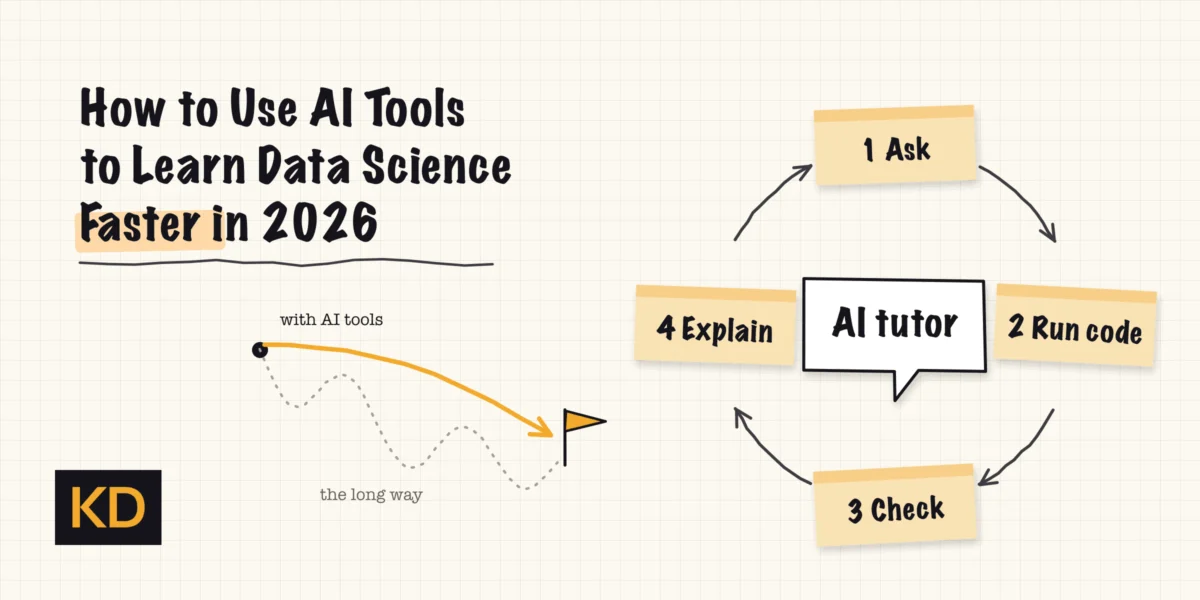
Learning data science in 2026 is no longer a linear path of textbook reading and tedious debugging. It has evolved into an interactive, high-velocity journey where AI tools act as both force multipliers and cognitive partners. However, this accessibility introduces a dangerous paradox: while the barrier to entry has lowered, the risk of "cognitive atrophy"—where the tool does the thinking for the student—has never been higher.
For the modern aspiring data scientist, the challenge is not access to information, but the curation of workflow. To thrive, one must shift from being a passive consumer of AI-generated code to an active orchestrator of intelligent systems.
The New Paradigm: Foundational Principles
The primary shift in 2026 is the role of the learner. AI assistants have replaced the "hours of frustration" model of debugging with instant, context-aware solutions. Yet, experienced educators emphasize a critical rule: Fundamentals remain non-negotiable.
If a student attempts to leverage Large Language Models (LLMs) to interpret a confusion matrix without understanding the basics of classification, they are essentially flying blind. AI models can hallucinate or provide technically sound code that is logically flawed for a specific business context. Consequently, building a rock-solid base in Python, linear algebra, and probability theory is the essential prerequisite before integrating AI into your stack.
The Chronology of Skill Acquisition
The modern learning trajectory has compressed significantly:
- Phase 1: The Analytical Base (Weeks 1-8): Mastery of Python,
pandas, andNumPy. Here, AI should only be used to clarify complex documentation or syntax errors. - Phase 2: The Conversational Tutor (Weeks 9-16): Utilizing ChatGPT or Claude to explain architectural concepts, such as why a particular loss function is chosen over another.
- Phase 3: The Productivity Sprint (Months 4-6): Incorporating GitHub Copilot and Cursor into daily workflows to optimize code structure and learn idiomatic patterns.
- Phase 4: Agentic Orchestration (Advanced): Moving beyond simple scripts to building RAG (Retrieval-Augmented Generation) systems and using frameworks like LangChain to automate data pipelines.
Supporting Data: The Productivity Shift
Industry reports from 2025 and early 2026 indicate a 40% gain in coding productivity for developers utilizing AI-integrated environments. For the data scientist, this speed is transformative. When a learner is no longer bogged down by the "syntactic friction" of library imports or boilerplate code, they can dedicate more time to the "what" and "why" of data science: feature engineering, model interpretability, and business impact.
Data from educational platforms like DataCamp and Dataquest suggest that students using adaptive AI tutors show a 30% higher retention rate in complex topics like Bayesian statistics compared to those using static video-based tutorials. The ability to ask "Why is this line of code necessary?" in real-time prevents the compounding of misconceptions, a common failure point in traditional self-study.
Official Perspectives: The Role of the AI Orchestrator
Vinod Chugani, a leading AI educator and mentor, argues that the professional identity of the data scientist is undergoing a fundamental transformation. "We are moving away from the ‘model builder’ archetype toward the ‘AI orchestrator,’" Chugani notes. "The value is no longer just in writing a gradient boosting model from scratch, but in understanding how to wire together LLMs, vector databases, and traditional statistical models to solve actual business problems."
This shift requires a new form of technical literacy. Professionals are now expected to be comfortable with:
- Prompt Engineering for Data Analysis: Designing prompts that force the AI to explain its logic before providing a code block.
- Model Validation: Using Perplexity or specialized RAG tools to cross-reference AI-generated findings against academic papers and documentation.
- System Design: Understanding the integration of LangChain and LlamaIndex to build agentic workflows that can handle live, unstructured data.
Practical Implementation: Strategies for Success
The "Thinking Partner" Protocol
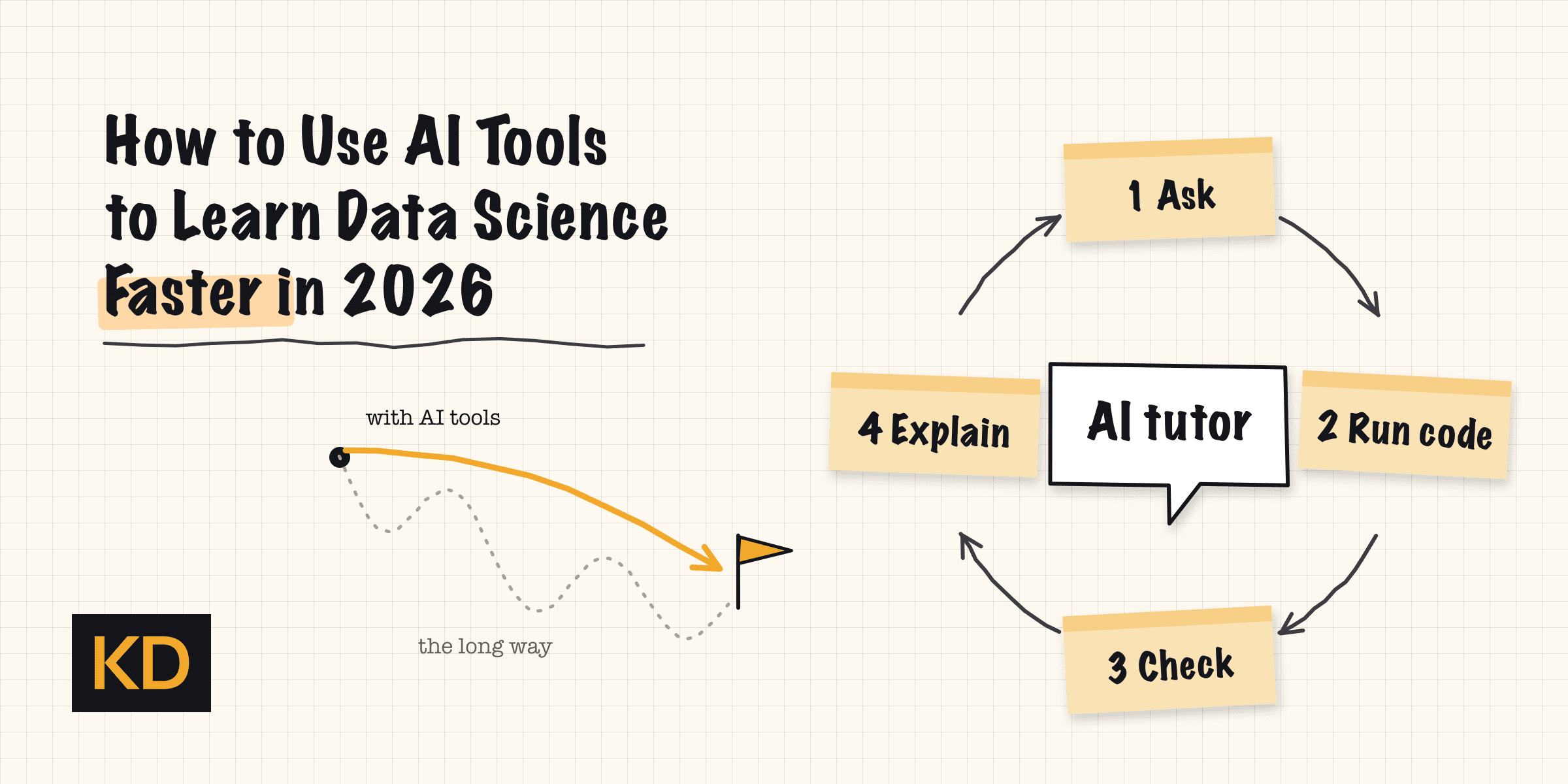
The most effective way to use AI is to treat it as a junior partner that is highly knowledgeable but prone to occasional errors.
- Never copy-paste blindly: Always challenge the AI’s output. Ask, "Can you provide an alternative way to solve this?" or "What are the performance trade-offs of this approach?"
- Active Recall via AI: Use ChatGPT as a quizmaster. By prompting, "Quiz me on time-series forecasting, starting with simple concepts and escalating to SARIMA models," you engage in active retrieval practice, which is scientifically proven to be more effective than passive reading.
Advanced Coding Workflows
Using tools like Cursor or GitHub Copilot within VS Code allows for a symbiotic development cycle. A recommended workflow for a learner involves:
- Manual Draft: Write the initial logic (e.g., a
pandasaggregation). - AI Refinement: Use the AI assistant to suggest optimizations (e.g., vectorization vs. loops).
- The "Explain-Back" Test: If the AI suggests a complex optimization, ask it to explain the change in plain English. If you cannot explain the logic to yourself, you haven’t truly learned the technique.
Implications: The Future of the Job Market
The job market of 2026 prizes "synthetic thinkers"—those who can integrate AI tools to produce higher-quality, more complex projects than their predecessors. Employers are no longer looking for candidates who have memorized syntax, but for those who can:
- Scope complex problems: Using AI to define the parameters of a portfolio project.
- Execute at speed: Building robust, well-documented models using AI-assisted coding.
- Communicate findings: Using LLMs to refine the storytelling aspect of data visualization.
However, the "AI trap" is real. If you rely entirely on AI to suggest project ideas and write the code, your portfolio will look identical to every other candidate’s. The competitive edge belongs to those who use AI to supplement their unique domain expertise, not replace it.
Summary of Essential Tools for 2026
- Foundational Learning: DataCamp (Adaptive tutoring), Coursera (Theoretical depth).
- Conversational Mentorship: Claude (Best for complex, multi-step logic) and ChatGPT (General-purpose versatility).
- Coding Assistants: GitHub Copilot (Standard for integration) and Cursor (Best for AI-first IDE control).
- Research & Verification: Perplexity (Citation-backed, essential for keeping up with rapidly evolving machine learning papers).
Final Word: The Intentional Learner
The conclusion for the modern data science student is clear: AI tools are not a replacement for study, but an acceleration of the effort you put in. The most successful practitioners of 2026 are those who remain "active learners." They use AI to bridge the gap between confusion and clarity, to scale their productivity, and to push the boundaries of what they can build.
As Vinod Chugani emphasizes, the goal is to bridge the gap between emerging technology and practical application. If you approach AI as a tool to sharpen your own intellect—rather than a substitute for it—you will not only survive the transition of the data science industry, you will lead it.