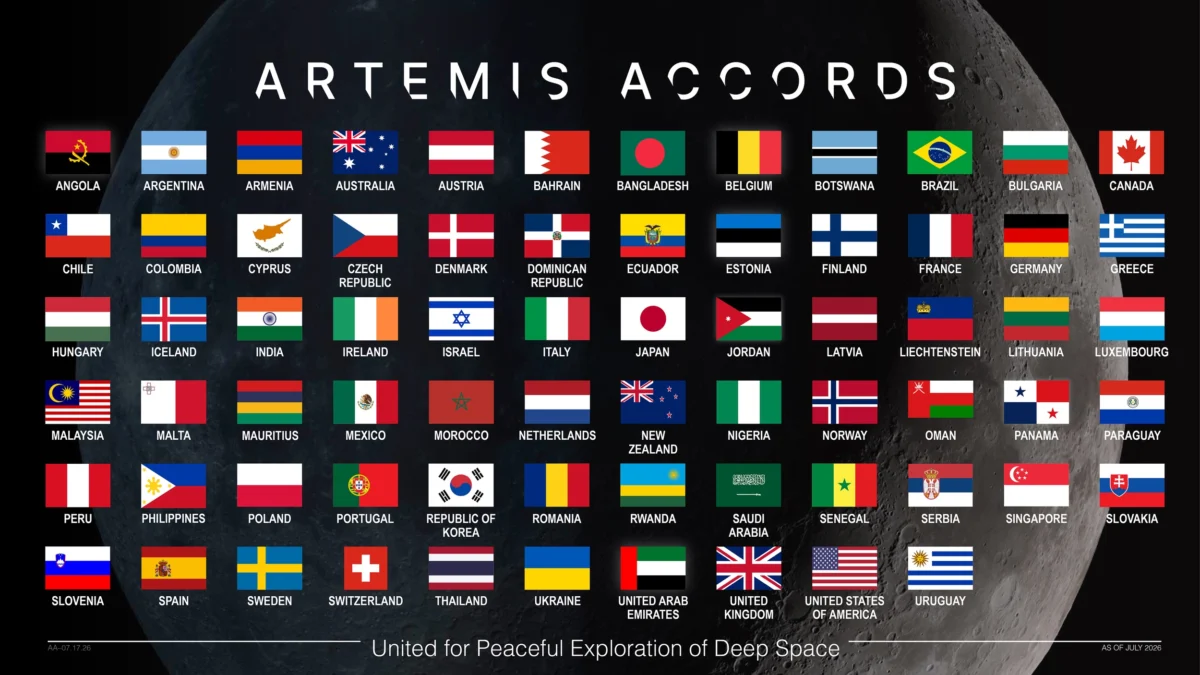
WASHINGTON — In a historic milestone for international space diplomacy, the island nation of Mauritius has officially signed the Artemis Accords, becoming the 70th nation to join the U.S.-led coalition for cooperative and peaceful space exploration.
The signing ceremony took place on July 17, 2026, in the Mauritian cyber-city of Ébène, marking a rapid acceleration in global participation. The accession of Mauritius occurred just one day after Serbia signed the agreement at NASA Headquarters in Washington, demonstrating the expanding geopolitical reach of the Accords across both highly industrialized nations and developing economies.
Main Facts: The Mauritius Signing and the 70-Nation Milestone
The signing ceremony in Ébène was led by Navindsing Jugmohunsing of the Mauritian Ministry of Tertiary Education, Science and Research, who signed the document on behalf of the government. The event was attended by high-ranking U.S. State Department officials, while NASA Deputy Administrator Matt Anderson participated remotely, delivering congratulatory remarks via a pre-recorded video address.
Mauritius’s entry into the Accords is highly symbolic. As a small island developing state (SIDS) located in the southwest Indian Ocean, the nation does not possess an active independent orbital launch capability. However, its leadership emphasized that signing the Accords is an essential step toward leveraging space technology for domestic environmental monitoring, ocean conservation, and climate resilience.
By joining the Accords, Mauritius has positioned itself as a proactive participant in the establishment of international norms for cislunar space (the region between Earth and the Moon) and surface lunar operations. The country is the 11th nation to sign the Artemis Accords in 2026 alone, highlighting a year of unprecedented diplomatic momentum for the framework.
Chronology: From Eight Founders to Seventy Signatories (2020–2026)
The evolution of the Artemis Accords from a localized bilateral initiative into a major multilateral framework has occurred in less than six years.
[October 2020]
NASA & State Dept launch Accords with 8 Founding Nations
       │
       ▼
[2021 - 2025]
Steady global expansion across Europe, Asia, and South America
       │
       ▼
[Early 2026]
Accelerated diplomatic outreach; 9 nations join in rapid succession
       │
       ▼
[July 16, 2026]
Serbia signs at NASA Headquarters (69th Signatory)
       │
       ▼
[July 17, 2026]
Mauritius signs in Ébène (70th Signatory)
The Genesis (2020)
The Artemis Accords were officially launched on October 13, 2020, by NASA and the U.S. Department of State. The framework was established with eight founding signatories:
The United States
Australia
Canada
Italy
Japan
Luxembourg
the United Arab Emirates
the United Kingdom
The primary goal was to establish a common set of principles, rooted in the 1967 Outer Space Treaty, to govern the civil exploration and use of outer space, with an immediate focus on NASA’s Artemis program to return humans to the Moon.
Gradual Expansion (2021–2025)
Over the next four years, the Accords attracted a diverse group of signatories across Europe, South America, Africa, and the Asia-Pacific region. Major spacefaring nations such as France, Germany, India, and South Korea signed on, alongside emerging space nations looking to build domestic high-tech sectors through international collaboration.
The 2026 Surge
The year 2026 has seen an extraordinary surge in diplomatic accessions. Eleven nations have signed the Accords in the first seven months of the year. This rapid expansion culminated in the mid-July back-to-back signings:
July 16, 2026: Serbia becomes the 69th signatory during a formal ceremony at NASA Headquarters in Washington, D.C.
July 17, 2026: Mauritius signs the document in Ébène, bringing the total to 70.
Supporting Data: The Principles and Framework of the Accords
The Artemis Accords are a non-binding political commitment designed to guide operational activities on the Moon, Mars, comets, and asteroids. The document relies heavily on reinforcing existing international treaties, primarily the 1967 Outer Space Treaty, the Agreement on the Rescue of Astronauts, the Liability Convention, and the Registration Convention.
Core Principles of the Artemis Accords
Principle
Description & Objective
Peaceful Purposes
All activities conducted under the Artemis program must be exclusively for peaceful purposes, in accordance with international law.
Transparency
Signatories commit to publicizing their space policies, exploration plans, and scientific data to foster predictability and safety.
Interoperability
The development of open, common technical standards to ensure that hardware and systems from different nations can work together seamlessly.
Emergency Assistance
A commitment to provide aid to astronauts and personnel in distress in outer space, reinforcing the Rescue Agreement.
Registration of Space Objects
Proper registration of all spacecraft to mitigate the risks of orbital collision and harmful interference.
Release of Scientific Data
Signatories agree to share scientific data openly with the global community to maximize the scientific return of space exploration.
Preserving Outer Space Heritage
Commitments to protect historically significant sites, such as human or robotic landing sites, from damage or interference.
Space Resources
The extraction and utilization of space resources (such as lunar regolith or water ice) must be conducted in a manner that complies with the Outer Space Treaty.
Deconfliction of Activities
The establishment of "safety zones" to prevent harmful interference between different actors operating in close proximity on the lunar surface.
Orbital Debris Mitigation
Commitment to plan for the safe and timely disposal of spacecraft and to minimize the generation of long-lived space debris.
Official Responses and Key Perspectives
The signing of the Accords by Mauritius has elicited strong statements from Mauritian officials, NASA leadership, and space policy experts, each highlighting different facets of the milestone.
The Mauritian Perspective
Navindsing Jugmohunsing, representing the Mauritian Ministry of Tertiary Education, Science and Research, framed the signing as a crucial step for developing nations in the global space arena:
"The accession of Mauritius to the Artemis Accords marks a defining chapter in our new space journey. As a small island developing state in the Indian Ocean, we are committed to ensuring that space serves humanity by protecting our oceans and coastlines and amplifying the voices of nations like ours. Mauritius stands ready to help shape the future of space governance while unlocking new opportunities for innovation and partnership."
The NASA Perspective
In his video address, NASA Deputy Administrator Matt Anderson emphasized the importance of international consensus as humanity prepares to establish a permanent presence on the Moon:
"Together, we are creating the foundation for future exploration while ensuring that space remains peaceful, accessible and beneficial for all. That work requires capable partners and a shared commitment to responsible exploration."
Policy and Industry Analysis
Mike Gold, currently the President of Redwire Space and formerly the NASA Associate Administrator for International and Interagency Relations who coordinated the development and launch of the Accords in 2020, expressed immense satisfaction at the rapid growth of the coalition:
"Going from seven nations joining the U.S. in signing the Accords in 2020 to 70 signatories in 2026 is a huge accomplishment. The success of the Accords demonstrates the inherent optimism and hope that the space program represents not only in America but around the world."
Gold emphasized that the Accords are more than just a legal text; they are an operational extension of the Artemis program itself:
"The Artemis Accords are inseparable from the Artemis program. I’m so excited to see the U.S. lead the way in bringing the world to the lunar frontier."
Implications: Geopolitical Competition and the Dual-Track Lunar Era
The rapid expansion of the Artemis Accords to 70 nations carries profound geopolitical implications, particularly in the context of a modern "space race" between the United States and China.
The Geopolitical Divide: Artemis vs. ILRS
While the U.S. champions the Artemis Accords, China, in partnership with Russia, has actively promoted its own framework: the International Lunar Research Station (ILRS). The ILRS aims to construct a permanent robotic and eventually crewed base at the lunar south pole by the mid-2030s.
This has led to a diplomatic competition, with both Washington and Beijing seeking to recruit international partners to their respective lunar programs. The signing of the Accords by nations like Mauritius is viewed as a victory for U.S. soft power and the promotion of Western-aligned space governance norms.
┌────────────────────────────────────────┐       ┌────────────────────────────────────────┐
│        U.S.-Led Coalition              │       │       Chinese-Led Coalition            │
│        ARTEMIS ACCORDS                 │       │   INTERNATIONAL LUNAR RESEARCH STATION │
│  - 70 Signatories (as of July 2026)    │       │   - Anchored by China & Russia         │
│  - Focus: Norms, Safety Zones,         │       │   - Focus: South Pole Base,            │
│    Commercial Resource Use             │       │     Joint Robotic/Crewed Infrastructure│
└───────────────────┬────────────────────┘       └───────────────────┬────────────────────┘
                    │                                                │
                    │         ┌────────────────────────────┐         │
                    └────────►│   "BRIDGE" NATIONS         │◄────────┘
                              │   - Serbia                 │
                              │   - Senegal                │
                              │   - Thailand               │
                              │   (Signed both frameworks) │
                              └────────────────────────────┘
The Rise of "Bridge" Nations
An intriguing dynamic in this competitive landscape is the emergence of "bridge" nations—countries that have signed agreements with both the U.S.-led Artemis Accords and the Chinese-led ILRS. Currently, three nations hold this dual-aligned status:
Serbia
Senegal
Thailand
This dual participation suggests that for many developing and middle-power nations, international space policy is not viewed as a strict, zero-sum Cold War binary. Instead, these countries are pursuing a pragmatic, multi-aligned strategy, seeking to maximize their domestic scientific, educational, and economic opportunities by collaborating with both major space powers.
Commenting on this trend, Mike Gold noted that even when nations align with China’s ILRS, their commitment to the principles of the Artemis Accords remains a net positive for international stability:
"Through the Artemis Accords, we’re not just launching our astronauts, we’re launching our values to the moon. Which is why every ILRS nation, such as Serbia, that commits to the principles of the Artemis Accords is a special victory for a peaceful and prosperous future in space."
Integrating Developing Nations into the Space Economy
The inclusion of Mauritius highlights a broader shift in how the global space economy is structured. Historically, space exploration was the exclusive domain of highly industrialized superpowers. Today, the Artemis Accords provide a mechanism for non-spacefaring and developing nations to gain a seat at the table.
For Mauritius, the benefits of joining are multi-faceted:
Capacity Building: Access to international training, educational pipelines, and joint scientific research.
Environmental Data: Improved access to Earth observation data, which is vital for monitoring rising sea levels, ocean acidification, and coral reef health in the Indian Ocean.
Economic Diversification: Encouraging the growth of high-tech startups and research institutions within the country.
By establishing a broad-based coalition of 70 nations, the United States has successfully built a diverse consensus around its vision for lunar governance. As NASA prepares for upcoming crewed Artemis missions, the challenge will shift from diplomatic recruitment to the practical implementation of these principles—such as defining safety zones and managing resource extraction—on the lunar surface.