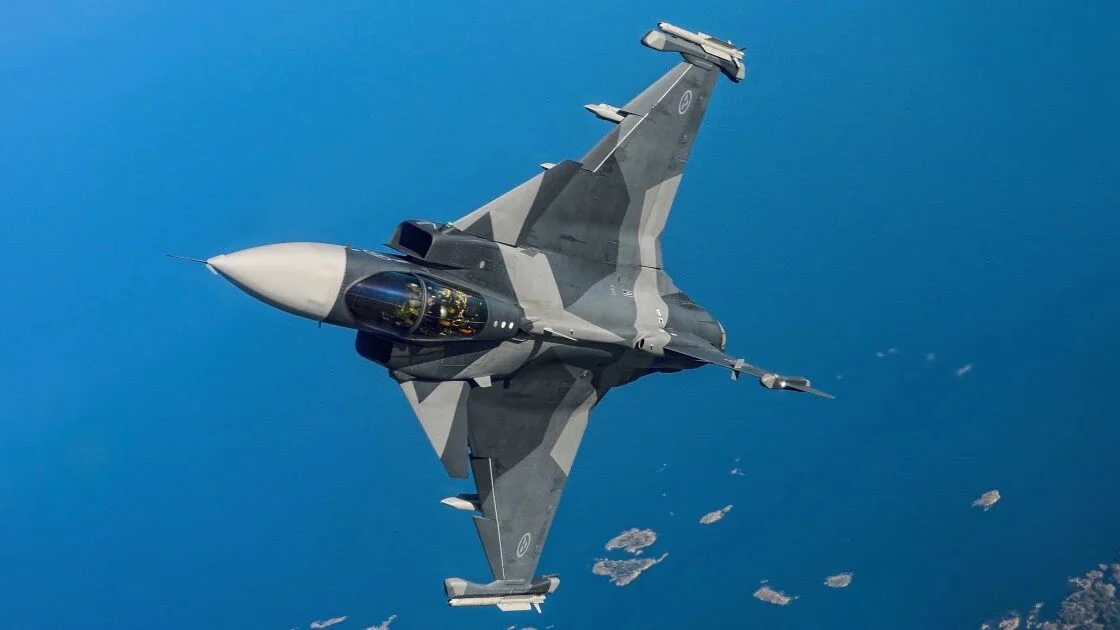
FARNBOROUGH — In a move that signals a significant shift in European defense posture, Sweden has confirmed plans to expand its fleet of Saab-manufactured Gripen E fighter jets. This strategic procurement is designed to replenish the nation’s air power capabilities following the decision to donate a fleet of older Gripen C/D aircraft to Ukraine.
As the conflict in Eastern Europe continues to redefine the requirements for modern air superiority, the Swedish Air Force is positioning itself not only as a donor of critical technology but as a long-term partner in building a resilient, interoperable coalition of Western-standard combat aircraft for the Ukrainian Armed Forces.
The Core Objective: Replenishing Swedish Air Power
Maj. Gen. Jonas Wikman, Chief of the Swedish Air Force, confirmed that Sweden will integrate an additional 12 Gripen E multirole combat aircraft into its procurement cycle. This acquisition is explicitly intended to offset the operational loss of the legacy C/D models slated for transfer to Kyiv.
Once these new units are delivered, the Swedish Air Force will possess a total of 72 Gripen E aircraft—a robust increase from the original 60-unit order placed in 2013. This expansion is viewed as a vital hedge against regional instability and a testament to Sweden’s commitment to maintaining a technologically superior aerial defense force in the post-NATO accession era.
Chronology of a Strategic Partnership
The trajectory of the Gripen’s involvement in the Ukraine conflict has evolved from theoretical academic discussions to concrete, multi-billion-dollar government contracts.
- November 2022: The Royal United Services Institute (RUSI) publishes a landmark report identifying the Saab Gripen as the "most suitable candidate" for the Ukrainian Air Force, citing its ease of maintenance and ability to operate from dispersed, austere bases.
- October 2023: Stockholm formally signals it will consider the transfer of Gripen jets to Ukraine, contingent upon the completion of its NATO accession process.
- July 2026: Ukraine signs a historic $2.5 billion contract with Sweden for the acquisition of 16 modern Gripen E fighters, with deliveries scheduled to begin by 2029.
- Late 2026/Early 2027: Ukraine is slated to receive its first operational Gripen C/D aircraft from existing Swedish stockpiles.
- Current Status: Sweden moves to authorize the procurement of 12 additional Gripen E units to ensure no degradation in domestic air defense readiness.
Supporting Data: Production and Operational Capability
The operational integration of the Gripen E is a milestone for Saab. According to Maj. Gen. Wikman, the Swedish Defense Material Administration (FMV) has already successfully flown "more than a handful" of the advanced E-variant jets.
"The build-up to entry into service is a huge step forward for us, and it is going very successfully," Wikman noted during recent briefings at the Farnborough International Airshow. "It took us only a few months to introduce a new capability."
Behind this rapid deployment is a massive scaling effort by Saab. Saab CEO Micael Johansson recently informed investors that the company is aiming to ramp up production to between 25 and 30 aircraft per year. This represents a near-doubling of the company’s current manufacturing capacity, a move necessitated by the dual demand of replenishing Swedish stocks and fulfilling the lucrative, high-priority contract with the Ukrainian government.
Official Responses and Strategic Rationale
The Swedish military leadership has been transparent about the dual-track strategy of supporting Ukraine while securing the Baltic Sea region.

"We are naturally looking forward to being a provider of continued support to Ukraine," Wikman stated. He emphasized that the Gripen program represents a "big step forward, not only for Ukraine, but also for the defense of Sweden and the defense of Europe."
The enthusiasm is mirrored in Kyiv. Ukraine’s long-term goal remains ambitious: the procurement of up to 150 Swedish jets to serve as the backbone of its reformed air force. By diversifying its fleet with Gripen E, F-16s, and French-made Mirage and Rafale platforms, Ukraine is creating a redundant, multi-platform ecosystem capable of withstanding the rigors of a protracted high-intensity conflict.
Implications: A New Era of European Air Defense
The "Dispersed Base" Philosophy
One of the primary reasons the Gripen remains the "gold standard" for the Ukrainian context is its operational philosophy. Unlike heavier, more maintenance-intensive platforms that require massive, stationary airbases, the Gripen was designed for "dispersed operations."
Swedish tactics—which the Ukrainian Air Force is now adopting—rely on the ability to land on short, austere runways, including public roads, and perform rapid turnaround maintenance using small, mobile ground crews. This "hide-and-strike" capability significantly complicates Russian targeting efforts, forcing the adversary to expend costly long-range missiles on shifting, elusive targets.
Interoperability and the NATO Context
The influx of Gripens into Ukraine is not an isolated event; it is a catalyst for deeper NATO-Ukraine integration. The Gripen E, with its advanced AESA (Active Electronically Scanned Array) radar, superior electronic warfare suite, and network-centric warfare capabilities, allows Ukraine to plug into the wider NATO tactical data link (Link 16) architecture. This ensures that the Ukrainian Air Force can operate seamlessly alongside their Nordic and European counterparts.
Economic and Industrial Impact
The surge in demand for the Gripen E has transformed Saab from a regional defense contractor into a global player with a massive, multi-year backlog. This economic windfall allows for sustained R&D investment, ensuring that the Gripen remains competitive against the latest iterations of Russian Su-35 and Su-57 fighters. The production ramp-up also provides a blueprint for how European nations can mobilize their defense industrial bases to support a partner in need without compromising their own national security.
Conclusion: A Long-Term Commitment
The decision by Sweden to order 12 additional Gripen E fighters is more than a mere administrative "top-up." It is a calculated, long-term commitment to a strategy that prioritizes regional security through the proliferation of advanced, interoperable, and survivable combat aircraft.
As Ukraine begins its transition to Western platforms, the Swedish Gripen will play a pivotal role. With Saab’s production lines running at record speeds and the Swedish Air Force successfully navigating the transition to the E-variant, the "Gripen effect" is likely to define the air war in Eastern Europe for the coming decade. Sweden has effectively demonstrated that by supporting an ally, it is simultaneously accelerating the modernization and hardening of its own defense capabilities, setting a standard that other European nations may soon seek to emulate.
The path ahead remains challenging, but with the institutional backing of the Swedish government and the industrial prowess of Saab, the Gripen is poised to remain a formidable guardian of the Northern skies—and a symbol of European solidarity in the air.