Introduction: The Shift to Sovereign Compute
For years, the development of artificial intelligence was synonymous with "renting" intelligence. Developers tethered their applications to massive cloud APIs, paying per-token fees and accepting the latency of data traveling across the globe. By 2026, however, the industry has undergone a fundamental shift. Engineers are no longer merely building wrappers around proprietary models; they are constructing autonomous, local AI agents that live entirely on their own hardware.
This transition toward "sovereign compute" is driven by three primary factors: data privacy, cost predictability, and the removal of third-party dependencies. When an agent runs locally, no proprietary data leaves the local network, and operational costs are decoupled from usage volume. However, this shift requires a new layer of infrastructure. Developers must now master the orchestration layer—the "brain" that coordinates tasks, manages memory, and directs tool usage for models sitting on local GPUs.

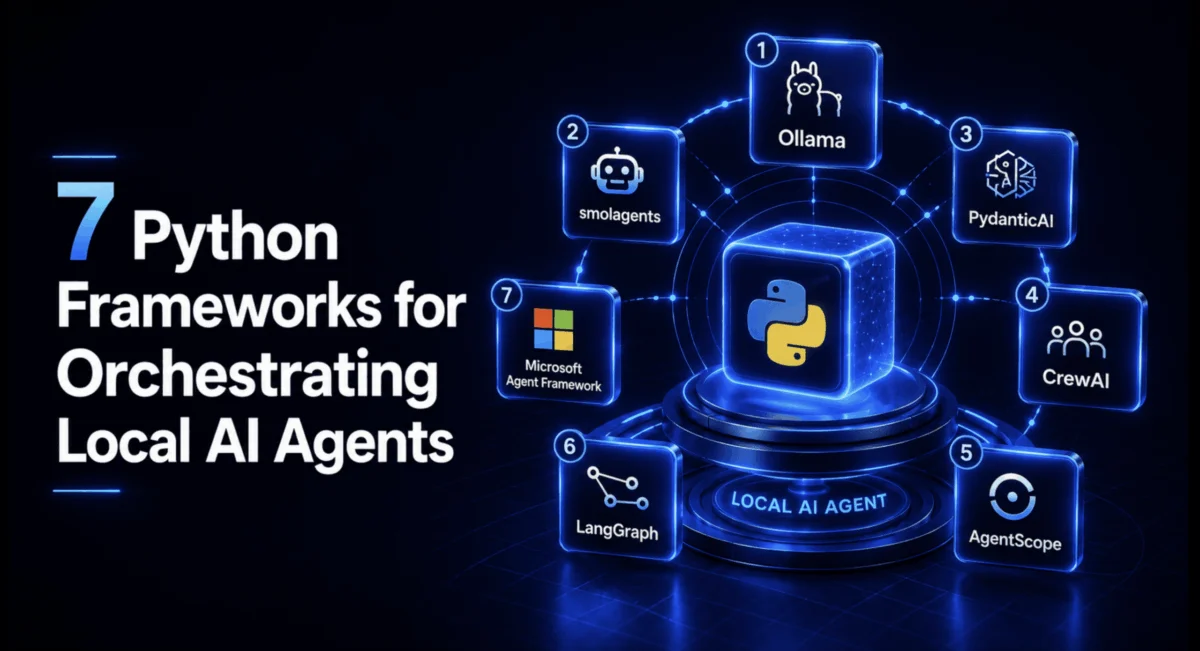
This report explores the seven definitive Python frameworks that are currently enabling this local-first revolution.
The Foundation: A Chronology of Local Orchestration
The evolution of local AI orchestration can be categorized into three distinct eras:
- The API Era (Pre-2024): Developers were entirely dependent on external providers. Orchestration was simple but restrictive.
- The Containerization Era (2024–2025): Tools like Ollama emerged, borrowing paradigms from Docker to simplify model deployment. This lowered the barrier to entry for local inference.
- The Agentic Era (2026–Present): Frameworks have evolved from simple "request-response" systems to complex, stateful, multi-agent ecosystems that prioritize safety, reliability, and enterprise-grade governance.
The Seven Pillars of Local Agent Frameworks
1. Ollama: The Infrastructure Bedrock
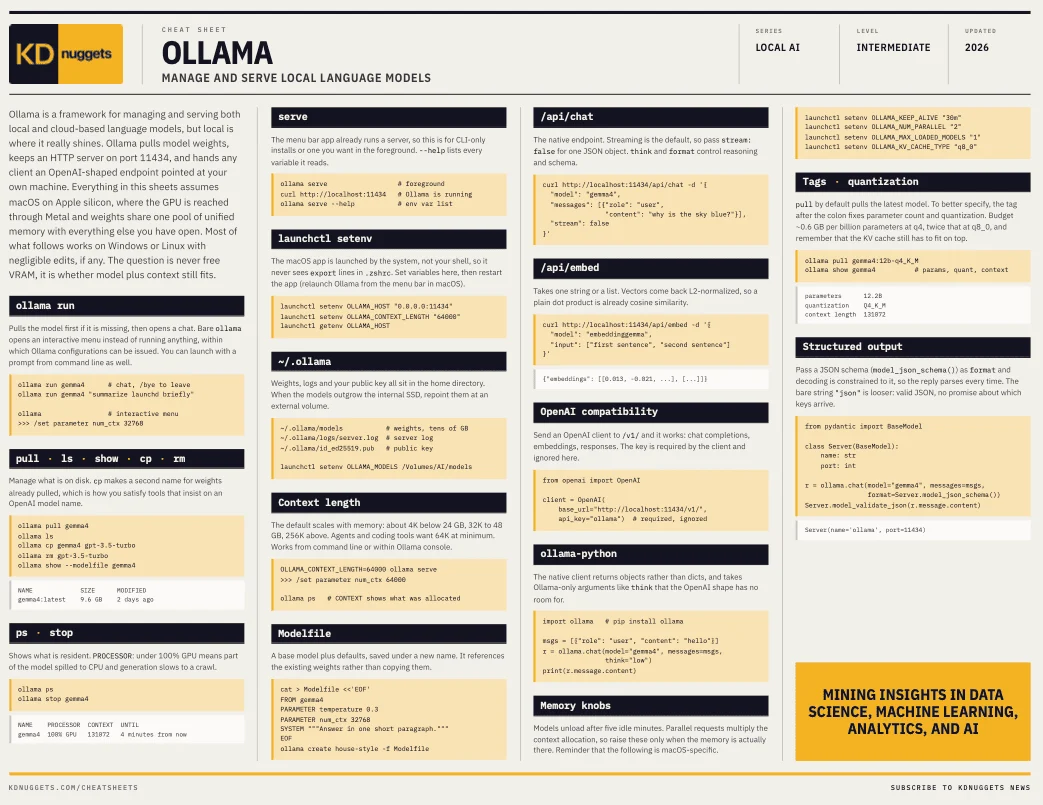
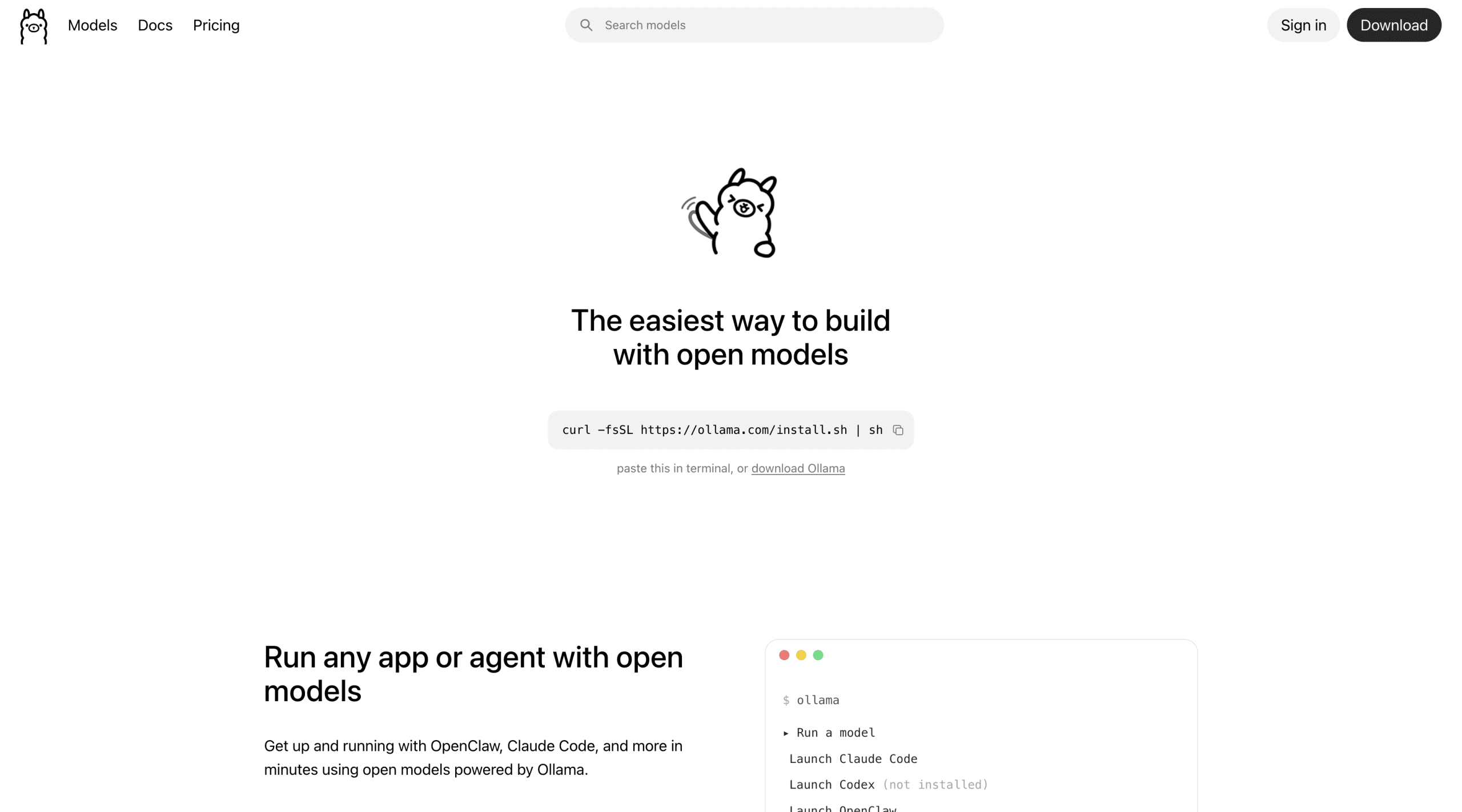
Before an agent can reason, it must have a model to run. Ollama has effectively become the "Docker of LLMs." By providing a unified runtime that handles model pulling and serving via an OpenAI-compatible API, Ollama removed the friction of CUDA driver management and complex environment configuration.
- Supporting Data: Most frameworks listed here default to an OpenAI-compatible endpoint. Because Ollama provides this natively, it serves as the universal adapter for local models.
- Implications: While Ollama is ideal for development and single-user tasks, it is not optimized for massive, high-concurrency enterprise workloads. For production-scale needs, many teams now use Ollama for prototyping, then pivot to vLLM for its PagedAttention architecture once they hit performance bottlenecks.
2. Smolagents: Minimalist Logic
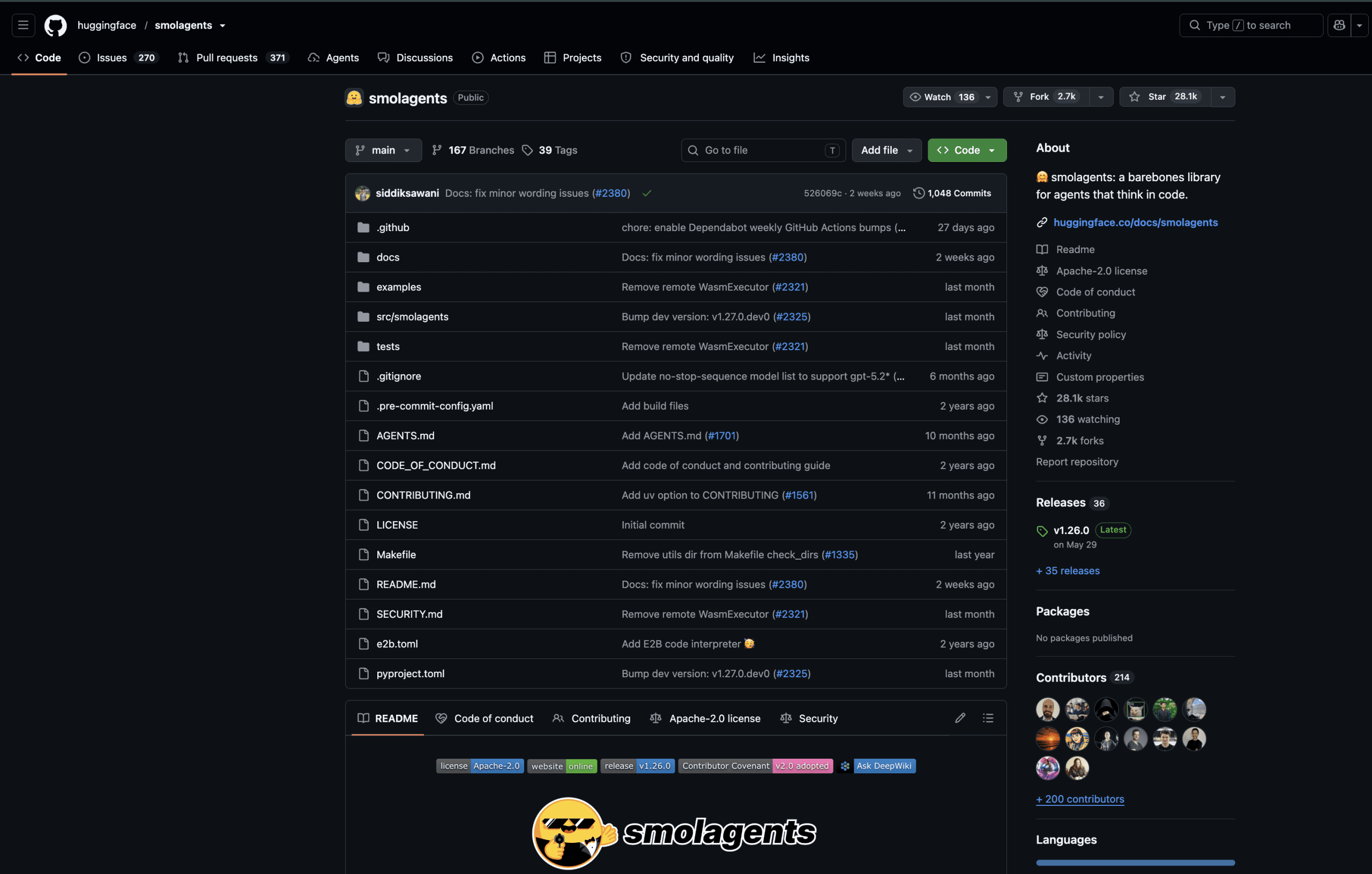
Hugging Face’s smolagents represents the antithesis of bloated enterprise software. Built with roughly 1,000 lines of code, it prioritizes transparency.

- Operational Philosophy: Unlike frameworks that rely on hidden prompt-engineering layers, smolagents focuses on
CodeAgents. These agents write executable code to perform tasks. - Safety Features: Recognizing the inherent risks of executing AI-generated code, smolagents integrates seamlessly with sandboxed environments like E2B and Modal, ensuring that malicious or erroneous code cannot damage the host machine.
3. PydanticAI: The Reliability Standard
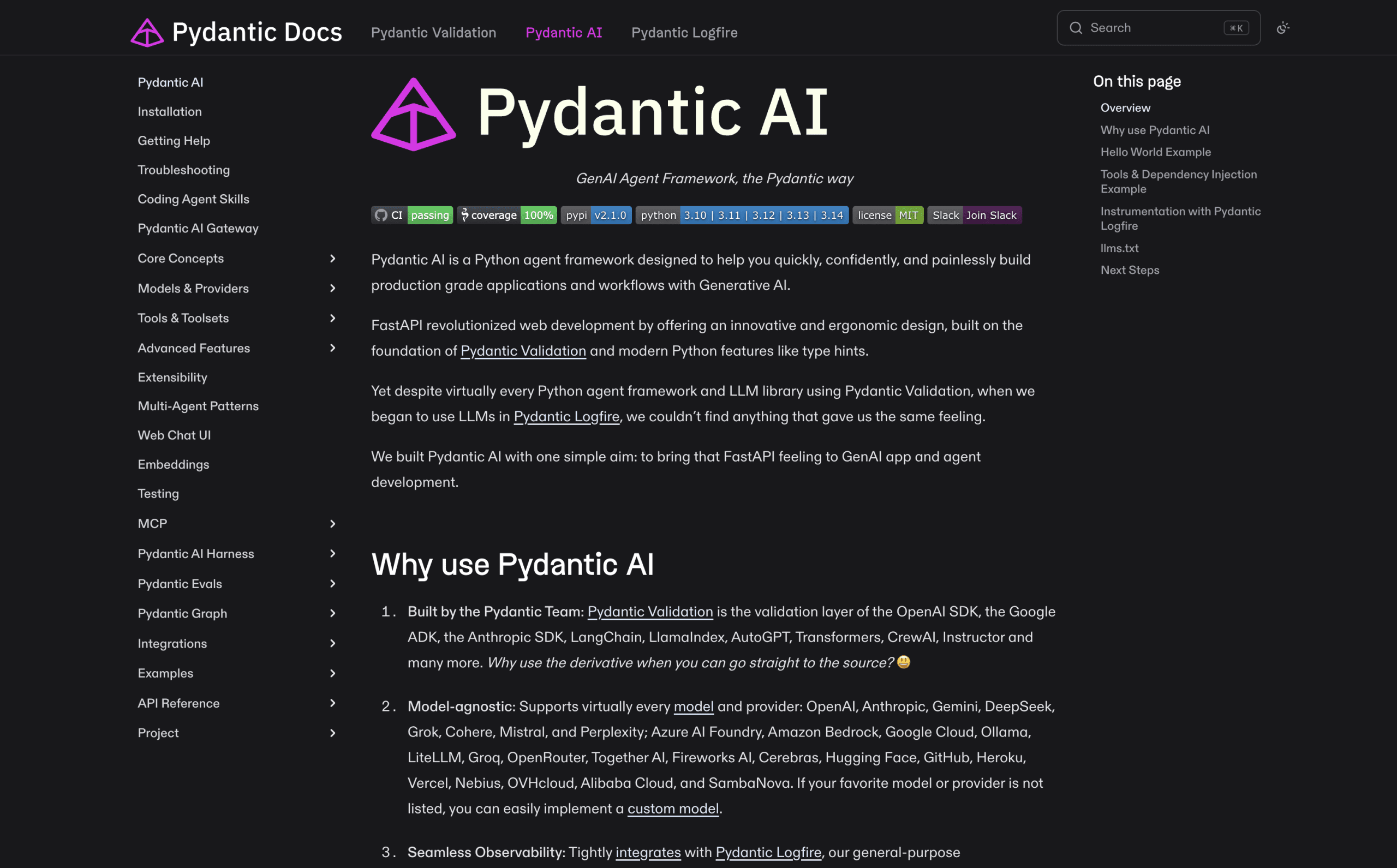
In high-stakes environments—finance, healthcare, or legal tech—an agent that "hallucinates" a JSON schema is a catastrophic failure. PydanticAI addresses this by baking strict data validation into the agentic workflow.
- Technical Edge: Leveraging Python type hints, PydanticAI forces agents to output structured, validated data. If the LLM drifts, the framework catches the error and triggers self-correction.
- Enterprise Adoption: As of April 2026 (v1.85.1), the framework has become a favorite for teams requiring rigorous audit trails. It is the bridge between the "wild west" of generative AI and the "strict requirements" of traditional software engineering.
4. CrewAI: Multi-Agent Collaboration
When a single agent is insufficient, CrewAI provides the orchestration for a "workforce." It allows developers to assign specific roles, goals, and tasks to distinct agents that collaborate to reach a final output.
- Connectivity: CrewAI supports the Model Context Protocol (MCP), enabling agents to access standardized tool servers regardless of the underlying model. This modularity allows developers to swap a local Llama-3 model for a specialized coding model without refactoring the entire crew.
5. AgentScope: Production-Grade Orchestration
Developed for teams that are beyond the "prototype" stage, AgentScope 2.0 treats local deployment as a first-class citizen. With over 27,300 GitHub stars and academic backing, it is built for durability.
- Communication Hub: AgentScope utilizes a message-passing architecture. Agents communicate through structured logs, which provides an auditable history of why a specific decision was made. This is essential for debugging complex, multi-agent systems where intent is often obscured by black-box reasoning.
6. LangGraph: The Stateful Backbone
State management is the Achilles’ heel of AI agents. If an agent crashes mid-task, it usually loses its context. LangGraph solves this with a robust persistence layer.
- Time-Travel Debugging: LangGraph’s ability to "checkpoint" state means developers can pause an agent, inspect its decision-making graph, and resume it from a specific node.
- Local Application: By pointing LangGraph’s backend at an Ollama endpoint, engineers gain the reliability of enterprise-grade state machines without sacrificing the privacy of local hosting.
7. Microsoft Agent Framework: The Unified Successor
Announced in late 2025, the Microsoft Agent Framework represents the consolidation of the AutoGen and Semantic Kernel ecosystems.
- Official Response: Microsoft’s pivot to a single SDK suggests that the industry is standardizing on "Enterprise-Ready Agentic Workflows." By unifying conversational abstractions (AutoGen) with enterprise middleware (Semantic Kernel), Microsoft is positioning itself as the leader for large organizations that need to balance local-first privacy with corporate governance.
- Strategic Caution: While it supports Ollama and local models natively, community feedback indicates that the "happy path" is currently optimized for Azure/OpenAI. Organizations relying heavily on open-source, non-Microsoft infrastructure should perform extensive due diligence before committing to the full framework.
Implications for the Future of Work
The rise of these seven frameworks signals a fundamental change in software development. We are moving toward a world where AI is a local utility—much like a database or a web server—rather than a remote service.

Privacy and Governance
For industries governed by GDPR, HIPAA, or internal security protocols, the ability to keep agentic reasoning on-premises is no longer a "nice-to-have." It is the baseline requirement. By utilizing frameworks like AgentScope or PydanticAI, companies can ensure that sensitive data is validated and processed without ever touching a public cloud.
The Cost of Intelligence
When the cost per token drops to zero (post-download), the economics of AI applications change. Developers can afford to run agents that perform thousands of "thought steps" to solve a problem—a strategy that would be economically unfeasible with cloud APIs. This will likely lead to a new generation of "heavy-thinking" local agents that are far more accurate than their cloud-based, latency-sensitive counterparts.

Conclusion
The choice of framework in 2026 is no longer about finding the "best" tool, but rather about selecting the architecture that aligns with your specific constraints.
- For speed and simplicity: Ollama + CrewAI.
- For safety and data integrity: PydanticAI + smolagents.
- For production-scale governance: Microsoft Agent Framework + AgentScope.
- For complex, stateful loops: LangGraph.
The infrastructure for local AI is mature. The models are capable. The only remaining variable is the engineer’s ability to integrate these tools into a cohesive, reliable, and secure system. The era of renting intelligence is ending; the era of building it has begun.
Shittu Olumide is a software engineer and technical writer focused on the intersection of AI orchestration and local-first computing. His work aims to demystify complex frameworks for developers building the next generation of autonomous systems.