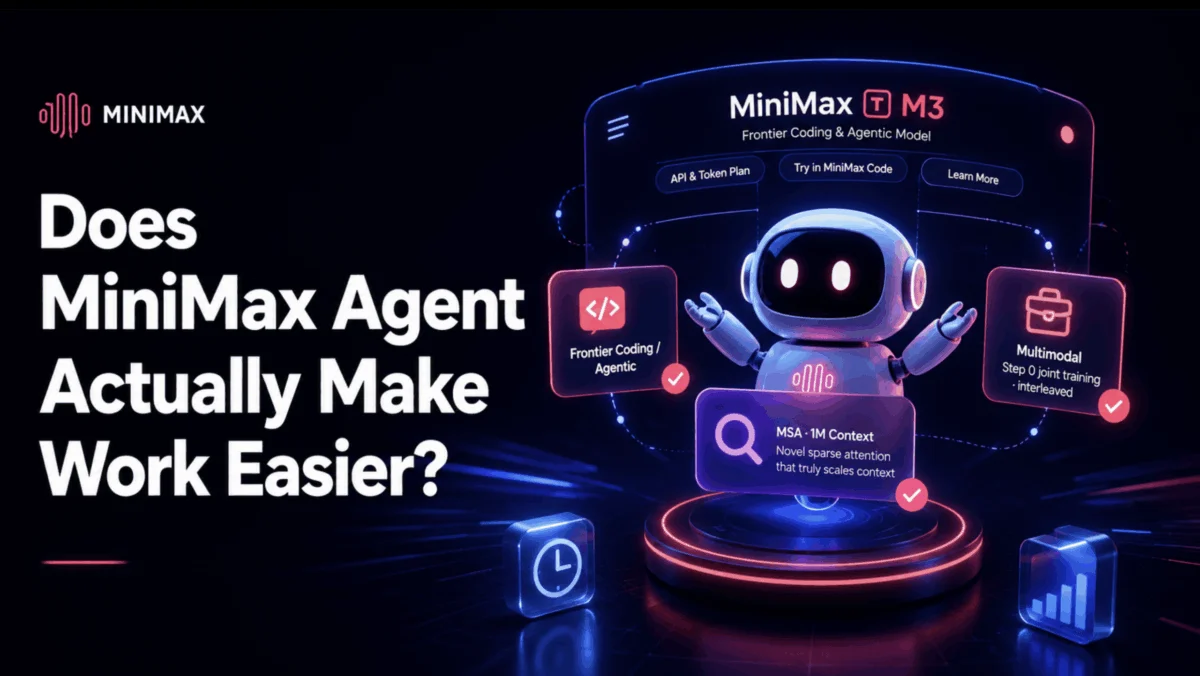
There is a familiar cadence to the way modern AI labs introduce their latest breakthroughs. Typically, an engineering team publishes a white paper that reads like a masterclass in controlled transparency: they define a new architecture, acknowledge its inherent costs, and offer a list of "best-use" scenarios. Often, these pieces are little more than marketing materials wearing a lab coat.
However, the blog post published by MiniMax on May 27, 2026, warrants a more rigorous approach. Instead of summarizing their claims, we must treat them as hypotheses to be tested. The central question for developers and enterprise leaders is not merely whether MiniMax’s underlying models—like the powerful M3—are performant on paper. The real query is whether their new agent-based product, now rebranded as "Mavis," fundamentally alters the nature of technical work or simply hides the same effort behind a more complex, expensive interface.
The Evolution of the MiniMax Agent: From Assistant to Mavis
To understand the current state of MiniMax, one must first clear away the legacy of previous iterations. MiniMax first entered the public consciousness in mid-2025 as a general-purpose assistant. Within two months of its internal deployment, the company reported that over 50% of its own staff were utilizing the agent for daily tasks.
By late May 2026, the company opted for a total rebranding. The product formerly known as "MiniMax Agent" was christened Mavis (an acronym for "MiniMax as a Jarvis"). The pivot was not merely cosmetic. The core innovation, dubbed "Agent Teams," represents a departure from the monolithic model approach. Instead of a single model attempting to reason through a complex, multi-step process, Mavis employs a collaborative structure: a Leader, a Worker, and a Verifier.
This shift coincides with a consolidation of their subscription ecosystem. Previously fragmented into "TokenPlan" and "Agent Plan," MiniMax has unified its offerings. A single API key now provides access to the command-line interface (CLI), the API, and the Mavis agent product, sharing a single credit pool. This simplification is a welcome move for developers, yet it masks a more complex reality regarding their underlying model licensing.
The Model Landscape and Intellectual Property Concerns
The trajectory of MiniMax’s models has been anything but linear. Their early releases—MiniMax-M2 and M2.5—were lauded for being fully open-weight models under permissive licenses. However, the release of M2.7 signaled a pivot toward more restrictive control. While the weights for M2.7 were initially released on Hugging Face, MiniMax quietly amended the commercial terms, requiring written authorization for commercial deployment.
The current flagship, M3, features a sophisticated sparse attention architecture supporting up to a 1-million-token context window and native multimodal capabilities. Yet, developers must weigh these capabilities against significant external pressures. MiniMax is currently entangled in high-profile copyright litigation involving Disney, Warner Bros., and Universal regarding its video generation products. Furthermore, the company faces allegations from Anthropic regarding the potential distillation of proprietary models. For production teams, these legal and ethical considerations are as critical as the model’s latency or token cost.
The Architecture of "Agent Teams"
MiniMax’s engineering team is unusually candid about the "coherence problem" inherent in single-agent architectures. When a model acts as both the contestant and the judge—writing a piece of code and then verifying its own logic—it inevitably suffers from blind spots. The Agent Team architecture aims to solve this by partitioning labor:
- The Leader: Evaluates the incoming task, determines if it requires decomposition, and assigns roles.
- The Worker: Executes the specific sub-tasks assigned by the Leader.
- The Verifier: Audits the Worker’s output against the objective criteria set by the Leader, initiating a "re-work" loop if standards are not met.
Unlike other agentic frameworks like LangGraph or OpenAI’s Agent SDK, MiniMax introduces the "Team Engine." This persistent state machine manages the workflow, allowing for asynchronous wakes and pauses. Instead of a single, brittle function call, the engine treats tasks as a multi-stage lifecycle. It is a robust design, but one that introduces significant overhead.
Supporting Data: The Cost of Consensus
MiniMax’s own documentation includes a fascinating admission regarding the "Cost of Consensus." Their research suggests that unstructured multi-agent debate among homogeneous models can result in token costs 2.1 to 3.4 times higher than a single, self-correcting agent, often with zero improvement in accuracy.
This finding is the "smoking gun" of the agentic era: multi-agent collaboration is not inherently better. It is only superior when the structure—the Leader, Worker, and Verifier roles—is strictly enforced. Without that structure, you are simply paying for expensive, redundant concurrency.
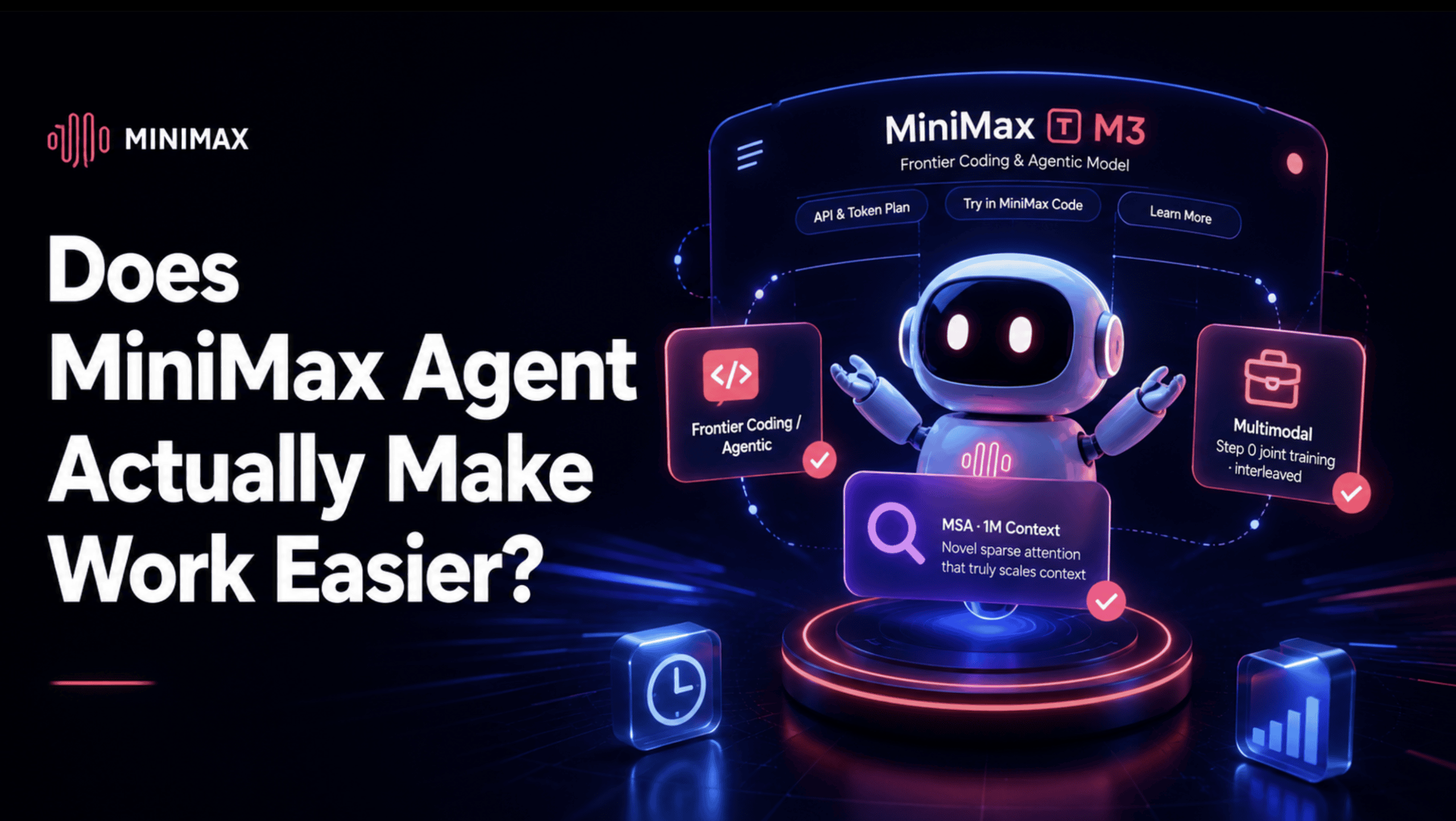
Furthermore, MiniMax identified "context anxiety" as a recurring bug in long-running agent processes. As an agent’s context window fills, its ability to determine if a task is "finished" degrades. Mavis attempts to mitigate this by having the Leader periodically intervene, effectively "refreshing" the plan. This, however, introduces a new cost: Handoff friction. Every time information is transferred between agents, or when the context window is re-serialized, the user pays in both latency and tokens.
Practical Implementation: Testing the API
To evaluate these claims, we tested the M3 model using the standard Anthropic-compatible SDK. By setting the ANTHROPIC_BASE_URL to MiniMax’s endpoint, developers can integrate the model with minimal friction.
Technical Setup
# Standard integration pattern
import anthropic
client = anthropic.Anthropic(
    api_key="your-minimax-key",
    base_url="https://api.minimax.io/anthropic"
)
In our testing, we tasked the agent with a two-part requirement: drafting a technical explanation of a software circuit breaker and verifying the word count using a custom tool. The results confirmed that M3 is highly capable of following tool-use instructions. However, the "turn count" remained the most critical metric. Each turn adds latency and cost.
At a promotional rate of $0.30 per million input tokens, MiniMax is aggressively priced—roughly 17 times cheaper than Claude 3.5 Opus. Yet, developers must realize that a "cheap" token rate is quickly neutralized if an agentic workflow requires 10 turns to complete a task that a well-prompted single-model call could handle in one.
Implications for Production Environments
What does this mean for the future of AI-assisted engineering?
First, the "agentic hype" is beginning to collide with the reality of production economics. MiniMax is correct to suggest that work becomes easier only when the task is sufficiently long and verifiable. If you are using an agent to write a simple email or fix a minor syntax error, the overhead of an agentic team—the handoffs, the consensus checks, and the token consumption—is pure waste.
Second, the "Mavis" architecture is a strong argument for structured orchestration. We are moving away from the era of "General Purpose AI" and toward an era of "Workflow-Specific AI." The value of Mavis lies not in its intelligence, but in its management of the state machine.
Finally, firms considering Mavis must look beyond the engineering blog posts. The legal landscape surrounding AI training data is shifting. Any enterprise considering a long-term integration with MiniMax must perform due diligence on the licensing of the M2.7 and M3 models, especially given the ongoing litigation with major media conglomerates.
Conclusion
MiniMax’s shift to the Mavis Agent Team architecture is a mature, honest admission that the industry is hitting a wall with naive agent implementations. By prioritizing a "Leader-Worker-Verifier" structure, they have created a system that is more reliable than its predecessors.
However, users should be wary of the marketing narrative that suggests "more agents equals better work." In reality, the architecture is a precision tool. It is designed for high-stakes, high-complexity, and verifiable tasks. For the vast majority of day-to-day coding and writing, the most efficient architecture remains a single, well-prompted model call. Before you implement a multi-agent team, ask yourself: Is the complexity of the task high enough to justify the overhead of the team? If the answer is no, you are better off keeping it simple.